

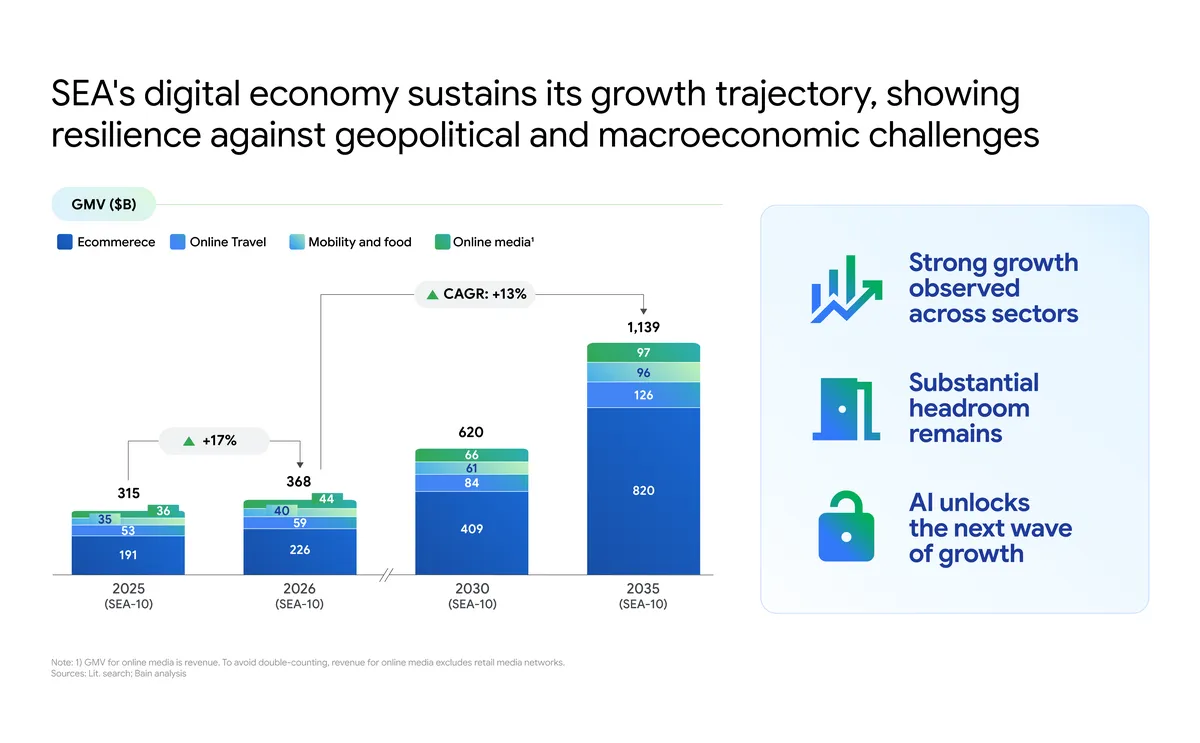
The digital landscape of Southeast Asia is undergoing a profound transformation as generative artificial intelligence (AI) transitions from a speculative technology to a cornerstone of daily economic activity. According to the 11th edition of the e-Conomy SEA report, titled "Building the Intelligent Economy," the region’s digital economy is projected to reach $368 billion in Gross Merchandise Value (GMV) by 2026. This trajectory, fueled by an unprecedented rate of AI adoption and a maturing digital infrastructure, sets the stage for Southeast Asia to surpass the $1 trillion mark by 2035.
The report, a collaborative effort between Google, Temasek, and Bain & Company, highlights a pivotal shift in consumer behavior and industrial application. Currently, 243 million people in the region—representing approximately 58% of the working-age population—actively engage with generative AI. The speed at which this technology has permeated the market is notable, scaling four times faster than the initial rollout of the mobile internet. This rapid integration is not merely a trend but a fundamental restructuring of how value is created and consumed across the Association of Southeast Asian Nations (ASEAN).
Historical Context and the Evolution of the Digital Frontier
To understand the magnitude of the projected $368 billion milestone, it is essential to look at the region’s digital evolution over the past decade. When the first e-Conomy SEA report was published in 2016, the regional digital economy was valued at approximately $31 billion. The initial growth was driven by the "mobile-first" revolution, where millions of consumers bypassed the desktop era entirely to enter the digital market via smartphones.
The COVID-19 pandemic acted as a secondary catalyst, forcing a decade’s worth of digital adoption into a two-year window. By 2022, the conversation shifted from basic connectivity to profitability and sustainable growth. The 2024–2026 period, however, marks a third distinct era: the "Intelligent Economy" phase. In this stage, the focus has moved beyond acquiring users to optimizing every interaction through high-compute technologies and autonomous systems.
Sectoral Performance and the AI Multiplier Effect
The 17% year-on-year growth projected for 2026 is distributed across several core sectors, each of which is experiencing a "multiplier effect" due to AI integration.
E-commerce: The Anchor of Growth
E-commerce remains the largest contributor to the digital economy, expected to reach $226 billion in GMV by 2026. This represents an 18% annual increase. The report identifies "multimodal discovery"—the ability for users to search via images, voice, and video—as a primary driver. AI-powered in-app assistants are now guiding shoppers through complex purchase journeys, leading to a 10% increase in conversion rates and, in some instances, a 75% uplift in order volumes. By personalizing the shopping experience at scale, platforms are reducing "search friction," a long-standing barrier in the fragmented Southeast Asian market.
Online Travel and Media
The online travel sector is projected to hit $59 billion in GMV by 2026. Interestingly, generative AI has overtaken social media to become the second-most preferred tool for planning complex travel itineraries, trailing only traditional search engines. This shift indicates a growing consumer reliance on AI for logistical synthesis rather than just inspiration.
Simultaneously, online media is expected to generate $44 billion in revenue, growing at 22% annually. AI is being utilized here to hyper-personalize content feeds and optimize advertisement placement. This has resulted in a 10% to 20% increase in quality engagement, fostering a $4 billion "commerce media" market where advertising and direct purchasing are seamlessly integrated.
Digital Financial Services (DFS)
Digital Financial Services continue to see robust expansion, with Gross Transaction Value (GTV) projected to reach $1.65 trillion. AI is proving critical in this sector for real-time fraud detection and expanding credit access to the region’s significant "unbanked" and "underbanked" populations. By using alternative data points processed through machine learning, lenders can more accurately assess risk, providing personalized financial recommendations that were previously unavailable to the average consumer.
The Rise of Agentic Commerce and Consumer Trust
A significant takeaway from the 2026 outlook is the emergence of "agentic commerce." This refers to a future where AI agents do more than just provide information; they autonomously execute tasks, such as comparing prices across platforms, booking services, and completing transactions on behalf of the user.
The report suggests that the region is uniquely positioned for this shift due to a high level of consumer optimism. Approximately 62% of Southeast Asian users report having more trust in AI tools today than they did a year ago. This trust is built on three pillars:

- Proven Track Record: 56% of users cite successful past interactions with AI.
- Familiarity: 55% feel more comfortable as AI becomes a standard feature in popular apps.
- Accuracy: 53% report a noticeable improvement in the quality of AI-generated outputs.
Currently, 75% of users expressed a willingness to allow AI agents to manage transactions autonomously. However, for this potential to be fully realized, the report emphasizes the need for "guardrails." Consumers are calling for robust privacy safeguards (44%), transparency regarding AI limitations (36%), and the ability to reverse or "undo" transactions performed by agents (30%).
Infrastructure and Adaptation: The Four Pillars of the AI Era
For Southeast Asia to sustain a projected 60-fold increase in AI usage over the next five years, the regional ecosystem must adapt across four critical areas. While the digital economy is booming, the physical and regulatory frameworks require significant investment to keep pace.
1. Data Center Capacity and Energy
The "Intelligent Economy" requires massive computational power. Regional leaders, particularly Singapore, Malaysia, and Indonesia, are seeing a surge in data center investments. However, this growth must be balanced with energy sustainability. The transition to AI-ready infrastructure involves not just building warehouses for servers but ensuring a stable, green energy supply to power them.
2. Specialized Talent and Upskilling
The report underscores a shift in the labor market. While 58% of the working population uses Gen AI, there is a shortage of high-level AI engineers and data scientists. National initiatives, such as Singapore’s AI 2.0 strategy and Malaysia’s digital talent grants, are aimed at bridging this gap. The focus is moving from basic digital literacy to "AI fluency."
3. Regulatory Harmony and Ethics
As AI agents begin to handle financial transactions and personal data, the legal frameworks of ASEAN nations must harmonize. Issues regarding cross-border data flows, algorithmic accountability, and intellectual property rights are at the forefront of policy discussions. A fragmented regulatory landscape could stifle the $1 trillion potential by creating silos between markets.
4. Investment and Capital Allocation
While venture capital (VC) funding in the region saw a slowdown in 2023–2024 due to global macroeconomic headwinds, the report notes a "flight to quality." Investors are increasingly targeting startups that demonstrate a clear "AI-first" strategy and a path to profitability. The focus has shifted from "growth at all costs" to "intelligent growth."
Regional Outlook and Economic Implications
The impact of this digital surge varies across the "ASEAN-6" (Indonesia, Malaysia, the Philippines, Singapore, Thailand, and Vietnam). Singapore continues to lead in terms of digital wealth platforms and high-value services, while Indonesia remains the region’s largest digital economy by volume. Vietnam and the Philippines are identified as the fastest-growing markets, driven by young, tech-savvy populations and aggressive government digitization programs.
Nitin Gajria, Managing Director for Google Southeast Asia and South Asia Frontier Markets, noted that the region’s ability to leapfrog traditional economic stages is its greatest strength. By adopting AI at a rate faster than previous technologies, Southeast Asia is not just participating in the global digital economy; it is increasingly defining its future.
The transition to a $368 billion economy by 2026 signifies more than just a numerical increase; it represents a qualitative shift. The integration of AI into the fabric of daily life—from the way a street food vendor in Jakarta manages their finances to how a traveler in Manila plans a trip to Bali—suggests that the "Intelligent Economy" is already here.
Conclusion: The Road to $1 Trillion
As Southeast Asia marches toward the 2035 goal of a $1 trillion digital economy, the next two years will be a critical litmus test. The success of this journey depends on the region’s ability to maintain consumer trust while scaling the physical and intellectual infrastructure required for AI.
The e-Conomy SEA 2026 report serves as both a roadmap and a reminder. While the growth figures are staggering, the true value of the "Intelligent Economy" lies in its ability to foster inclusivity, efficiency, and innovation. With 243 million people already leading the charge, Southeast Asia is well-positioned to remain one of the most dynamic digital frontiers in the world. The shift from "digital" to "intelligent" is no longer a distant prospect—it is the current reality driving the region’s $368 billion future.
