

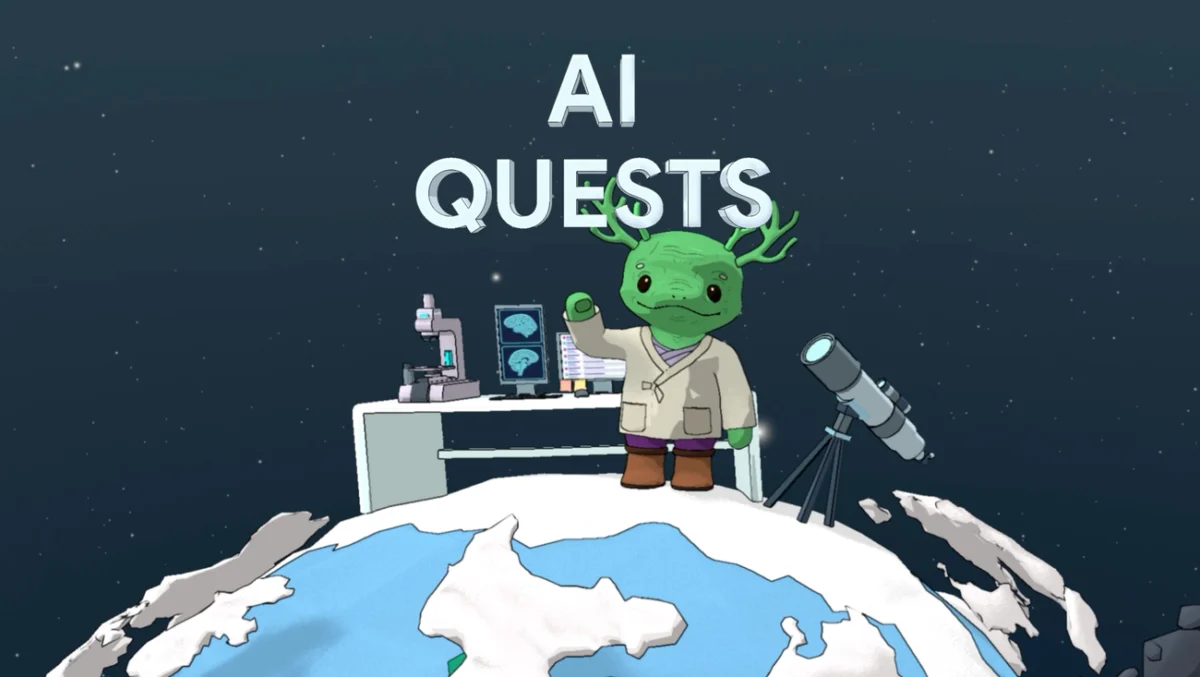
A New Frontier in Educational Gamification
The introduction of "Polar Peaks" marks a strategic expansion of the AI Quests narrative. While the previous modules focused on macroscopic and clinical challenges—flood forecasting and eye disease detection, respectively—this third quest dives into the microscopic world of neural pathways. In "Polar Peaks," students are introduced to a character suffering from memory loss, providing a narrative framework for their scientific tasks. Under the guidance of virtual mentors modeled after real-world Google scientists, students must scan and map neurons to identify the underlying causes of the character’s condition.
The gameplay is structured to mirror the actual workflow of data scientists and neuroscientists. Students are not merely observers; they are required to perform critical tasks such as data cleaning, identifying incorrect labels in training sets, and testing AI models for accuracy. This hands-on approach is designed to teach a fundamental lesson in modern technology: AI is not an autonomous "magic box" but a tool that requires rigorous human-in-the-loop verification. By identifying errors in brain scan labels, students learn firsthand how "noisy" data can lead to flawed algorithmic outputs, reinforcing the importance of critical thinking in the age of automation.
The Evolution of the AI Quests Series
The AI Quests initiative was born out of a partnership between Google’s research division and Stanford University’s experts in learning sciences. The goal was to create a curriculum that moved beyond theoretical explanations of AI and instead offered experiential learning. The series has followed a chronological progression of complexity and application:
- Quest 1: Flood Forecasting: Inspired by Google Research’s real-world Flood Forecasting initiative, this quest taught students how AI uses historical data and satellite imagery to predict natural disasters. It introduced the concept of predictive modeling and the societal impact of early warning systems.
- Quest 2: Eye Disease Detection: This module drew from Google’s ARDA (Automated Retinal Disease Assessment) project, which uses deep learning to screen for diabetic retinopathy. Students learned about image recognition and the ethical considerations of deploying AI in healthcare settings.
- Quest 3: Polar Peaks (Neuroscience): The current release focuses on connectomics. It challenges students to understand how AI can process vast amounts of biological data—tasks that would be impossible for humans to complete manually within a reasonable timeframe.
This chronological development reflects a broader strategy to show students that AI is a horizontal technology with the potential to transform every field of human endeavor, from environmental science to the deepest mysteries of biology.
Scientific Foundations: From Fruit Flies to Human Connectomics
The "Polar Peaks" quest is not merely a fictional exercise; it is deeply rooted in over a decade of pioneering research conducted by Google’s Connectomics team. Connectomics is the subfield of neuroscience dedicated to creating a "wiring diagram" of the brain, mapping every neuron and synapse to understand how neural structure dictates function.
In the real world, this work is staggering in its scale. Recently, Google Research, in partnership with the Howard Hughes Medical Institute’s Janelia Research Campus, achieved a milestone by mapping the complete brain of a male fruit fly (Drosophila melanogaster). Despite being only about the size of a poppy seed, the fruit fly brain contains approximately 150,000 neurons and 50 million synapses. Mapping it required the use of high-resolution electron microscopy to produce petabytes of data, which AI models then processed to reconstruct the 3D shapes of neurons.
By completing "Polar Peaks," students gain access to interviews and insights from the actual researchers behind these breakthroughs. They learn that while AI can "segment" or trace neurons at a speed millions of times faster than a human, it still makes mistakes that require expert correction. This mirrors the real-world process where scientists must validate AI-generated maps to ensure they are biologically accurate.
Supporting the Educators: The Google AI Educator Series
Recognizing that the success of any educational tool depends on the proficiency of the teacher, Google is simultaneously rolling out comprehensive training modules for educators. These modules are hosted within the Google AI Educator Series and are designed to help teachers integrate AI Quests into their existing science, technology, engineering, and mathematics (STEM) curricula.
The training materials provide teachers with the vocabulary and conceptual framework needed to lead classroom discussions on AI ethics, data bias, and the future of work. While the training modules for the first two quests are currently available, Google has confirmed that the dedicated module for "Polar Peaks" will be released next month. This support system is intended to bridge the "AI literacy gap," ensuring that teachers feel as confident as their students when navigating these complex digital landscapes.
Industry Recognition and Broader Implications
The pedagogical value of AI Quests has already been recognized by the broader tech and education communities. In 2026, the series was honored with a Webby Award for AI Education, Learning & Training. It also received the accolade for Best Global K–12 Learning Solution at the ETIH Innovation Awards. These awards underscore a growing consensus that AI literacy is no longer an optional skill but a core competency for the next generation.
The implications of this initiative extend beyond the classroom. By targeting the 11-to-14 age demographic, Google and Stanford are intervening at a critical developmental stage when students begin to form career interests. By framing AI as a tool for "humanity’s biggest challenges," the program seeks to inspire a more diverse cohort of future scientists and engineers who view technology through an ethical and service-oriented lens.
Furthermore, the focus on "responsible use" in the curriculum addresses a major concern among policymakers and parents. As generative AI and automated systems become ubiquitous, understanding the limitations of these technologies is as important as understanding their capabilities. The AI Quests series emphasizes that human judgment remains the ultimate arbiter of truth and efficacy in scientific research.
Future Outlook: Expanding the Scope of AI Literacy
As the 2026-2027 school year progresses, Google Research has indicated that it will continue to collaborate with educators and global partners to expand the reach of the AI Quests series. Plans are reportedly in place to localize the content into even more languages and to explore additional "frontiers" for future quests, potentially including topics like climate change mitigation, quantum computing, or ethical robotics.
The launch of "Polar Peaks" represents a significant step in democratizing high-level scientific concepts. By turning the daunting task of mapping the human brain into an engaging, interactive "quest," the initiative proves that even the most complex technologies can be made accessible to young learners. In doing so, it provides a blueprint for how the technology industry and academic institutions can work together to prepare the workforce of the future for a world where AI and human intelligence are inextricably linked.
Through the lens of neuroscience, students are not just learning how to use AI; they are learning how to think about thinking. As they map the neurons of a digital character, they are simultaneously mapping the possibilities of their own future in a world reshaped by artificial intelligence.
