

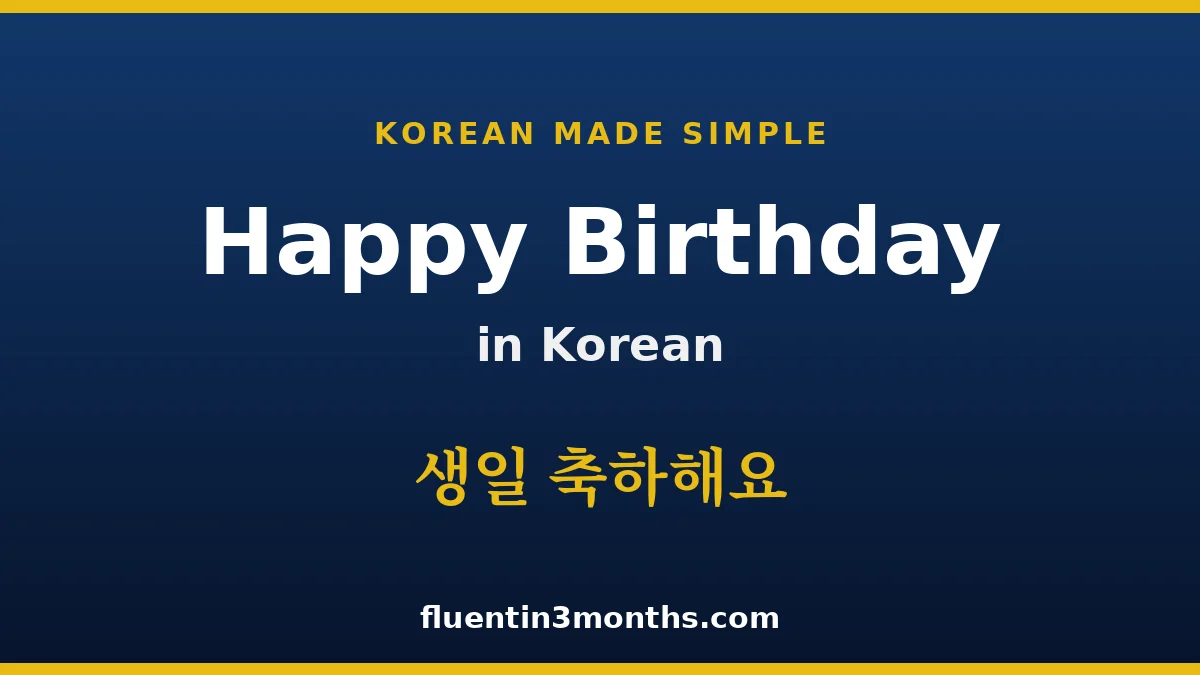
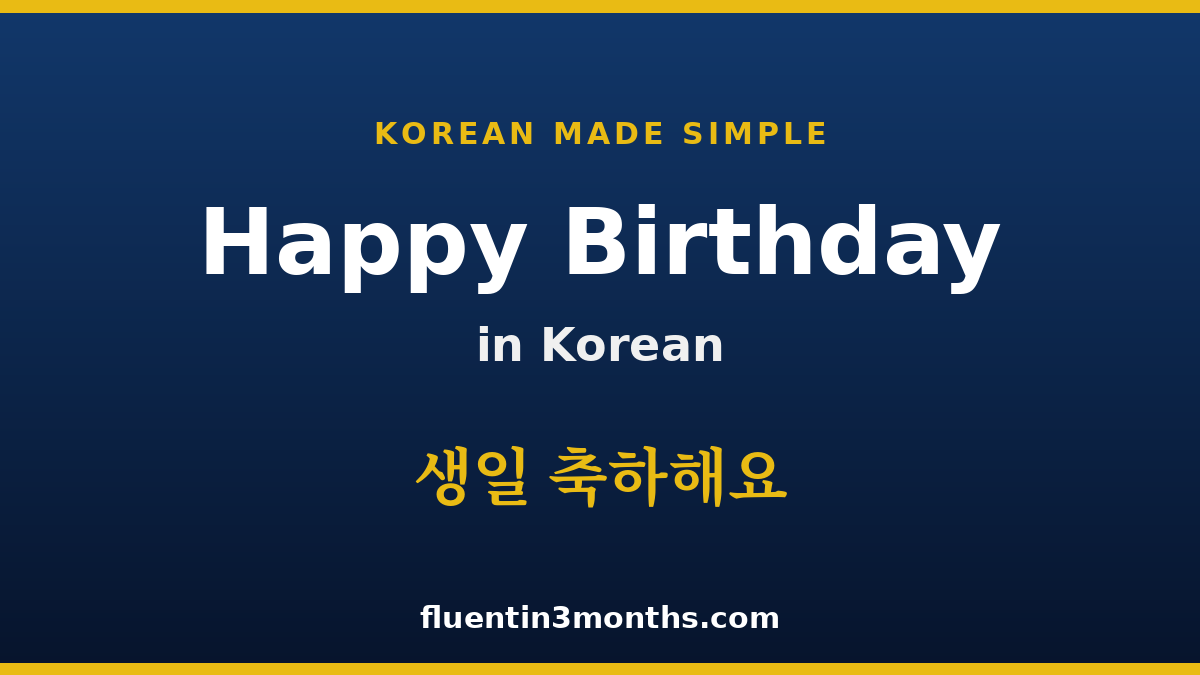
The linguistic landscape of South Korea is defined by a sophisticated hierarchy of politeness, honorifics, and social context, making the simple act of wishing someone a "happy birthday" a nuanced exercise in cultural navigation. While the standard phrase, saengil chukhahaeyo (생일 축하해요), serves as the primary gateway for international learners and acquaintances, the Korean language offers a spectrum of expressions tailored to the age, status, and intimacy of the recipient. In recent years, the significance of these celebrations has been further complicated by landmark legislative changes regarding how age is calculated, shifting the nation from a centuries-old traditional system to the international standard. Understanding how to celebrate a birthday in Korea requires more than memorizing a single phrase; it necessitates an appreciation of the country’s Confucian roots, its culinary traditions, and its modern administrative evolution.
The Linguistic Hierarchy of Birthday Greetings
In the Korean language, the relationship between the speaker and the listener dictates the choice of vocabulary and sentence endings. This system, deeply rooted in Neo-Confucian values that emphasize respect for elders and social order, categorizes speech into several levels of formality. When wishing someone a happy birthday, four distinct versions are commonly employed:
- Saengil chukhahae (생일 축하해): This is the casual form, known as banmal. It is reserved exclusively for close friends, siblings, or those younger than the speaker within an established intimate relationship. Using this with a superior or an older stranger is considered a significant social faux pas.
- Saengil chukhahaeyo (생일 축하해요): The polite standard. By adding the suffix "-yo," the speaker maintains a respectful distance while remaining friendly. This is the "default" phrase used among colleagues, acquaintances, and in most general social settings.
- Saengil chukhahamnida (생일 축하합니다): This formal version is often heard in public announcements, formal gatherings, or when singing the traditional birthday song. It utilizes the "-hamnida" ending, which conveys a high degree of professional or ceremonial respect.
- Saengsin chukhadeurimnida (생신 축하드립니다): This is the highest honorific form. The word for birthday is elevated from saengil to saengsin, and the verb for "to congratulate" is replaced with a humble form of "to give" (deurida). This version is strictly used for grandparents, elderly relatives, or highly respected social superiors to demonstrate maximum deference.
The etymology of these phrases reveals the underlying logic of the greeting. Saeng (생) refers to "birth," and il (일) means "day." The verb chukhahada (축하하다) translates to "to congratulate." Thus, the Korean greeting is literally an act of congratulating the individual on the anniversary of their birth, rather than simply stating that the day is "happy."
The 2023 Legal Shift: Standardizing the "International Age"
Perhaps the most significant development in Korean birthday culture occurred on June 28, 2023. Prior to this date, South Korea utilized a unique "Korean age" system (seneun nai), where a child was considered one year old at birth and gained a year every New Year’s Day. Under this traditional method, a baby born on December 31 would technically turn two years old on January 1, despite having lived for only two days.
Following a campaign promise by President Yoon Suk Yeol to reduce administrative and social confusion, the South Korean National Assembly passed amendments to the Administrative Basic Act and the Civil Act. The new law mandates the use of the international system (man nai) for all judicial and administrative matters.
According to the Ministry of Government Legislation, the shift was designed to eliminate the "unnecessary social and economic costs" associated with the age discrepancy. Minister Lee Wan-kyu stated at the time of the implementation that the change would "greatly reduce social disputes and inconveniences caused by the mixed use of age calculations."
While the legal standard is now international, the social transition remains in progress. Many Koreans still refer to their traditional age in casual conversation, and certain laws—such as the legal age for purchasing tobacco and alcohol or the school enrollment year—still follow a third system called "year age" (yeon nai), which calculates age by subtracting the birth year from the current year, regardless of the specific birth date.
Cultural Foundations: Seaweed Soup and the Significance of Miyeokguk
Beyond the linguistic requirements, the Korean birthday is defined by specific culinary traditions. The most prominent of these is the consumption of miyeokguk (미역국), or seaweed soup. This tradition is inextricably linked to the maternal bond. Because seaweed is rich in iodine and calcium, it has been the traditional recovery meal for Korean mothers following childbirth for centuries.
By eating seaweed soup on their birthday, individuals symbolically honor their mothers and the pain of their birth. This ritual serves as a reminder of one’s origins and the care received during infancy. In modern Korea, even if a full celebratory feast is not prepared, the presence of miyeokguk is often considered the essential marker of a birthday.
Milestone Celebrations: Doljanchi and Hwangap
While every birthday is celebrated, certain milestones hold profound historical and cultural weight in South Korean society.
Doljanchi (The First Birthday)
The first birthday, or doljanchi, is arguably the most important celebration in a Korean person’s early life. Historically, when infant mortality rates were high due to disease and seasonal hardships, reaching the one-year mark was a significant achievement. Families would gather for a large feast to pray for the child’s longevity and prosperity.
A central feature of the doljanchi is the doljabi (돌잡이). During this ceremony, the child is placed before a variety of objects, such as thread (symbolizing long life), money (wealth), a book or brush (intelligence), or more modern items like a stethoscope (becoming a doctor) or a microphone (becoming an entertainer). The first object the child picks up is playfully seen as a prediction of their future career or destiny.
Hwangap (The 60th Birthday)
The 60th birthday, known as hwangap, represents the completion of one full cycle of the Chinese zodiac (five turns of the 12-year cycle). In the past, when life expectancy was lower, reaching 60 was a cause for massive celebration and a sign of great fortune. While modern medicine has made 60 a relatively young age, the hwangap remains a respected milestone, though many families now opt for smaller gatherings or luxury travel rather than the massive traditional banquets of the past.
The Korean Birthday Song: A Globalized Hybrid
The "Korean Birthday Song" follows the melody of the Western "Happy Birthday to You," but with localized lyrics. The standard version used in most social settings is:
Saengil chukha hamnida (Happy birthday to you)
Saengil chukha hamnida (Happy birthday to you)
Saranghaneun (Name)-ssi (Dear beloved [Name])
Saengil chukha hamnida (Happy birthday to you)
Interestingly, even in casual settings among friends, the song almost always uses the formal hamnida ending. This reflects the ceremonial nature of the song itself. In corporate settings, the use of the honorific title "-ssi" or a professional rank (e.g., Gwajang-nim) is essential to maintain workplace decorum.
Linguistic Mechanics and the Invention of Hangul
The ability to write and pronounce these greetings correctly is tied to the history of Hangul, the Korean writing system. Commissioned by King Sejong the Great in 1443 and published in 1446, Hangul was designed to be a phonetic script that could be learned by the common people, who previously struggled with complex Chinese characters.
For learners of Korean, the pronunciation of saengil chukhahaeyo involves specific phonetic rules. The final consonant (batchim) of the first syllable often carries over to the next if it starts with a vowel, and the "h" (ㅎ) sound in chukha is often softened or aspirated depending on the preceding consonant. This scientific design of the alphabet makes Korean one of the most accessible Asian languages for written literacy, a fact that has contributed to the "Korean Wave" (Hallyu) and the global surge in Korean language enrollment.
Broader Impact and Global Implications
The global interest in Korean culture, driven by the success of K-pop, K-dramas, and cinema, has transformed Korean birthday greetings from a niche linguistic curiosity into a global trend. Data from language-learning platforms like Duolingo frequently rank Korean among the fastest-growing languages in the Western world, particularly in the United States and the United Kingdom.
This cultural export has significant economic implications. The "celebration economy"—including the export of Korean food products like instant miyeokguk, birthday-themed merchandise, and K-beauty gift sets—has seen a marked increase. Furthermore, the 2023 age reform has simplified international business interactions, as Korean professionals no longer need to explain the discrepancy between their legal age and their social age during international negotiations.
As South Korea continues to influence global aesthetics and social trends, the nuances of its traditions remain a bridge between its rapid technological modernization and its deep-seated cultural heritage. Whether through the formal deference of saengsin chukhadeurimnida or the playful predictions of a doljabi ceremony, the Korean birthday remains a vital expression of identity, family, and social harmony.
