

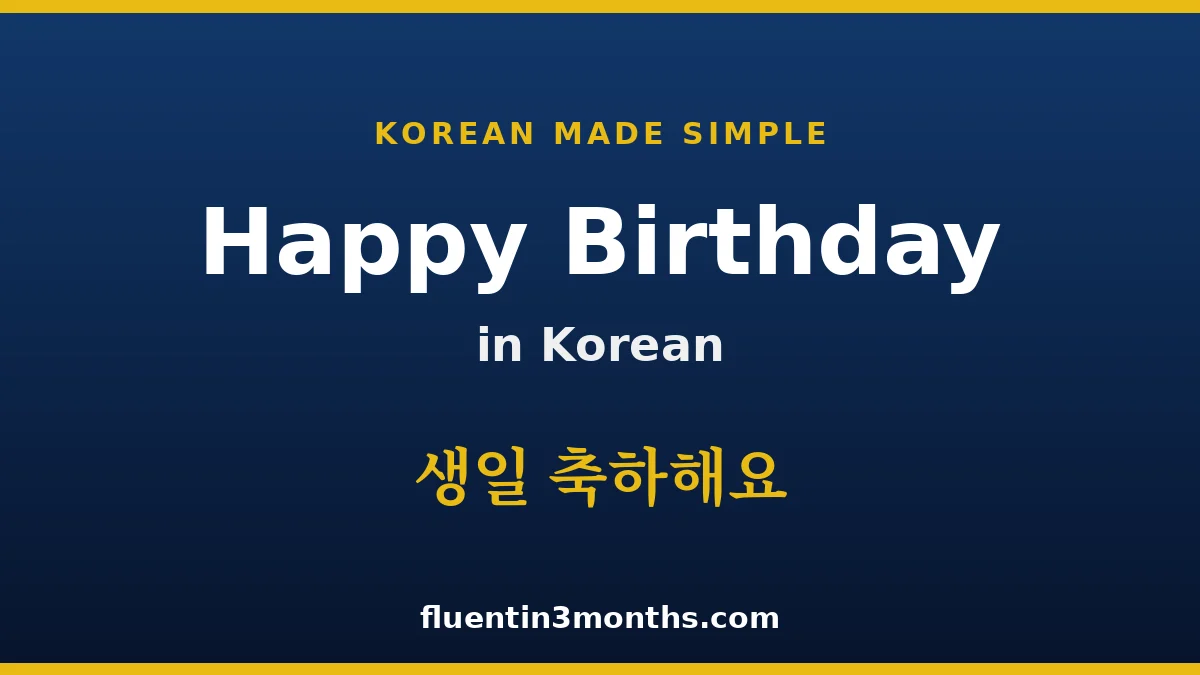
The Korean language is characterized by a sophisticated system of honorifics and speech levels that reflect the nation’s deep-seated cultural emphasis on social hierarchy and mutual respect. For non-native speakers, the act of wishing someone a "Happy Birthday" serves as an entry point into this complex linguistic landscape, where the choice of words is dictated by the age, status, and relationship between the speaker and the recipient. The primary phrase, saengil chukhahaeyo (생일 축하해요), represents only one tier of a multi-leveled communication strategy. In a society where social harmony (inhwa) is paramount, utilizing the incorrect politeness level can result in social friction, ranging from perceived coldness in intimate relationships to a lack of proper deference toward elders.
The Linguistic Architecture of Korean Birthday Greetings
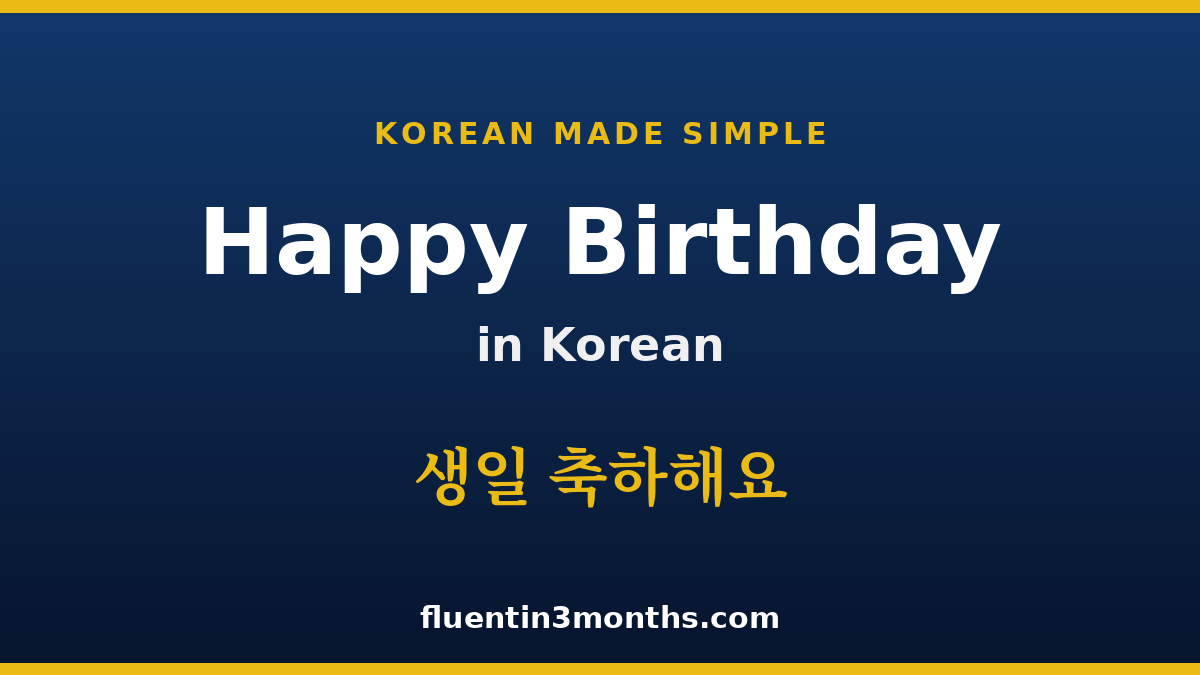
The most common iteration of the birthday greeting is saengil chukhahaeyo. To understand its function, one must analyze its components through a morphological lens. The term "saengil" (생일) translates to "birthday," while "chukhahada" (축하하다) is the verb "to congratulate." Unlike the English "Happy Birthday," which focuses on the emotional state of the individual during the day, the Korean expression is a congratulatory acknowledgement of the person’s achievement in reaching a new year of life. This reflects a broader East Asian linguistic trend that prioritizes the milestone over the transient mood of the celebration.
The suffix "-haeyo" (-해요) denotes the polite, informal speech level. This level is considered the "safe" default for most social interactions in modern South Korea. It is appropriate for use with colleagues, acquaintances, and individuals of similar age or status with whom the speaker is not on intimate terms. However, the Korean language provides three other primary variations to accommodate different social dynamics:
- Informal (Banmal): Saengil chukhae (생일 축하해). This version omits the polite suffix and is strictly reserved for close friends, younger siblings, or children. Using this with a superior or an elder is considered a significant breach of social etiquette.
- Formal (Hasipsio-che): Saengil chukhahamnida (생일 축하합니다). This level is used in formal settings, public announcements, or when addressing individuals of significantly higher rank, such as a CEO or a high-ranking government official. It is also the standard form used in the Korean version of the "Happy Birthday" song.
- Honorific (Highest Respect): Saengsin chukhadeurimnida (생신 축하드립니다). This form employs "saengsin" (생신), an honorific substitute for "saengil," and "deurida" (드리다), a humble version of the verb "to give." This is the mandatory greeting for grandparents, elderly parents, or esteemed mentors, signaling the speaker’s profound respect for the recipient’s seniority.
The 2023 Legislative Shift: Standardization of the Korean Age System
A critical context for understanding Korean birthdays is the historical method of age calculation, which underwent a monumental legal change recently. Historically, South Korea followed a "counting age" system (senneun nai), where a child was considered one year old at birth, accounting for the time spent in the womb. Furthermore, everyone in the country gained a year collectively on New Year’s Day, regardless of their actual birth date. This often resulted in individuals being two years "older" in Korea than their international age would suggest.
On June 28, 2023, the South Korean government officially standardized the age system to match international norms (man nai). This legislative reform, spearheaded by the Ministry of Government Legislation, aimed to reduce social and administrative confusion. Minister Lee Wan-kyu stated at the time that the move would significantly lower social costs and legal disputes arising from the coexistence of multiple age-counting methods. While the "Korean age" remains a topic of casual conversation, particularly among older generations, the legal and official standard now aligns with the global practice of incrementing age on one’s actual birthday.
Cultural Traditions: Culinary Symbolism and Rituals
Korean birthday celebrations are deeply rooted in traditions that honor both the individual and their lineage. Two primary customs—the consumption of seaweed soup and the first-birthday ritual—provide insight into the nation’s historical values.
The Significance of Miyeok-guk
The consumption of miyeok-guk (미역국), or seaweed soup, is a ubiquitous birthday tradition in South Korea. The origins of this custom are tied to maternal health. Since the Goryeo Dynasty, seaweed has been a staple for postpartum recovery due to its high iodine and calcium content. By eating seaweed soup on their birthday, individuals perform a symbolic act of gratitude toward their mothers for the pain and effort of childbirth.
Interestingly, the soup carries a secondary cultural meaning regarding academic performance. Due to the slippery texture of seaweed, there is a widespread superstition that eating the soup before an examination will cause the student to "slip" and fail. Consequently, while mandatory for birthdays, it is strictly avoided on the morning of the Suneung (National Representative College Scholastic Ability Test).
Doljanchi: The Milestone of the First Year
The first birthday, or doljanchi (돌잔치), remains one of the most significant celebrations in a Korean person’s life. This tradition dates back to a period when infant mortality rates were high due to poor nutrition and disease. Reaching the one-year mark was seen as a triumph over hardship.
The centerpiece of the celebration is the doljabi (돌잡이), a divination ritual. The child is placed before a variety of objects, each representing a potential future path:
- String/Thread: Represents a long and healthy life.
- Money/Rice: Symbolizes future wealth and abundance.
- Pencil/Book: Indicates a future as a scholar or academic.
- Stethoscope/Mallet: Represents modern professions such as medicine or law.
The object the child picks up is playfully interpreted as a prediction of their career or destiny, serving as a highlight for the gathered extended family.
Linguistic Mechanics and the Role of Hangul
The ease with which international learners can master these birthday greetings is largely attributed to the design of the Korean writing system, Hangul. Created in 1443 by King Sejong the Great, Hangul was designed to increase literacy among the common people. It is a featural alphabet, meaning the shapes of the consonants are designed to mimic the physical position of the speech organs (tongue, mouth, and throat) during pronunciation.
For instance, the character "ㄱ" (g/k) represents the tongue blocking the throat, while "ㄴ" (n) shows the tongue touching the upper gum. This logical structure allows learners to grasp the phonetic requirements of phrases like saengil chukhahaeyo with greater speed than systems based on arbitrary symbols. In the modern era, the global spread of the "Hallyu" or Korean Wave has seen a surge in interest in the language. According to data from language learning platforms like Duolingo, Korean has consistently ranked as one of the fastest-growing languages globally, driven largely by interest in K-pop and K-dramas.
Broader Sociological Implications of Speech Levels
The requirement to shift politeness levels based on the listener is a reflection of Neo-Confucian values that have influenced Korean society for centuries. These values emphasize hierarchy, filial piety, and the "rectification of names"—the idea that social harmony is maintained when everyone acts according to their specific role.
In a contemporary business context, the use of formal birthday greetings like saengil chukhahamnida serves to reinforce professional boundaries while acknowledging personal milestones. However, as South Korean society becomes increasingly globalized and influenced by Western egalitarianism, some younger generations and tech-oriented companies are experimenting with "horizontal" speech cultures. Despite these shifts, the honorific system remains a core pillar of the Korean identity, ensuring that even a simple birthday wish serves as a reaffirmation of the social bond between the speaker and the listener.
Conclusion: The Intersection of Language and Respect
Mastering the phrase "Happy Birthday" in Korean is more than a vocabulary exercise; it is an exercise in cultural competency. By navigating the four politeness levels, understanding the historical weight of the 2023 age reform, and recognizing the maternal tribute inherent in a bowl of seaweed soup, an outsider demonstrates a profound respect for the nuances of Korean life. As South Korea continues to exert significant cultural influence on the world stage, these linguistic markers serve as essential tools for genuine cross-cultural engagement, ensuring that a simple congratulatory message is delivered with the appropriate level of sincerity and social awareness.
