

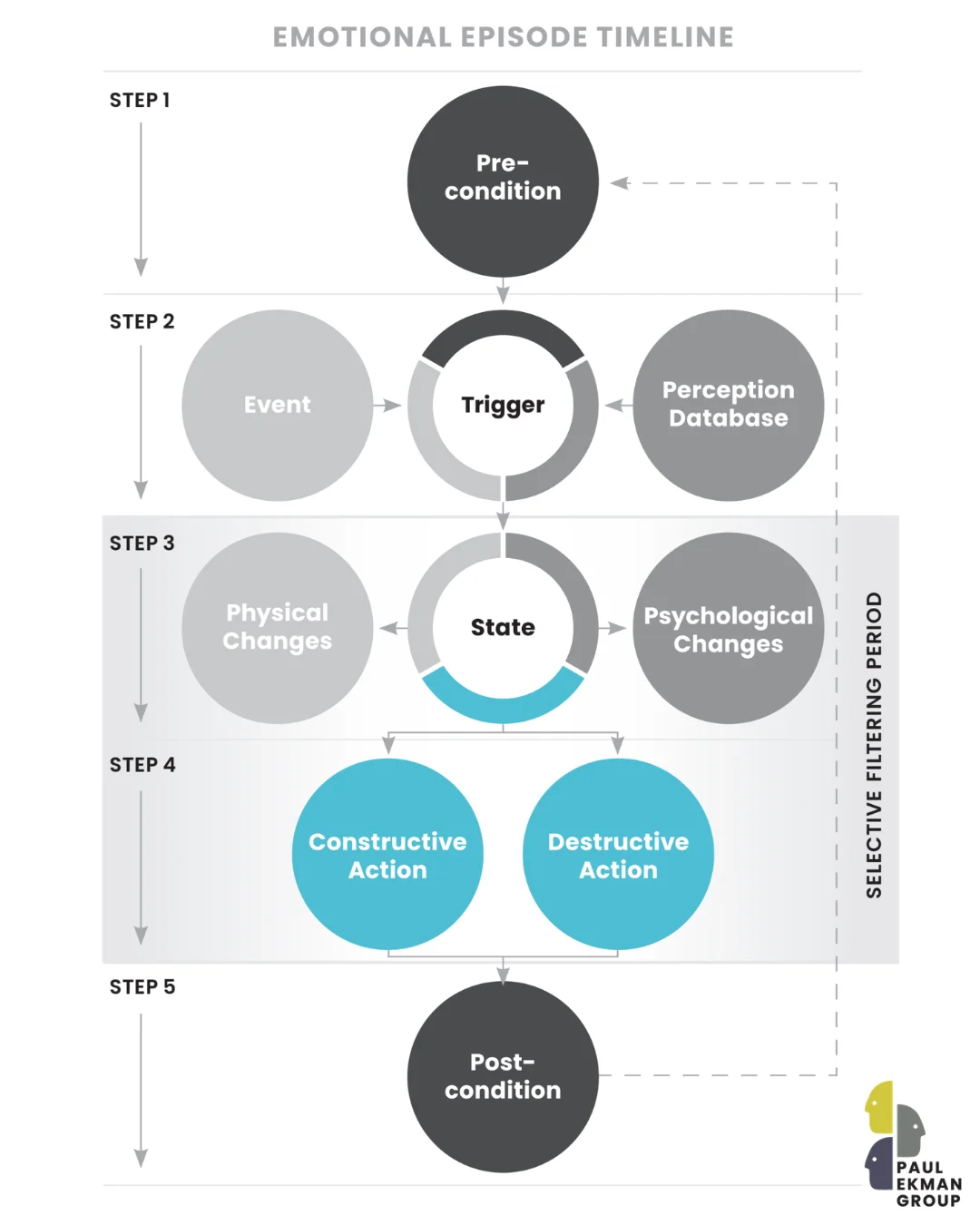
Have you ever found yourself reacting emotionally before you even realized what was happening? While our responses to emotions can feel sudden and unpredictable, they actually follow a simple, yet complex, three-step process. Every emotional experience unfolds through a sequence of events shaped by our current circumstances and our past experiences. Understanding this sequence, known as the Emotional Episode Timeline, can equip individuals with the ability to recognize their emotions earlier, respond more skillfully, and, over time, soften patterns that no longer serve them. This framework, developed by emotion researchers, offers a scientific lens through which to deconstruct the intricate journey from internal stimulus to outward expression.
Emotional Episodes Unfold Through a 5-Step Process
At its most fundamental, an emotion can be simplified into a three-part sequence: Trigger – Experience – Response. This basic pattern occurs countless times throughout each day, often in minor, forgettable episodes, such as becoming momentarily frustrated by misplacing keys or a phone. However, even these small episodes provide valuable insights into our habits and underlying patterns. We might discover a tendency to blame others for misplaced items or to be overly self-critical. To delve deeper into these habits and patterns, the Emotional Episode Timeline expands this into a more detailed, five-step process.
[Image placeholder: A diagram illustrating the 5 stages of the Emotional Episode Timeline: Pre-condition, Trigger, State, Action, Post Condition.]
Step 1: The Pre-condition – Setting the Emotional Stage
The first step in the Emotional Episode Timeline is the Pre-condition. This refers to the physical and emotional context that an individual brings into any given moment, essentially their "emotional starting point." This state can significantly influence the intensity and likelihood of an emotional response. For instance, a night of poor sleep can leave an individual more susceptible to irritability, while a recent success might foster a sense of optimism and resilience. Factors contributing to the pre-condition include:
- Physiological State: Hunger, fatigue, pain, or illness can all lower an individual’s threshold for experiencing negative emotions. Conversely, feeling physically well can promote a more balanced emotional state.
- Psychological State: Stress from work or personal life, excitement from good news, or a general sense of calm can all shape how an individual is primed to react.
- Environmental Context: The immediate surroundings, such as a noisy or chaotic environment versus a peaceful one, can also contribute to the pre-condition.
When an individual is feeling neutral or at ease, the pre-condition might be minimal, meaning less emotional baggage is carried into the subsequent stages. However, even subtle shifts in pre-condition can have a cascading effect on how subsequent events are perceived and experienced.
Step 2: The Trigger – Event and the Perception Database
The Trigger is the catalyst for an emotional experience, arising from a confluence of external or internal events, our appraisals of these events, and our unique internal "database" of past experiences and learned responses, all filtered through our current pre-condition.
The Event: An event is any encounter, whether external or internal. This can manifest as:
- Interpersonal Interactions: Encounters with other people.
- Situational Circumstances: Specific settings or scenarios.
- Internal Stimuli: A thought, memory, fantasy, or even a dream.
- Sensory Input: Anything perceived through sight, smell, sound, taste, or touch.
Crucially, our minds are in a perpetual state of automatic appraisal. This unconscious process rapidly evaluates what is happening around and within us, identifying potential opportunities or threats and preparing us for action. For example, the sudden swerving of a car to avoid an animal on the road is a rapid, automatic appraisal of a threat. Similarly, not receiving a timely text reply from a new acquaintance can be automatically appraised as a sign of rejection. This automatic appraisal system is a fundamental aspect of human survival, allowing for swift reactions to perceived dangers.
The Perception Database: Each individual possesses a unique Perception Database. This internal library is comprised of emotional memories, learned associations, and ingrained response patterns that fundamentally shape how we interpret the world. It functions as an "emotional alert system," enabling our minds to quickly determine the significance of incoming information. This database is constructed from two primary sources:
- Innate Biological Predispositions: Evolutionary adaptations and biological wiring that may predispose individuals to certain emotional sensitivities or responses.
- Learned Experiences and Cultural Conditioning: All the experiences, relationships, teachings, and societal norms encountered throughout an individual’s life that inform their emotional understanding and reactions. This includes upbringing, cultural values, and personal history.
The interplay between the immediate event and this deeply ingrained perception database is what creates the specific trigger for an emotion. Two individuals encountering the exact same event may experience vastly different triggers due to the unique composition of their perception databases.
Step 3: The State – The Embodied Experience
The State represents the emotion itself, aligning with the "Experience" step of the simplified model. This is a comprehensive mind-body phenomenon, encompassing both physiological and psychological changes.
Physical Changes: These are the observable and felt bodily reactions associated with an emotion. Depending on the specific emotion, individuals might experience:
- Increased heart rate
- Flushing or paleness of the face
- Muscle tension (e.g., clenched jaw, tightened shoulders)
- "Butterflies" in the stomach or other visceral sensations
- Tears
- Changes in breathing patterns (e.g., rapid, shallow breaths; holding one’s breath)
Research in affective neuroscience indicates that each universal emotion is linked to a characteristic pattern of physiological changes. These changes are not random; they are adaptive responses designed to prepare the body for specific actions. For instance, the physiological cascade associated with fear readies the body for fight or flight. It’s important to note that sometimes, individuals may not be consciously aware of the trigger that initiated the emotion, but they become acutely aware of the shifts occurring within their bodies.
Psychological Changes: This dimension refers to the subjective, internal "felt sense" of the emotion. It is how the emotion colors our conscious awareness and internal experience. For example:
- Sadness might be perceived as a heavy, slow, and withdrawn feeling.
- Anger can feel hot, sharp, and expansive.
- Joy might manifest as lightness, warmth, and an urge to connect.
Each emotion possesses a unique "flavor," a distinctive way of coloring our psychological landscape. This subjective experience is a critical component of emotional awareness, allowing us to differentiate between various emotional states.
Step 4: The Action – Responding to the Emotion
Emotions are intrinsically linked to action. The Action stage is where the internal emotional state translates into an outward behavior or an internal shift in response. These actions can be categorized as either constructive or destructive. Instead of labeling emotions as "positive" or "negative," it is more beneficial to assess the nature and consequence of the resultant actions.
- Constructive Actions: These actions are beneficial to oneself and/or others, promoting well-being, problem-solving, or healthy relationships. Examples include expressing needs assertively, seeking support, engaging in problem-solving, or offering comfort.
- Destructive Actions: These actions are detrimental to oneself and/or others, leading to harm, conflict, or distress. Examples include aggression, withdrawal, self-harm, or destructive criticism.
It is crucial to understand that even emotions often labeled as "negative," such as anger, can lead to constructive outcomes. For instance, anger can be a powerful motivator for social change or for setting necessary boundaries, provided it is expressed in a controlled and purposeful manner. Conversely, an emotion like joy, while generally considered positive, could lead to destructive actions if it manifests as reckless impulsivity or disregard for consequences. The ability to choose constructive actions, rather than being solely driven by automatic impulses, is a hallmark of emotional regulation and maturity.
Step 5: The Post-condition – The Lingering Impact
Every emotional episode leaves a residual effect, known as the Post-condition. This is the state of affairs that exists after the immediate action has occurred. If an individual yelled in anger, the other person might respond with reciprocal anger or defensiveness. If anger was suppressed, a lingering sense of irritation or resentment might persist internally.
These post-conditions are not merely endpoints; they can serve as triggers for subsequent emotional episodes. A retaliatory yell can reignite anger, fear of another’s reaction can foster anxiety, and regret over one’s own behavior can lead to shame or sadness. This creates a cyclical pattern, where the outcome of one emotional episode directly influences the initiation of the next.
However, post-conditions also represent a critical opportunity for reflection and learning. By pausing to analyze what happened, individuals can gain valuable insights into their emotional patterns, the effectiveness of their responses, and the underlying needs or triggers that were at play. This reflective practice is essential for personal growth and for developing more skillful and adaptive emotional responses over time.
The Selective Filtering Period: A Crucial Element Within Emotion
It is important to note that a Selective Filtering Period is not a distinct step in the timeline but rather a phenomenon that occurs during Steps 3 (State) and 4 (Action). When an emotion is actively experienced, our perception tends to narrow, a process known as emotional bias. Information is filtered to align with the prevailing emotional state.
- In Fear: An individual might become hyper-focused on potential threats, both real and imagined, while overlooking signs of safety or reassurance.
- In Anger: The focus often narrows to the sources of frustration, while positive aspects of the situation or mitigating factors are disregarded.
This selective filtering, while adaptive for immediate survival by prioritizing relevant information, can significantly distort an individual’s perception of reality if they are not aware of its influence. Recognizing this filtering process is key to maintaining a more objective assessment of situations, even when experiencing intense emotions.
Implications and Broader Impact
The understanding of the Emotional Episode Timeline offers significant implications for individuals and society. By demystifying the emotional process, it empowers individuals to move from being passive recipients of their emotions to active participants in their emotional lives. This awareness can lead to:
- Improved Emotional Intelligence: A greater capacity to understand and manage one’s own emotions, as well as to recognize and influence the emotions of others.
- Enhanced Relationships: More effective communication and conflict resolution skills, stemming from a better understanding of emotional triggers and responses.
- Greater Resilience: The ability to navigate challenges and setbacks with greater equanimity and to recover more quickly from adverse experiences.
- Reduced Mental Health Challenges: By identifying and modifying maladaptive emotional patterns, individuals can mitigate the risk or severity of conditions like anxiety and depression.
The scientific exploration of emotion, as exemplified by the Emotional Episode Timeline, is an ongoing endeavor. Resources like "The Feelings Field Guide" and the interactive "Atlas of Emotions" provide accessible pathways for individuals to deepen their understanding of these fundamental human experiences. The development of further resources, such as the forthcoming "Atlas of Emotions book," promises to expand upon these foundational concepts, offering additional insights, practical guidance, and illustrative examples.
Frequently Asked Questions Addressed by the Timeline:
- Why do I react before I even know what’s happening? This is due to automatic appraisal, a rapid, unconscious evaluation during the trigger stage. Your brain processes potential help or harm before your conscious awareness can fully register the event.
- Why do small things set me off more on some days than others? Your pre-condition – how tired, stressed, hungry, or generally at ease you are – significantly influences how easily an emotion can arise. A compromised pre-condition lowers your threshold.
- Why can’t I think clearly when I’m upset? During the state and action stages, you enter a selective filtering period. Your perception narrows to focus on aspects of the situation that align with your current emotion, making it difficult to consider broader perspectives.
- Can I control how I react to an emotion? While the trigger and state stages are largely automatic, the action stage – how you choose to respond – is where agency and constructive choices become possible. Developing awareness and practicing skills can enhance your ability to choose your actions consciously.
By dissecting the emotional experience into these distinct, yet interconnected, stages, the Emotional Episode Timeline provides a valuable framework for understanding, navigating, and ultimately, mastering our emotional lives. This scientific approach moves beyond simplistic notions of emotion, offering a nuanced and actionable path towards greater emotional well-being.
