

In contemporary business discourse, the concept of storytelling has transcended mere rhetoric, evolving into a critical competency for leaders seeking to influence, persuade, and drive action. The ability to distill complex information into a compelling narrative is increasingly recognized as a cornerstone of successful negotiation, budget allocation, team mobilization, and effective change management. This sophisticated approach to communication extends beyond anecdotal embellishment; it involves the deliberate application of time-tested narrative techniques to engage audiences, foster understanding, and prompt desired outcomes across diverse professional settings—from executive boardrooms to sales pitches, marketing campaigns, and organizational announcements. This article explores seven fundamental presentation examples that illustrate how to seamlessly integrate storytelling into any business presentation, thereby elevating its impact and resonance.
The Strategic Imperative of Business Storytelling
The modern business environment is characterized by an unprecedented volume of information, fierce competition for attention, and rapid rates of change. In this landscape, traditional data-heavy, linear presentations often struggle to cut through the noise, leaving audiences disengaged and key messages lost. Research in cognitive psychology and communication consistently demonstrates that human brains are hardwired for stories. Narratives activate more brain regions than mere facts, leading to enhanced memory retention, deeper emotional connection, and a greater propensity for empathy and action. Leaders who harness the power of storytelling transform dry statistics into relatable experiences and abstract concepts into tangible realities, thereby closing deals, securing crucial funding, and guiding their teams through significant transitions with greater efficacy. The following strategies offer a practical framework for cultivating this essential skill.
1. Embracing the Hero’s Journey as a Foundational Structure
At the heart of compelling storytelling lies an enduring structural archetype: the Hero’s Journey. Popularized by mythologist Joseph Campbell, this narrative framework describes a universal pattern of adventure, challenge, transformation, and ultimate return. In its simplest form, a hero embarks on an adventure, confronts a significant challenge, receives guidance from a mentor, overcomes obstacles, and achieves a new state of being or understanding.

Applying this structure to a business presentation provides an inherent dramatic arc. It necessitates a clear beginning, middle, and end, moving the audience through a recognizable progression. The "beginning" establishes the current reality and introduces a problem or challenge. The "middle" details the journey through potential solutions, obstacles, and the pivotal role of a guiding force. The "end" culminates in a vision of a transformed future, a "happily ever after" that, in a business context, represents the successful resolution of the initial problem. Crucially, for this structure to resonate, presenters must precisely define who embodies the hero and, equally important, who assumes the role of the mentor. This distinction fundamentally shapes the presentation’s persuasive power.
2. Positioning the Audience as the Central Hero
A common pitfall in business presentations is the presenter inadvertently casting themselves or their organization as the hero. Such presentations often dedicate extensive time to cataloging company history, client successes, or accolades, inadvertently alienating an audience whose primary concern is their own challenges and aspirations. While establishing credibility is vital, focusing solely on organizational achievements can make a presentation feel self-serving and disconnected from the audience’s immediate needs.
In contrast, the most effective storytelling presentations strategically position the audience as the hero. This shift in perspective is paramount because it is the audience who faces the challenges, seeks solutions, and ultimately stands to benefit from the proposed guidance. By framing the audience’s struggles and aspirations at the core of the narrative, the presenter demonstrates empathy and understanding, creating an immediate and powerful connection. This approach transforms the presentation from a monologue about the presenter’s accomplishments into a shared journey toward the audience’s success. This audience-centric approach aligns with established principles of persuasive communication, where addressing the listener’s self-interest is far more effective than merely touting one’s own merits.
3. Assuming the Empowering Role of the Mentor
Following logically from the audience-as-hero paradigm, the presenter’s most impactful role is that of the mentor. Experienced presentation storytellers consistently adopt this stance, prioritizing the empowerment of their audience over personal acclaim. Their objective is not to bask in glory but to furnish the audience with the necessary tools, insights, and solutions to overcome their challenges and achieve their desired "new bliss."

Consider a hypothetical scenario involving a presentation designed to sell a company’s meal kit delivery service. A "hero" presenter might emphasize, "Our company leads the market with the freshest ingredients, the most innovative menus, and over a thousand five-star reviews, demonstrating our unparalleled excellence." While this conveys quality, it largely overlooks the customer’s perspective.
Conversely, a "mentor" presenter would frame the offering differently: "Many parents today grapple with the difficult dilemma of balancing precious family time with the desire to provide fresh, healthy home-cooked meals. What if a solution could halve your weekly cooking time, allowing you to reclaim those invaluable hours? Our meal kit delivery service is precisely that solution. By delivering meticulously pre-portioned, fresh ingredients directly to your door, we empower the average family to save five hours each week. This means no longer having to choose between quality time in the kitchen and quality time with your children; we enable you to embrace both fully."
This distinction is profound. The mentor-focused narrative immediately addresses the audience’s pain points and positions the service as the indispensable guide to a better future. By centering the discourse on the problems the presenter’s solution solves for the audience, credibility is built through genuine utility and understanding, rather than self-aggrandizement.
4. Employing Contrast through the Presentation Sparkline™ Framework
Engaging storytelling thrives on contrast. A linear, uninterrupted flow of information, often characterized by sequential "and then… and then…" statements, struggles to maintain audience attention. The most captivating narratives, however, introduce friction and dynamism by replacing "and then" with "but then." For example, "Sarah wakes up and gets in her car to go to work, but then she has a flat tire. She manages to catch a ride to the office for an important meeting, but then she realizes she went to the wrong conference room." This introduction of unexpected turns and challenges creates dramatic tension and holds interest.
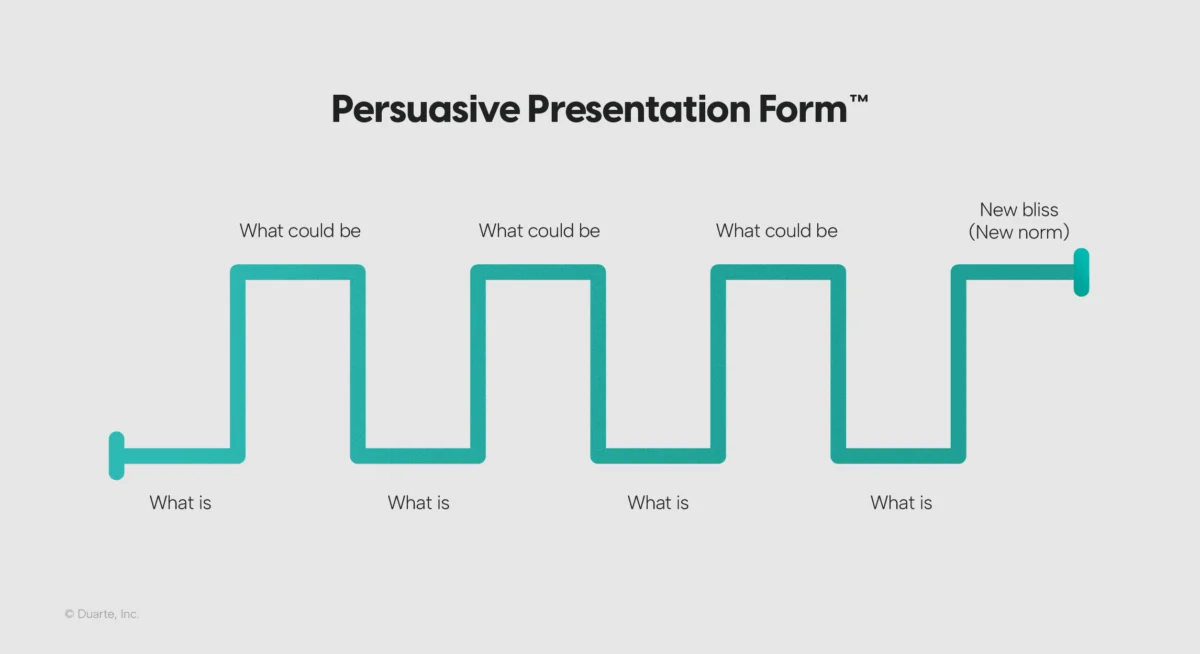
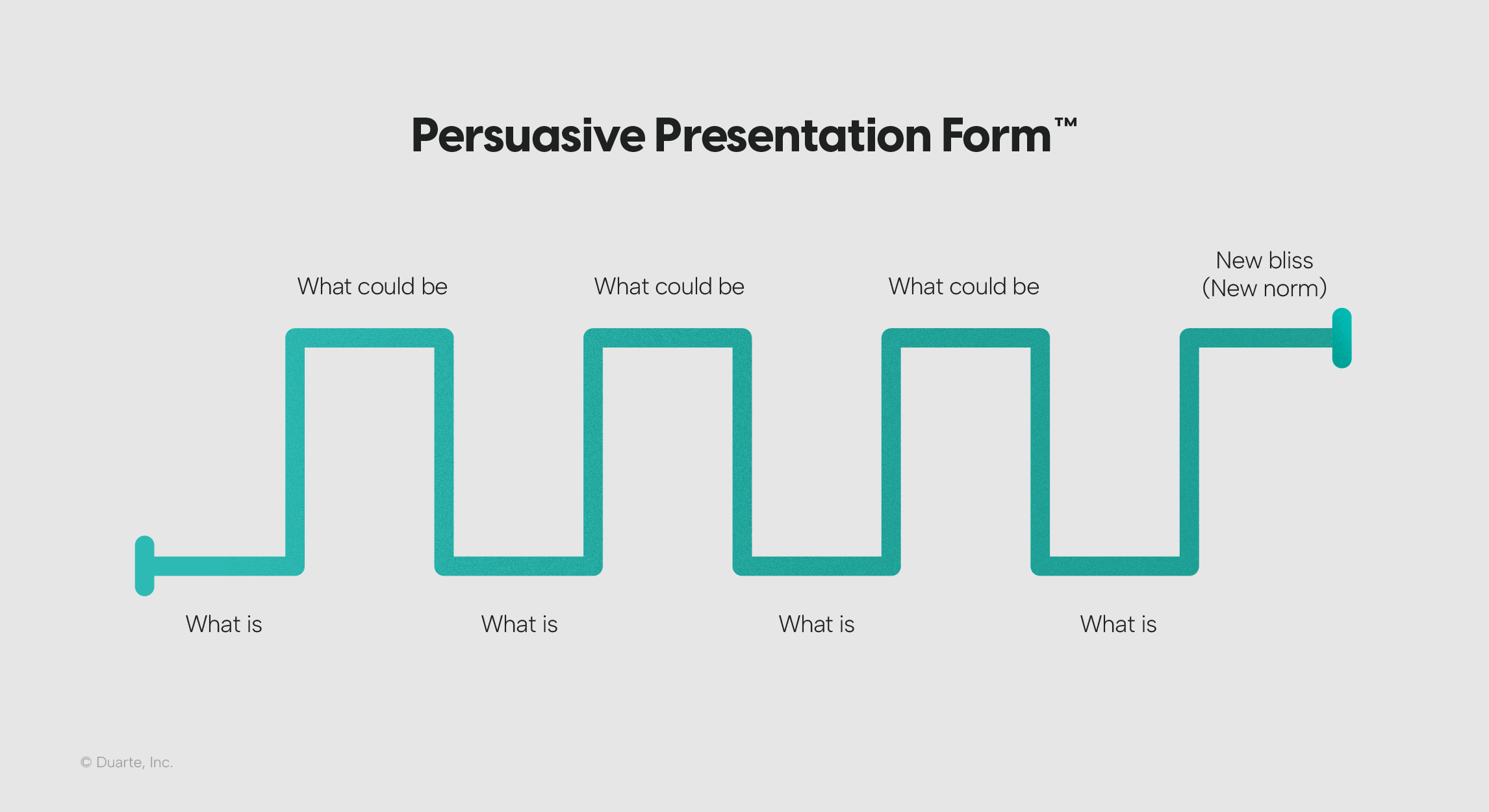
In the realm of business presentations, this principle is elegantly captured by the Presentation Sparkline™ framework, also known as the Persuasive Presentation Form™. This framework posits that presentations should not adhere to a flat, linear trajectory but rather oscillate dynamically between "what is" (the current problematic reality) and "what could be" (the desirable future state).

Traditional reports often remain largely on the "what is" line, meticulously detailing current status, challenges, and data points, with only a brief upward inflection for a final recommendation. While factual, this approach can become monotonous. Conversely, a typical sales pitch might quickly move from a brief acknowledgement of "what is" to an extended, often exaggerated, projection of "what could be," risking sounding unrealistic or lacking substance.
The Sparkline framework, however, proposes a constant interplay. It systematically presents the current reality, then contrasts it with a vision of improvement, returning to present challenges before ascending to new possibilities. This rhythmic movement keeps the audience engaged, making the journey compelling and the proposed solutions more impactful. Celebrated examples, such as Steve Jobs’ 2007 iPhone launch and Dr. Martin Luther King, Jr.’s "I Have a Dream" speech, demonstrably follow this oscillating structure, illustrating its power to persuade and inspire. The continuous shift between problem and solution, challenge and opportunity, mirrors the natural rhythm of human thought and decision-making, ensuring sustained engagement.
5. Crafting S.T.A.R. Moments™ for Unforgettable Impact
In the vast sea of information, distinguishing oneself requires creating moments that deeply resonate. A S.T.A.R. Moment™ – an acronym for "Something They’ll Always Remember" – is a deliberately designed element within a presentation that aims for high memorability and emotional impact. While audiences may struggle to recall exhaustive lists of data points, they are significantly more likely to retain vivid, specific moments that trigger an emotional response or present information in an unexpected way.
A classic illustration of a S.T.A.R. Moment comes from Al Gore’s presentation on climate change, which formed the basis for his Academy Award-winning documentary, An Inconvenient Truth. Faced with the challenge of conveying the alarming projected rise in CO2 concentration over the next half-century, Gore employed a powerful visual. Instead of merely displaying a static chart, he used a lift that physically ascended alongside the projected data, dramatically extending beyond the visible limits of the screen. This immersive and tangible demonstration brought the abstract threat of rising CO2 levels into startling reality, creating an unforgettable sensory experience that underscored the urgency of his message far more effectively than any mere statistic could. Such moments cut through cognitive overload, leaving a lasting impression and reinforcing the core message.
6. Incorporating Data Storytelling for Persuasion

A significant hurdle for many business presenters is transforming raw data into a compelling narrative. Data, in isolation, lacks inherent meaning; it requires a presenter to imbue it with context, relevance, and an emotional anchor. Data storytelling offers potent strategies to achieve this, moving beyond mere reporting to active interpretation. Presenters can leverage data by marveling at its magnitude, humanizing its implications, or surprising the audience with unexpected revelations.
Marveling at magnitude involves presenting data in a way that emphasizes its sheer scale or significance, often through comparisons or analogies that make large numbers comprehensible. Humanizing data connects abstract figures to individual experiences or societal impacts, making the statistics relatable on a personal level. Surprising the audience with the unexpected involves presenting data in a counter-intuitive or novel manner that challenges preconceived notions, thereby capturing attention and fostering deeper consideration.
A seminal example of surprising the audience with the unexpected is Steve Jobs’ 2008 reveal of the MacBook Air. Instead of simply stating the laptop’s slimmest dimension (0.76 inches), Jobs famously slid the entire device out of a standard manila envelope. This unexpected visual demonstration instantly conveyed the product’s revolutionary thinness in a universally understood and highly memorable way. The audience wasn’t just told a statistic; they experienced the data through a vivid, surprising demonstration that cemented the product’s key differentiator in their minds. This technique bypassed cognitive processing of numbers and appealed directly to intuitive understanding, making the data undeniable and impactful.
7. Concluding with a Vision of "New Bliss"
Every effective story culminates in a resolution, and business presentations are no exception. The ending of a story-driven presentation should not merely summarize points but rather paint a vivid, inspiring picture of "new bliss." This "happily ever after" in a business context is not a fantastical illusion but a tangible, attainable vision for the future, one that directly addresses and resolves the challenges initially presented to the audience (the hero).
The "new bliss" is a strategic imperative because it provides the audience with a clear understanding of the positive outcomes of adopting the proposed solutions. As the mentor, the presenter has offered guidance and tools; the "new bliss" illustrates the concrete benefits and improved state of affairs that await the hero after embracing these solutions. It serves as a powerful call to action, motivating the audience by showing them precisely what they stand to gain. This forward-looking vision reinforces the value proposition, consolidates the narrative arc, and leaves the audience with a sense of hope, empowerment, and a clear path forward.
Cultivating Storytelling Prowess for Organizational Advancement
The integration of storytelling into business presentations is not merely an individual skill enhancement; it is a strategic imperative for organizational progress. In an increasingly complex and interconnected global economy, the ability to articulate vision, secure consensus, inspire innovation, and navigate change effectively hinges on compelling communication. Every successful deal, every cohesive team, and every impactful change initiative is often the direct result of a well-crafted narrative delivered at the opportune moment.
Organizations that invest in developing storytelling capabilities among their leaders and teams gain a significant competitive advantage. This mastery enables clearer communication of strategic objectives, more engaging pitches to potential clients and investors, and more resilient internal cultures capable of adapting to market shifts. By moving beyond traditional, fact-heavy presentations towards engaging, audience-centric narratives, businesses can foster deeper understanding, catalyze action, and cultivate lasting relationships. Whether through specialized training programs or expert consultation, cultivating this muscle is an investment that yields substantial returns in influence, engagement, and ultimately, organizational success.
