

The German verb haben serves as a primary cornerstone of the German language, functioning as both a fundamental lexical verb denoting possession and a critical auxiliary component required for the construction of complex grammatical structures. In the hierarchy of German linguistics, haben is categorized alongside sein (to be) and werden (to become) as one of the three essential auxiliary verbs. Its mastery is considered a prerequisite for achieving proficiency according to the Common European Framework of Reference for Languages (CEFR), specifically at the A1 and A2 levels. Beyond its literal translation as "to have," the verb acts as the primary engine for the Perfekt tense, which is the standard form of past-tense communication in spoken German. Consequently, an analytical understanding of haben is not merely an exercise in vocabulary acquisition but a necessary step in accessing the broader syntactic framework of the Germanic linguistic family.
Historical Evolution and Etymological Context
The verb haben finds its roots in the Proto-Germanic habjaną, which is cognate with the English "have" and the Dutch "hebben." Historically, the verb has undergone significant phonetic erosion due to its high frequency of use. Linguists note that high-frequency words in any language are subject to "syncope" or "apocope"—the loss of sounds from the interior or end of a word—as speakers seek efficiency. This explains the characteristic irregularity in the present tense conjugation, specifically the dropping of the "-b-" in the second and third person singular forms (du hast and er/sie/es hat*).
Comparatively, the development of haben mirrors the evolution of the English "have." Just as the English "haves" evolved into "has" for the third-person singular, German transitioned from the theoretical regular forms habst and habt to the streamlined hast and hat. This historical streamlining underscores the verb’s role as a workhorse of the language, where ease of articulation took precedence over morphological consistency.
Quantitative Importance and Frequency in Modern German
According to data from the Mannheim Corpus of the Institute for the German Language (IDS), haben consistently ranks within the top five most frequently used verbs in both written and spoken German. Its prevalence is attributed to its dual-purpose nature. Approximately 80% of all German verbs utilize haben as their auxiliary partner to form the Perfekt tense, whereas only 20% (primarily verbs of motion or change of state) utilize sein.
In a statistical analysis of standard communicative situations, a speaker will utilize a form of haben in nearly every three to five sentences. This frequency makes it a high-priority target for pedagogical focus. Linguistic experts suggest that errors involving haben are among the most "costly" for learners, as they often result in a fundamental breakdown of temporal clarity, making it difficult for listeners to discern whether an action is occurring in the present or has been completed in the past.
The Structural Mechanics of Conjugation
The conjugation of haben follows a "mixed" pattern, exhibiting traits of both weak (regular) and strong (irregular) verbs. This hybrid nature requires learners to approach the verb with a structured memorization strategy.
The Present Tense (Präsens)
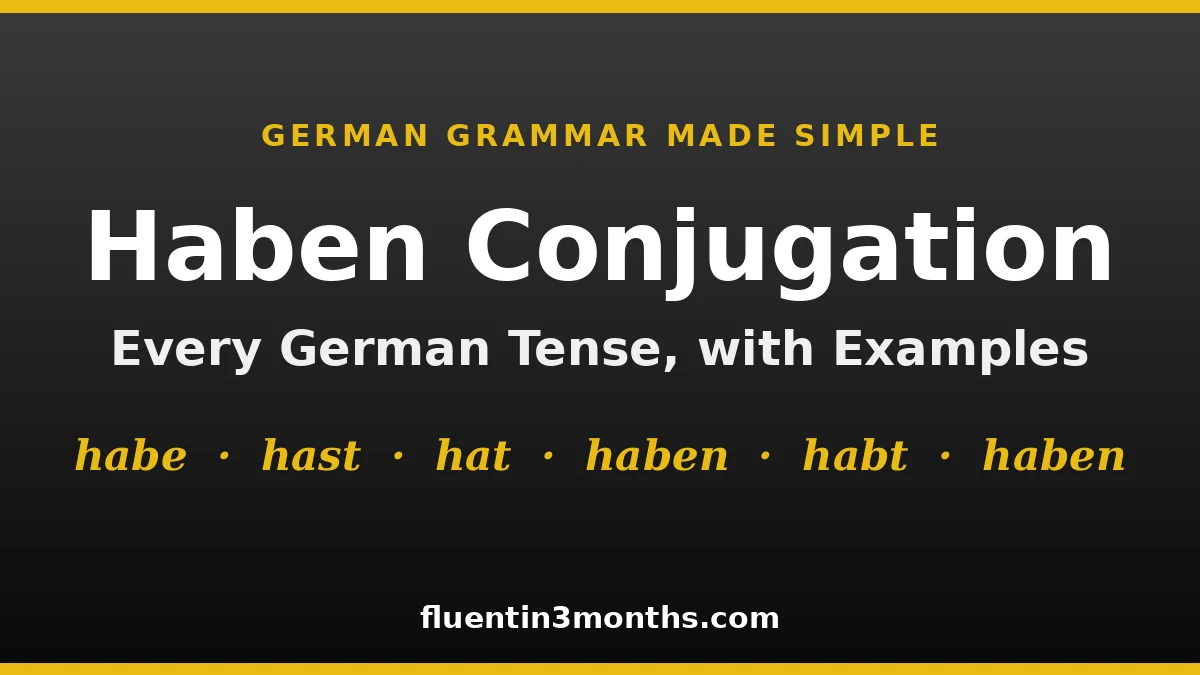
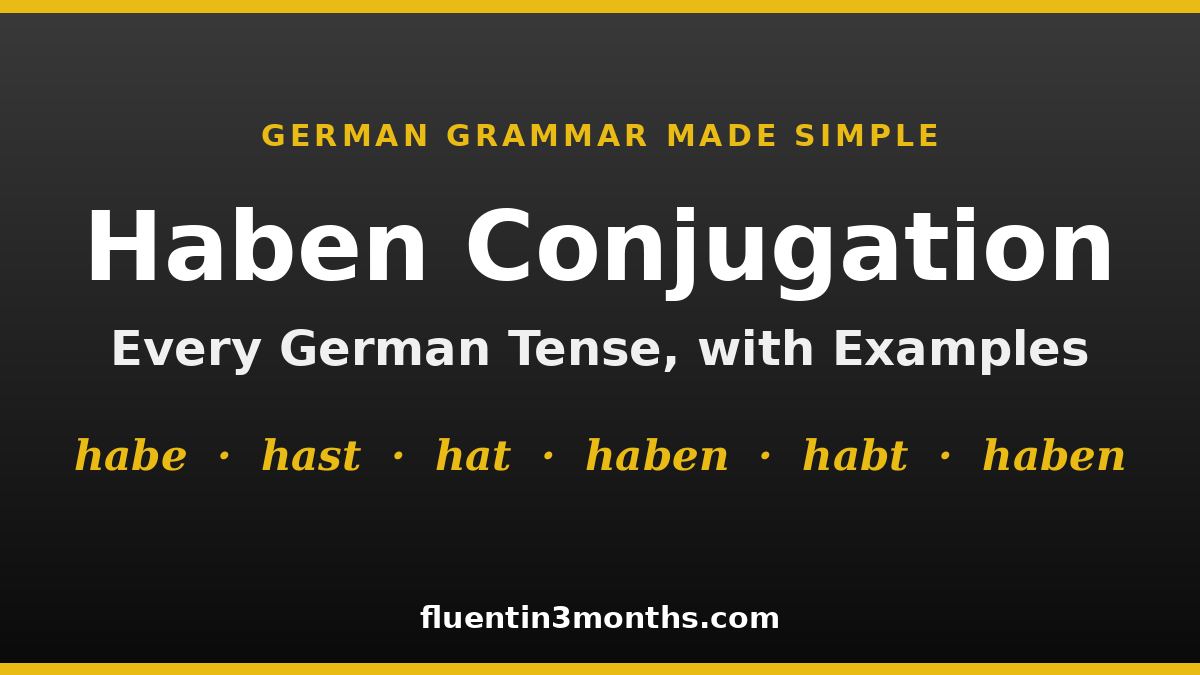
The present tense is the most vital for immediate communication. While the plural forms (wir haben, ihr habt, sie/Sie haben) and the first-person singular (ich habe) follow the standard regular endings, the second and third-person singular are irregular:
- ich habe (I have)
- du hast (you have – informal)
- er/sie/es hat (he/she/it has)
- wir haben (we have)
- ihr habt (you all have)
- sie/Sie haben (they/you formal have)
The Simple Past (Präteritum)
In written narratives and formal reports, the Präteritum is the preferred past tense. Haben adopts the stem hatt-, followed by the standard weak verb endings.
- ich hatte (I had)
- du hattest (you had)
- er/sie/es hatte (he/she/it had)
- wir hatten (we had)
- ihr hattet (you all had)
- sie/Sie hatten (they had)
The Compound Tenses: Perfekt and Plusquamperfekt
The Perfekt is constructed by combining the present tense of haben with the past participle gehabt. Interestingly, haben serves as its own auxiliary. While the Perfekt is the standard spoken past for most verbs, haben and sein are notable exceptions where speakers often prefer the Präteritum (ich hatte) over the Perfekt (ich habe gehabt) for brevity.
The Konjunktiv II: Social and Conditional Utility
One of the most significant applications of haben occurs in the Konjunktiv II (Subjunctive II) mood. The form hätte (would have) is indispensable for expressing hypothetical situations, polite requests, and unfulfilled desires.
In German retail and hospitality sectors, the phrase "Ich hätte gern…" (I would like to have…) is the standard of polite discourse. Linguistic analysts point out that using the indicative ich will (I want) can be perceived as abrasive or demanding in German culture. Therefore, the mastery of the Konjunktiv II of haben is as much a matter of social etiquette as it is of grammatical accuracy.
Comparative Syntactic Analysis: Haben vs. Sein
A critical juncture for any student of German is the distinction between using haben or sein as the auxiliary verb for the Perfekt tense. The rules are governed by the semantic nature of the main verb:
- Haben (The Default): Used for all transitive verbs (verbs that take a direct object, e.g., Ich habe den Brief geschrieben) and most intransitive verbs that describe a state or a continuous action (e.g., Ich habe geschlafen).
- Sein (The Exception): Reserved for intransitive verbs indicating a change of location (gehen, fahren) or a change of state (aufwachen, sterben).
Official guidelines from the Goethe-Institut emphasize that if a learner is unsure, defaulting to haben is statistically more likely to be correct. However, mastering the "Sein-Verbs" is a hallmark of the transition from a beginner to an intermediate speaker.
Idiomatic Divergence from English and Romance Languages
A significant challenge for English, French, and Spanish speakers lies in idiomatic expressions where German utilizes haben where other languages might use "to be" (English) or "avoir/tener" (Romance).
In German, physiological and psychological states are often "possessed" rather than "inhabited." For example:
- Hunger haben (To have hunger/To be hungry)
- Durst haben (To have thirst/To be thirsty)
- Angst haben (To have fear/To be afraid)
- Recht haben (To have right/To be right)
Conversely, a common pitfall occurs with age. While Spanish (tener… años) and French (avoir… ans) use "to have," German aligns with English in using "to be" (Ich bin 20 Jahre alt). This cross-linguistic interference is a frequent subject of study in error analysis within the field of Second Language Acquisition (SLA).
Pedagogical Implications and Educational Strategy
Educational institutions worldwide have adapted their curricula to reflect the foundational status of haben. Modern communicative approaches prioritize "functional fluency," which dictates that haben should be introduced in the first week of instruction.
Linguistic experts argue that "drilling" the present tense of haben is more effective than passive reading because the verb’s irregularities must become reflexive. The "b-drop" in hast and hat is often used as a litmus test for a student’s foundational stability. If a student continues to say habst at the B1 level, it indicates a fossilized error that may impede further grammatical development.
Conclusion: The Broader Impact on Linguistic Proficiency
The verb haben is more than a vocabulary item; it is a structural pillar that supports the entire weight of German temporal expression. Its role as an auxiliary verb makes it the gateway to the past, while its idiomatic applications provide a window into the German conceptualization of the self and the world.
For the professional or academic learner, haben represents the first major hurdle in mastering German syntax. Its complexities—from the phonetic erosion of its stem to its critical role in the subjunctive mood—mirror the complexities of the German language itself. By securing a firm grasp of this verb, speakers do not merely learn to say what they "have"; they acquire the tools necessary to describe what they have done, what they would like to do, and how they interact with the world around them. As linguistic data continues to show, the path to German fluency is paved with the consistent and correct application of haben.
