

Rites of passage, whether the ceremonial singing of Auld Lang Syne on New Year’s Eve or the symbolic smashing of champagne on a ship’s hull for its maiden voyage, mark significant new beginnings. In the corporate realm, particularly for sales organizations, the yearly cycle is often inaugurated with a Sales Kickoff (SKO) event. Far from being a mere annual gathering, a successful SKO serves as a critical strategic inflection point, designed to define objectives, align efforts, and ignite the collective ambition of the sales force for the year ahead. Much like orchestrating a memorable celebration, an impactful SKO demands meticulous reflection, strategic foresight, and a compelling narrative that genuinely resonates with every participant.
The stakes for modern SKOs are exceptionally high. In an increasingly competitive global marketplace, sales teams are the frontline drivers of revenue, and their motivation, clarity, and capability directly translate to bottom-line success. Industry analysts frequently underscore the tangible benefits of well-executed sales training and alignment initiatives, with some research indicating that companies with highly aligned sales and marketing teams achieve up to 20% higher annual revenue growth. Conversely, poorly planned or executed SKOs can lead to disengagement, confusion, and a significant waste of resources, both financial and human. Estimates suggest that large-scale corporate events can cost hundreds of thousands, if not millions, of dollars, making their return on investment a paramount concern for leadership.
With the right preparation and flawless execution, SKOs possess the power to reinvigorate sellers, seamlessly launch new sales initiatives, and cultivate essential momentum. However, achieving this requires moving beyond mere pomp and spectacle. While celebrity keynotes and elaborate productions can momentarily capture attention, true impact stems from content that informs, inspires, and genuinely empowers. To maximize the effectiveness of any forthcoming sales kickoff, four fundamental elements have emerged as indispensable for keeping audiences engaged, energized, and ready to meet the demands of the selling landscape.
The Strategic Imperative: Beyond Pomp and Spectacle
Many organizations, often in their pursuit of grandeur, inadvertently undermine the strategic objectives of their SKOs. Some may invest heavily in high-profile speakers, others might focus excessively on abstract goals without delineating the practical pathways to achieve them. Such approaches risk creating events that are superficially impressive but ultimately fail to unify sellers or imbue them with the excitement and actionable insights needed for goal attainment. To circumvent these common and costly pitfalls, a structured approach centered on four core principles can transform a merely "good" event into an exceptional one, delivering relevant content, striking an emotional chord, and fostering genuine commitment. This transformative journey begins with prioritizing the most vital stakeholders in the room: the audience.
I. The Audience at the Core: Understanding Your Sales Force
A prevalent inclination among corporate leaders is to prioritize the organization’s health, future trajectory, and financial performance above all else. While these concerns are undeniably critical, allowing them to singularly dictate the messaging of a sales kickoff can be a strategic misstep. This often manifests as a tacit assumption that the sales audience, despite being integral to daily operations, inherently shares the exact same concerns and perspectives as the executive leadership. The predictable outcome is often a deluge of slides replete with abstract numbers, high-level projections, and a palpable lack of engagement as attendees’ eyes glaze over.
This common pitfall is entirely avoidable through a deceptively simple yet profoundly impactful question: Who is my audience, truly?
Before the commencement of any event material drafting, it is imperative to delve into the prevailing mindset and experiences shaping the sales force as they approach the kickoff. This necessitates a series of probing questions for self-reflection: What were their major wins and challenges in the previous year? What are their current market anxieties or opportunities? What specific tools or support do they genuinely need? What are their personal career aspirations and how do current company goals align with them?

Maintaining an objective and empathetic perspective throughout this discovery process is crucial. It ensures that all programming and materials are meticulously crafted and designed with the individual sales team member in mind. Leaders must endeavor to articulate overarching company goals in terms that are relatable, tangible, and directly beneficial to the sellers. Furthermore, curating an optimal environment for maximum information absorption extends beyond content. This includes thoughtful scheduling of events throughout the day, providing ample amenities (such as proper nourishment, hydration, and caffeine), and integrating a judicious mix of passive learning (presentations) and active participation (workshops, breakout sessions) to sustain engagement.
Consider an organization poised to launch an innovative AI-enabled sales workflow. A leadership-first approach might trumpet it solely as a "productivity win." An audience-first strategy, however, would begin by anticipating how sellers will perceive this change. This involves proactively addressing potential reservations by centering their hopes (e.g., easier tasks), fears (e.g., job displacement), struggles (e.g., learning new tech), and unique pain points (e.g., administrative burden). The message then shifts to highlight why they should care and actively support this evolution.
Instead of merely framing it as a blanket productivity boost, the discourse would emphasize the specific time sellers will reclaim, perhaps 8-10 hours weekly, allowing them more energy and bandwidth to nurture high-value relationships without compromising engagement. Rather than subjecting them to a lengthy, passive live demonstration, allocate dedicated time for small group breakouts where sellers can actively test and familiarize themselves with the new technology. While the underlying benefit remains a productivity gain, this seller-centric approach creates immediate inroads for teams to develop a personal stake and investment in the future, fostering adoption rather than resistance. This demonstrates a clear difference in impact.
To glean these crucial insights and illuminate effective messaging pathways prior to the SKO, engaging directly with team leaders or conducting interviews with sellers themselves is invaluable. These conversations not only make team members feel seen and validated in their contributions but also provide the raw, authentic material essential for crafting a compelling message and making high-stakes programming decisions. Tools like Duarte’s Audience Needs Map™ can further assist leaders in synthesizing these responses from an audience-first perspective, translating insights into actionable steps. With this targeted input, leaders can then ask more nuanced questions during the content creation phase: What specific challenges do sellers face daily? How can this new initiative directly alleviate those? What outcomes would motivate them most?
II. The Guiding Star: Establishing a Singular "Big Idea"
Following thorough audience reflection, the next critical step is to distill the core message. Each year, ambitious presenters inadvertently dilute the impact of their SKOs by attempting to cover an excessively long list of topics. Financial performance, product roadmaps, and sweeping industry prognostications are all valid subjects, but they must all serve a single, overarching takeaway that the audience is expected to remember and act upon.
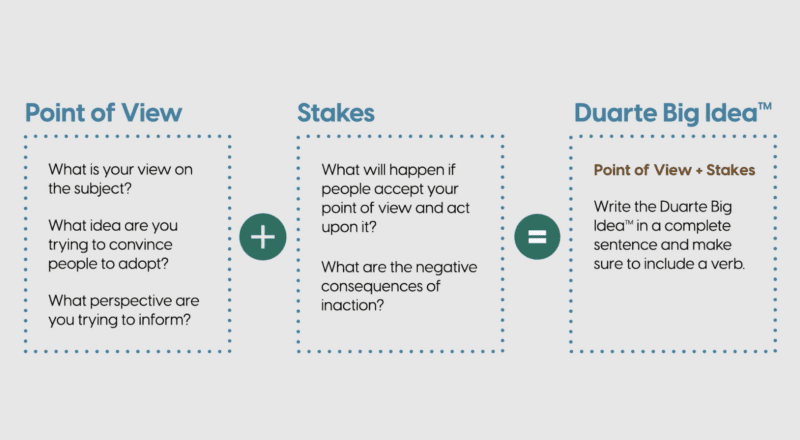
The Duarte Big Idea™ provides a scalable framework for distilling complex messaging into a clear, concise, and unforgettable takeaway. It is a structured process for articulating your unique point of view on a subject alongside what is at stake for your audience in a single, digestible sentence. This formula essentially posits: Point of View + Stakes = Duarte Big Idea™. The Point of View defines your specific stance or the idea you wish to instill, while the Stakes delineate the consequences of either accepting and acting on that view, or of inaction.
Establishing and rigorously adhering to this principle is a cornerstone of The Duarte Method™ and is trusted by numerous Fortune 50 and global brands for high-stakes communications. Its efficacy lies in its simplicity and adaptability. The initial aim is to craft the Big Idea™ as a single, unambiguous sentence. If it exceeds this, the task becomes to ruthlessly identify and eliminate extraneous information without compromising the core meaning. The guiding question here is: What is the absolute essence of what I want to communicate?
Once this singular, unmissable point is sharpened, it serves as the north star for all subsequent content creation, including the SKO keynote, breakout session programming, and supporting materials. It dictates both what to include and, equally importantly, what to omit. If a piece of content does not directly serve the overarching Duarte Big Idea™ for the kickoff, its inclusion should be reconsidered, perhaps relegating it to an alternative communication channel.
To summarize the creation of a Duarte Big Idea™ for a sales kickoff: Identify your core message, determine what’s at stake for your audience, and combine these into one clear, concise sentence. For our AI workflow example, a powerful Big Idea™ could be: "This new AI workflow will cut clerical tasks for sellers by 20% and free up between 8-10 hours a week for high-value account holders." This statement clearly articulates the change (POV) and the direct, beneficial outcome for the sales team (Stakes). With this clear takeaway established, the next step is to give the messaging a compelling structure.
III. The Narrative Arc: Structuring for Impact and Retention
Having thoroughly considered the audience and cemented the Duarte Big Idea™, the focus shifts to structuring the flow of the SKO programming. Leveraging a classic three-act story structure provides a universally recognizable framework that audience members can effortlessly follow: a beginning, a middle, and an end. This narrative archetype is deeply embedded in human psychology and culture, underpinning everything from ancient myths to modern blockbusters.
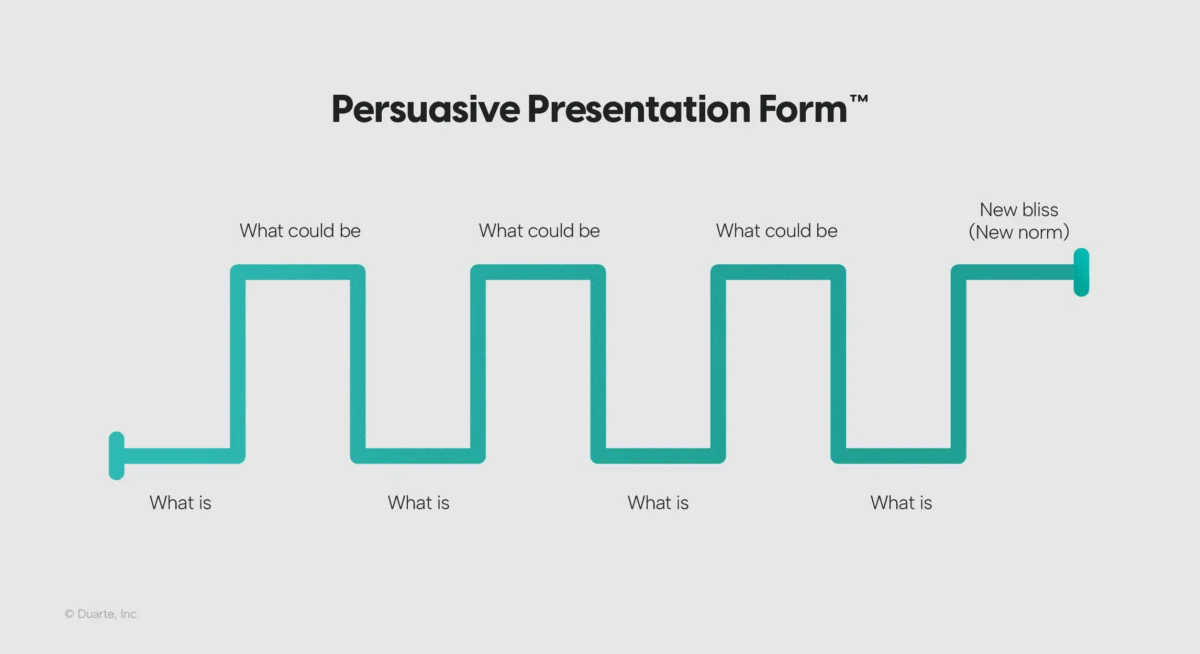
The beginning of the SKO story is where the audience is positioned as the hero. It sets the current stage, acknowledges existing circumstances, and validates the feelings, gaps, and needs identified during the audience research phase. This act establishes the "what is." The middle is where the core action unfolds. The hero (the sales team) encounters new challenges, learns new strategies, and confronts the obstacles that test their resolve. This creates narrative tension as old ways give way to new. The end sees the hero emerge transformed, achieving resolution as a new reality takes hold, and the tension built in the middle is released, culminating in a state of "new bliss."
Much of the SKO content will naturally reside in what The Duarte Method™ refers to as the messy middle—the crucial phase where growth occurs, and the transition from current realities to future possibilities is navigated. Structuring this section as a call-and-response using the Persuasive Presentation Form™ can effectively guide this tension toward the desired outcome. This form alternates between depicting the world as it is and envisioning how it could be, compelling the audience to embrace the "new bliss" presented in the resolution.
Duarte CEO, Nancy Duarte, famously articulated this oscillating structure as the "Presentation Sparkline™" in her viral TED Talk. Its defining characteristic is the dynamic movement between "what is" (the current state, often at the bottom of a visual representation) and "what could be" (the envisioned future, at the top). This oscillation builds conviction, leading to a climax where "what could be" becomes a tangible reality.
To effectively apply the Persuasive Presentation Form™ at your next sales kickoff:
- Begin with "what is": Acknowledge current challenges, pain points, or inefficiencies.
- Transition to "what could be": Introduce the solution, vision, or new initiative and its potential benefits.
- Address obstacles ("what is"): Acknowledge the difficulties or resistance associated with the change.
- Reinforce benefits ("what could be"): Reiterate the positive outcomes of overcoming these obstacles.
- Conclude with "new bliss": Present the desired future state where the solution is adopted and benefits are realized.
Consider our AI workflow example within this structure: "We know some sellers likely have reservations about this new AI-enabled workflow. Change is hard. There will be bumps along the way, but with adoption, we think you’ll find more space in your day to nurture high-value accounts and build meaningful relationships. We’re anticipating an onboarding period throughout the next quarter and encourage some trial and error to feel comfortable with the new cadence. To help with the transition, IT and Learning & Development teams have collaborated on comprehensive training materials. We believe you’ll be amazed at the time you reclaim."
Notice how this narrative toggles seamlessly between acknowledging the growing pains of change ("Change is hard," "bumps along the way") and reminding the audience of the achievable benefits ("more space in your day," "nurture high-value accounts," "time you reclaim"). Audiences appreciate transparency; addressing concerns head-on builds credibility. The Persuasive Presentation Form™ strategically integrates these obstacles into the narrative, allowing speakers to contextualize them alongside the significant gains audience members stand to achieve through perseverance.
For optimal flow and impact, moving beyond the confines of a screen during the planning phase is highly recommended. Utilizing sticky notes or physical cards to map out talking points allows for agile experimentation with different cadences and sequences, revealing what feels most natural and impactful. This tactile visualization offers a big-picture perspective, facilitates nimble adjustments, and often sparks critical "aha!" moments. With this structural groundwork meticulously laid, the final element involves a touch of personalization to elicit a truly genuine response.
IV. The Human Connection: Weaving in Personal Stories

After conducting thorough audience-first reflection, crystallizing a succinct Duarte Big Idea™, and packaging the message within a familiar 3-act story structure, the final, yet profoundly impactful, piece is the integration of a personal touch. While some individuals are natural storytellers, weaving in personal anecdotes can be daunting for many. However, the effort is often its own reward; audiences are generally forgiving of minor imperfections when the intention is authentic.
The advice is simple: just try it.
For a forthcoming presentation, consider strategically weaving in a brief personal aside to enrich the message and break through potential monotony. Before deploying this technique at a high-stakes event like an SKO, "soft launch" it during a smaller team meeting to gauge its reception. The story doesn’t need to be profoundly vulnerable or deeply personal; rather, aim for a happy medium that invites listeners in by offering a glimpse into your authentic self outside the strictly professional realm. When executed effectively, a precisely placed personal story can:
- Forge deeper connections: Bridging the gap between speaker and audience.
- Humanize complex ideas: Making abstract concepts relatable and understandable.
- Inspire empathy and trust: Building rapport and fostering a sense of shared experience.
- Increase memorability: Stories are inherently more memorable than raw data.
If this approach feels unfamiliar, reflect on the most challenging aspect of your talk—the part that might be hardest for your audience to believe, embrace, or fully comprehend. Consider the underlying reasons for this potential resistance. Then, assess: Can this moment be connected to an emotion through a concise story? Is there a way to render an abstract or complex element relatable by revealing a personal detail?
Let’s revisit the AI workflow example with a personal narrative: "While testing this new workflow over the past several months, something unexpected happened in my personal life. My son had just entered his ‘terrible twos,’ and my wife and I were utterly exhausted from keeping up with his antics. I was consistently working late into the evenings, and she was shouldering an increasing burden of toddler duty. But as my understanding and proficiency with these new AI tools grew, my workdays began to end earlier. I found myself keeping pace with tasks and reclaiming precious time. Now, we all go to the park every day after picking him up from daycare. He gets to burn off his boundless energy, I’m contributing more effectively around the house, and, crucially, we’re all sleeping a little better."
This brief anecdote effectively hooks the audience, allowing them to perceive the genuine thought and emotional investment behind the presented point of view. It connects a professional tool to a relatable personal benefit—work-life balance—making the organizational change feel deeply human and desirable. To discover the perfect story to enliven your SKO, reflect on your life and leadership experiences for an appropriate analogy. Practice integrating it into smaller meetings or presentations first, tracking its reception before deploying it in the spotlight. For those looking to hone their storytelling skills, seeking feedback from a trusted audience is invaluable. With consistent practice and precise timing, the right stories can powerfully move hearts and minds toward embracing a shared vision.
Beyond the Kickoff: Sustaining Momentum and Measuring Success
A truly successful SKO is not an isolated event but rather the launchpad for a year-long journey. The four pillars—audience-first thinking, a clear Big Idea, a compelling 3-act structure, and authentic personal stories—provide the foundational framework. However, the impact must be sustained. This involves robust post-SKO mechanisms:
- Ongoing Training and Support: Reinforcing new skills and initiatives through continuous learning modules and accessible resources.
- Performance Tracking: Implementing clear metrics to monitor the adoption of new strategies and their impact on sales performance. Sales operations teams are increasingly leveraging analytics to track alignment between strategic directives and field execution.
- Feedback Loops: Establishing channels for ongoing feedback from the sales team to address challenges and celebrate successes.
- Celebrating Early Wins: Publicly acknowledging and rewarding individuals or teams who successfully implement new strategies, creating positive reinforcement.
Companies that commit to comprehensive post-SKO reinforcement programs consistently report significant uplift in sustained performance metrics compared to those that treat the SKO as a standalone event. This continuous engagement transforms the initial inspiration into lasting behavioral change and measurable business outcomes.
By meticulously reflecting on the audience’s needs, committing to a singular, impactful Big Idea™, structuring the narrative with a compelling 3-act flow, and skillfully weaving in authentic personal stories, an organization’s next SKO is poised not just to meet, but to exceed its strategic goals. It becomes a powerful catalyst for alignment, motivation, and ultimately, unparalleled sales success, fostering a vibrant culture where every seller feels empowered, understood, and inspired to contribute to a shared future. For organizations seeking to fine-tune their kickoff events, expert guidance can prove invaluable, from crafting impactful keynote presentations to training teams for dynamic breakout sessions, ensuring every message is airtight and the entire organization is unified around a single, resonant story.
