

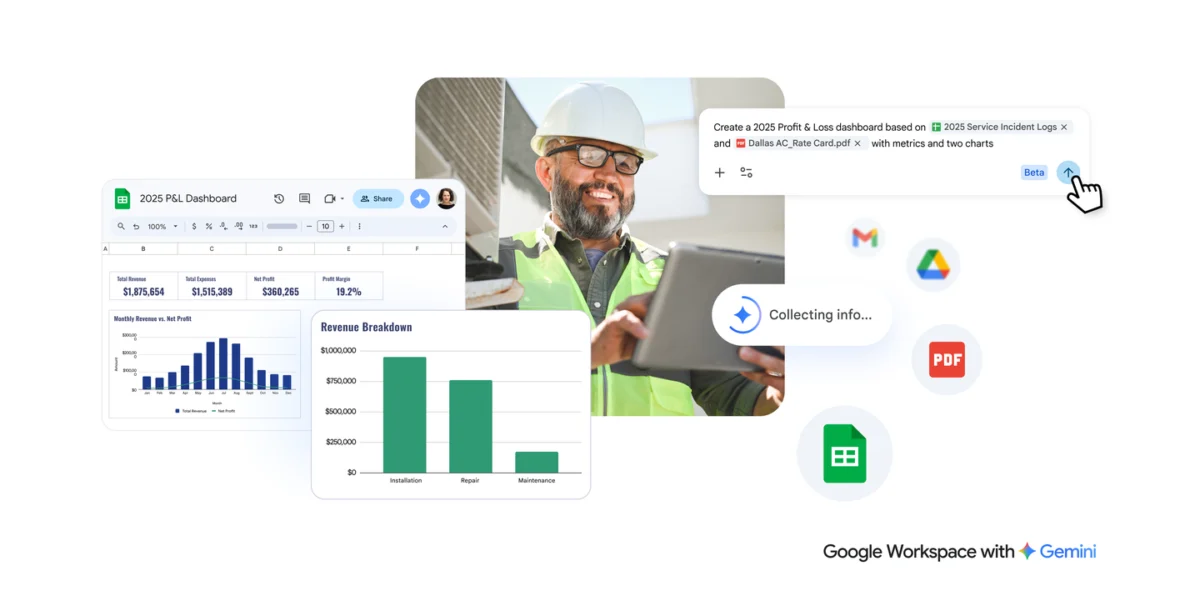
The technology giant Google has officially unveiled a suite of new beta features for Gemini in Google Sheets, marking a significant milestone in the integration of generative artificial intelligence within enterprise productivity software. This update allows users to create, organize, and edit entire spreadsheets by simply providing natural language descriptions of their requirements. By transitioning from basic assistance to autonomous spreadsheet manipulation, Google aims to streamline complex data workflows that previously required specialized knowledge of formulas, pivot tables, and data visualization techniques.
This announcement comes as part of a wider ecosystem update for Google Workspace, which includes enhanced AI capabilities for Google Drive, Docs, and Slides. However, the advancements in Sheets are particularly noteworthy due to the technical complexity involved in managing structured data and the high level of accuracy required for financial and analytical tasks.
The Evolution of Autonomous Spreadsheet Management
The new beta features represent a shift in how users interact with tabular data. Rather than manually selecting ranges or writing complex nested formulas, users can now engage with Gemini through a conversational interface to perform high-level tasks. These tasks range from the initial construction of a data framework—such as building a project tracker or a budget template—to the sophisticated analysis of existing datasets.
According to the technical documentation released alongside the announcement, Gemini in Sheets can now interpret intent with a high degree of nuance. For example, a user could request the AI to "create a quarterly sales report that compares regional performance against annual targets and highlights underperforming sectors in red." The AI then autonomously structures the columns, populates the necessary formulas, and applies conditional formatting without further manual intervention.
Benchmark Performance and the SpreadsheetBench Dataset
Central to the announcement is Gemini’s performance on the SpreadsheetBench dataset, a rigorous public benchmark designed to evaluate the proficiency of large language models (LLMs) in editing and manipulating spreadsheets within real-world scenarios. SpreadsheetBench tasks are notoriously difficult because they require the AI to understand spatial relationships within a grid, maintain data integrity across multiple tabs, and execute multi-step logical reasoning.
Google reported that Gemini in Sheets has achieved a 70.48% success rate on the full SpreadsheetBench dataset. This figure is significant for several reasons:
- Superiority Over Competitors: The score exceeds the performance of contemporary models in the same category, positioning Google’s offering as the current state-of-the-art for spreadsheet-specific AI.
- Proximity to Human Expertise: At over 70% accuracy, the model is approaching the proficiency levels of human experts who specialize in data management. While human experts still maintain a lead in handling highly abstract or creative data structuring, the gap is narrowing rapidly.
- Real-World Application: Unlike synthetic tests, SpreadsheetBench utilizes scenarios derived from actual business use cases, suggesting that the AI’s performance in the lab will translate effectively to office environments.
The high success rate is attributed to Google’s refinement of Gemini’s reasoning capabilities and its specific training on structured data formats. This allows the model to predict the most logical structure for a dataset based on minimal input.
Chronology of AI Integration in Google Workspace
The journey toward autonomous spreadsheet manipulation has been a multi-year endeavor for Google. To understand the significance of the March 2026 update, it is necessary to examine the timeline of Google’s AI integration:
- Early 2023: Google introduced "Duet AI" for Workspace, which provided basic text generation in Docs and simple "Help me organize" features in Sheets. These early iterations were limited to generating templates rather than manipulating live data.
- Late 2023: Google rebranded its AI efforts under the Gemini name, integrating more powerful models that could summarize long email threads in Gmail and draft more complex documents.
- 2024 – 2025: The company focused on multimodal capabilities, allowing Gemini to process images and audio. In Sheets, this era saw the introduction of "Smart Fill" enhancements, where the AI could predict data entry patterns with higher accuracy.
- March 2026 (Current): The launch of the current beta marks the transition to "autonomous agency." Gemini is no longer just a predictive text tool; it is a functional agent capable of executing a series of complex commands to alter the state of a spreadsheet independently.
Broader Integration: Drive, Docs, and Slides
While the Sheets update is the centerpiece of the recent announcement, Google has also synchronized these advancements across the broader Workspace suite. The objective is to create a seamless "cross-app" intelligence where data can flow and be transformed between different formats.
In Google Drive, Gemini has been updated to provide more sophisticated file management and content discovery. Users can now ask questions about the contents of their entire Drive, such as "Find all the contracts signed in Q3 and summarize the termination clauses," and the AI will synthesize information from multiple PDFs and Word documents.
In Google Docs and Slides, the AI’s role has expanded from drafting content to structural editing. In Slides, for instance, Gemini can now take a raw data sheet and automatically generate a visually coherent presentation deck, selecting the appropriate chart types and layout styles to best represent the underlying data.
Official Responses and Industry Context
Industry analysts have noted that Google’s aggressive rollout of Gemini features is a direct response to the "AI arms race" currently dominating the technology sector. Microsoft, Google’s primary competitor in the productivity space, has been heavily promoting its Copilot integration within Excel and the wider Microsoft 365 ecosystem.
While Microsoft was early to market with many generative features, Google’s latest benchmark results suggest a focus on deep technical proficiency and autonomous execution. "The 70.48% success rate on SpreadsheetBench is a clear signal that Google is prioritizing the ‘utility’ of AI over mere ‘novelty,’" noted one senior analyst in the enterprise software space. "For corporate clients, the value isn’t in an AI that can write a poem; it’s in an AI that can reliably balance a ledger or identify a discrepancy in a 10,000-row spreadsheet."
Within Google, the sentiment is one of cautious optimism. In official communications, the company emphasized that while the beta represents a massive leap forward, the human-in-the-loop model remains essential. The features are labeled as "beta" to encourage user feedback and to acknowledge that in the high-stakes world of data analysis, verification by human experts is still a best practice.
Technical Analysis of Implications
The implications of an AI reaching near-human proficiency in spreadsheet manipulation are profound, particularly for the fields of finance, accounting, and data science.
Democratization of Data Analysis
Traditionally, the ability to perform complex data analysis was gated by the need to learn specific software functions or coding languages like SQL or Python. By enabling natural language control, Google is effectively "democratizing" data analysis. A marketing manager with no knowledge of VLOOKUPs or Pivot Tables can now perform the same level of analysis as a junior data analyst by simply asking the right questions.
Efficiency Gains and the Reduction of Manual Labor
For power users, the benefit lies in the elimination of "grunt work." Building the skeleton of a complex spreadsheet and cleaning messy data are time-consuming tasks. If Gemini can handle the first 70% of the labor—the organization and initial calculation—human experts can focus their time on the final 30%: interpretation and strategic decision-making.
Accuracy and Security Concerns
Despite the high benchmark scores, the transition to AI-driven spreadsheets raises questions about data integrity. Large language models are known to occasionally "hallucinate" or provide confidently wrong answers. In a spreadsheet, a single misplaced decimal point or an incorrect formula reference can have catastrophic financial consequences.
Google has addressed these concerns by ensuring that Gemini provides "citations" or explanations for its actions. When the AI generates a formula or edits a range, the user can see exactly what logic was applied. Furthermore, the company maintains that the data used to train Gemini in Workspace is not used to train its public models, addressing the privacy concerns of enterprise clients.
Future Outlook for AI-Native Productivity
The March 2026 update suggests that the future of productivity software is "AI-native." Rather than being a feature added on top of an existing interface, the AI is becoming the primary interface.
Looking ahead, the logical next step for Gemini in Sheets is "proactive assistance." Instead of waiting for a user to describe what they need, the AI could monitor data streams in real-time and alert users to anomalies, trends, or errors. For example, if a company’s inventory levels drop below a certain threshold relative to historical sales data, the AI could autonomously draft a restock order sheet for review.
As Google continues to refine these models, the barrier between different types of software—documents, spreadsheets, and presentations—will likely continue to blur. If an AI can understand the underlying information, the "format" (whether it is a table or a paragraph) becomes a secondary choice made at the moment of output.
For now, the rollout of these beta features marks a significant victory for Google in the competitive landscape of enterprise AI. By achieving record-breaking proficiency on the SpreadsheetBench dataset, Google has demonstrated that Gemini is no longer just a digital assistant, but a powerful tool capable of handling the rigors of professional data management. Users across the globe will now begin the process of testing these capabilities in the wild, determining if the AI can truly match the precision and reliability of a human expert.
