

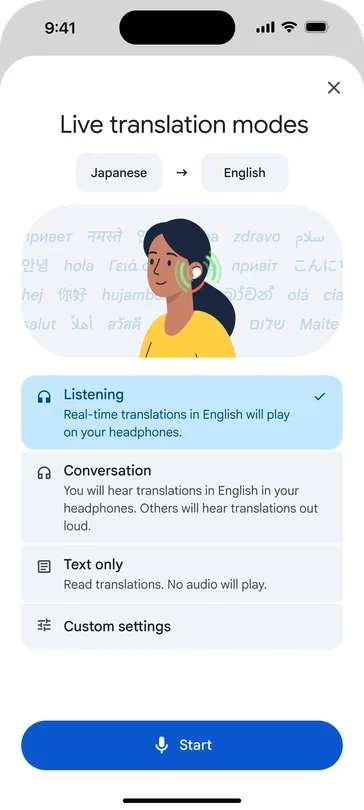
Google LLC has officially announced the rollout of its Live Translate feature for headphones to the iOS platform, marking a significant milestone in the company’s efforts to democratize real-time language processing across competing mobile ecosystems. This expansion signifies a strategic shift from the feature’s historical roots as an Android-exclusive capability, specifically tailored for Google’s proprietary Pixel hardware. In addition to the iOS launch, Google is significantly broadening the geographical availability of this technology, extending full support to users in France, Germany, Italy, Japan, Spain, Thailand, and the United Kingdom. By leveraging advanced artificial intelligence and the latest Gemini-driven capabilities, the update enables users to engage in fluid, bilingual conversations in over 70 languages using any standard pair of compatible headphones.
The Evolution of Real-Time Translation Technology
The journey toward seamless, wearable-based translation has been a decade-long endeavor for Google’s Research and Development teams. The concept first gained significant public attention in 2017 with the launch of the original Google Pixel Buds. At the time, the feature was restricted to Google’s own hardware and required a tethered connection to a Pixel smartphone. This early iteration utilized Google’s Neural Machine Translation (NMT) system, which had been introduced in 2016 to replace the aging phrase-based translation models that often struggled with syntax and context.
Over the subsequent years, Google transitioned the technology from a hardware-locked feature to a broader service available on all Google Assistant-optimized headphones. By 2019, the company had expanded the capability to most Android devices, yet the iOS ecosystem remained a significant frontier. The current announcement represents the final bridge in this cross-platform strategy, acknowledging the global market share of Apple’s iOS, which holds approximately 28% of the global smartphone market and over 50% in regions like the United States and the United Kingdom.
The integration of Gemini—Google’s most capable multimodal AI model—into the Translate infrastructure marks the most recent technological leap. Unlike traditional models that translate word-for-word or phrase-for-phrase, Gemini-enhanced translation analyzes the intent, tone, and cultural nuances of speech. This reduces the mechanical "robotic" nature of translated audio, providing a more natural cadence for users engaged in live dialogue.
Strategic Expansion: Why These Seven Markets?
The selection of France, Germany, Italy, Japan, Spain, Thailand, and the U.K. for this expansion is not coincidental. These nations represent some of the world’s most significant hubs for international tourism and global commerce. According to data from the United Nations World Tourism Organization (UNWTO), France, Spain, and Italy consistently rank as the top three most visited countries globally. Japan and Thailand follow closely as primary destinations in Asia, with Japan seeing a massive surge in post-pandemic tourism.
In these contexts, the Live Translate feature serves as a critical tool for navigating complex social and logistical environments. In Japan, for instance, where English proficiency levels can vary significantly outside of major metropolitan areas, the ability to receive real-time Japanese-to-English translation through headphones allows travelers to navigate transit systems and interact with local vendors with unprecedented ease. Similarly, in Thailand, the feature supports the local economy by lowering communication barriers between service providers and international visitors.
Furthermore, the inclusion of Germany and the U.K. highlights Google’s focus on professional and educational sectors. Germany remains Europe’s largest economy, hosting thousands of international trade fairs annually where multilingual communication is a prerequisite. By making the tool available on iOS in these regions, Google is targeting a demographic of business professionals who frequently utilize iPhones for corporate communication.
Technical Framework and Hardware Compatibility
The technical execution of Live Translate on iOS involves a sophisticated interplay between the Google Translate mobile application, cloud-based processing units, and the device’s Bluetooth stack. To activate the feature, users must have the latest version of the Google Translate app installed on their iPhone. Upon tapping the "Live Translate" interface and connecting a pair of headphones—ranging from Apple’s AirPods and Beats to third-party Bluetooth headsets—the app creates a dual-channel audio stream.
One channel captures the ambient speech of the interlocutor through the smartphone’s microphone, while the second channel delivers the translated audio directly to the user’s ears. This "interpreter mode" allows for a natural flow where the user can maintain eye contact with the person they are speaking to, rather than constantly looking down at a screen.
The system relies on low-latency audio processing to ensure that the delay between the spoken word and the translated output is minimal. This is achieved through Google’s global network of Edge Computing nodes, which process the voice data closer to the user’s physical location. The support for over 70 languages covers the vast majority of the world’s most spoken tongues, including Mandarin Chinese, Hindi, Arabic, and Portuguese, alongside the newly highlighted European and Asian languages.
Market Context and Competitive Landscape
The move to bring Live Translate to iOS is a direct response to the intensifying competition in the AI-driven translation market. Apple recently introduced its own "Translate" app and "Live Text" features within iOS, seeking to keep users within its ecosystem. However, Google’s vast database of linguistic data—accumulated over nearly 20 years of operating Google Search and Translate—gives it a distinct advantage in terms of accuracy and language variety.
Industry analysts suggest that by offering a superior translation experience on Apple’s own hardware, Google is reinforcing its position as the "utility layer" of the internet. "Google understands that the value of its AI lies in ubiquity," says senior technology analyst Marcus Thorne. "If they can make an iPhone user dependent on a Google service for something as fundamental as communication, they maintain their relevance even on a competitor’s platform."
The global machine translation market is projected to reach a valuation of approximately $3 billion by 2027, according to market research firms. This growth is driven by the increasing globalization of businesses and the rising demand for real-time linguistic support in healthcare, emergency services, and travel. Google’s expansion into seven key markets and the iOS platform positions the company to capture a larger share of this burgeoning sector.
Official Responses and User Safety
While Google has not released a formal press conference transcript, the company’s product blog emphasizes the goal of "instantly understanding and connecting with the world." Internal sources at Google Translate have indicated that the focus of this update was not just on expansion, but on the refinement of the user interface to ensure that even non-technical users can navigate the "Live Translate" settings with ease.
Privacy remains a paramount concern in the development of live audio processing. Google has stated that audio data processed for Live Translate is encrypted during transit. Furthermore, the company provides users with controls to manage their activity history, ensuring that sensitive conversations are not stored indefinitely on servers. This is particularly relevant for the corporate users in Germany and the U.K., where GDPR (General Data Protection Regulation) compliance is a strict requirement for any software utilized in a professional capacity.
Broader Implications for Global Connectivity
The implications of universal, real-time translation extend far beyond convenience for tourists. For the millions of expatriates and refugees living in countries like Germany and France, this technology can be a lifeline for accessing public services, healthcare, and legal assistance. By removing the cost barrier of human interpreters for basic interactions, Google is providing a form of "digital accessibility" that was previously unimaginable.
In the realm of education, the expansion to Thailand and Japan supports international exchange programs. Students can use the headphone-based translation to supplement their language learning, providing a safety net during the early stages of immersion.
Looking forward, the integration of Live Translate with AR (Augmented Reality) glasses is the expected next step. While the current update focuses on audio through headphones, the underlying AI infrastructure is being built to support a future where translated text could be overlaid on a user’s field of vision in real-time. For now, the move to iOS and the expansion into seven major global markets ensures that Google Translate remains the most versatile and accessible translation tool in the mobile era.
As the update rolls out across the App Store and Google Play Store in the coming weeks, users in the specified regions can expect a seamless transition to the new capabilities. By bridging the gap between Android and iOS, Google has effectively turned any pair of headphones into a powerful tool for cross-cultural dialogue, further shrinking the distances created by language barriers in an increasingly globalized world.
