

Storytelling, far from being a mere buzzword, has emerged as a critical competency for leaders across all sectors, transforming how information is conveyed, understood, and acted upon. In today’s information-saturated environment, the ability to shape complex data and strategic objectives into a compelling narrative is not just an advantage, but a necessity for securing deals, garnering budget approvals, and navigating organizational change effectively. A business presentation infused with storytelling techniques transcends a dry recitation of facts, becoming an immersive experience that deeply engages audiences and compels them towards desired outcomes. This approach leverages established psychological principles to make messages memorable, relatable, and ultimately, persuasive.
The Evolution of Business Communication: From Data Dumps to Dynamic Narratives
For decades, business presentations often prioritized sheer volume of information, relying on dense slide decks and exhaustive data points to convey authority and expertise. The prevailing belief was that more facts equated to more persuasion. However, this approach frequently led to audience disengagement, information overload, and a lack of retention. As research into cognitive psychology and communication evolved, a crucial insight emerged: humans are inherently wired for stories. Narratives provide context, create emotional resonance, and make abstract concepts tangible. This understanding catalyzed a shift, particularly over the last two decades, towards integrating storytelling into corporate communication, transforming presentations from informational broadcasts into persuasive dialogues.
Communication experts widely agree that while data provides the "what," storytelling provides the "why" and "how," bridging the gap between raw information and meaningful action. Studies by organizations like the Stanford Graduate School of Business have highlighted that information presented in a story format is significantly more memorable and impactful than information presented as mere statistics or bullet points. This paradigm shift underscores the strategic imperative for business leaders to cultivate advanced storytelling skills, moving beyond conventional presentation styles to embrace a more dynamic, audience-centric approach.
The Foundational Narrative Arc: Adapting the Hero’s Journey for Business
At the heart of effective storytelling lies a universal structure, often recognized as the "Hero’s Journey." This classic narrative arc, popularized by mythologist Joseph Campbell, details a protagonist who embarks on an adventure, faces a crisis, and emerges transformed. Translating this structure into a business context provides a powerful framework for presentations.
The core elements remain consistent: a beginning that establishes the current state or problem, a middle that introduces challenges and solutions, and an end that envisions a transformed future. In a business presentation, this translates to:
- The Ordinary World (Beginning): The audience’s current reality, often fraught with specific challenges, inefficiencies, or unmet needs. This sets the stage and establishes relatability.
- The Call to Adventure (Problem Identification): The moment the audience recognizes the depth of their problem, realizing that the status quo is unsustainable or that a significant opportunity is being missed.
- Meeting the Mentor (Solution Introduction): This is where the presenter introduces the proposed solution—a product, service, strategy, or idea—as the tool or guidance needed to overcome the challenge.
- The Ordeal (Implementation/Overcoming Obstacles): Addressing potential hurdles, complexities, or the effort required to adopt the solution, demonstrating empathy for the audience’s journey.
- The Reward (The "New Bliss"): The tangible benefits and positive outcomes achieved once the solution is implemented.
- The Return (Call to Action): Empowering the audience to take the necessary steps to achieve this desired future.
Establishing this clear beginning, middle, and end, punctuated by the hero’s problem and the mentor’s solution, is paramount. Without a defined narrative structure, even compelling facts can lose their impact, leaving the audience without a clear pathway to understanding or action.
Shifting the Spotlight: The Audience as the Protagonist
A common pitfall in business presentations is for the presenter to inadvertently position themselves or their company as the hero. This often manifests in extensive discussions about company history, impressive client lists, or numerous awards. While such details can build credibility, an overemphasis diverts focus from the audience’s immediate concerns, diminishing engagement.
Leading communication strategists emphasize that the most effective storytelling presentations unequivocally position the audience as the hero. This strategic shift is rooted in psychological principles of self-interest and empathy. Audiences are primarily concerned with their own challenges, aspirations, and potential for growth. By framing the narrative around their struggles and triumphs, the presenter taps into a powerful sense of relevance.

Consider a sales presentation: instead of listing product features, a presenter focused on the audience as the hero would articulate the specific pain points the audience experiences daily and how the proposed solution directly alleviates those struggles. This approach fosters a deeper connection because it resonates with the audience’s lived experience, making the message personal and urgent. Research by Forrester, for instance, has repeatedly shown that customer-centric messaging significantly outperforms product-centric messaging in terms of sales conversion rates and customer loyalty.
The Presenter’s Essential Role: Guiding as the Mentor
If the audience is the hero, then the presenter naturally assumes the role of the mentor. This distinction is crucial for building trust and establishing authority rooted in service, not self-aggrandizement. The mentor is not interested in personal glory but is deeply committed to equipping the hero with the necessary tools, insights, and strategies to overcome their challenges.
This approach transforms the presentation from a monologue into a collaborative journey. For example, instead of a company promoting its "industry-leading technology" (hero-presenter), a mentor-presenter would articulate: "You’re grappling with escalating operational costs and shrinking margins. Our technology is designed specifically to streamline your workflows, reducing expenditure by X% and freeing up your team to focus on innovation." The focus here is entirely on the audience’s problem and the presenter’s ability to provide a solution that empowers them.
This mentor-driven narrative builds immense credibility because it demonstrates empathy and a genuine understanding of the audience’s world. It moves beyond a transactional exchange of information to a relationship built on trust, positioning the presenter as a valuable guide rather than just a salesperson or information provider.
Dynamic Engagement Through Contrast: The Sparkline Framework Explained
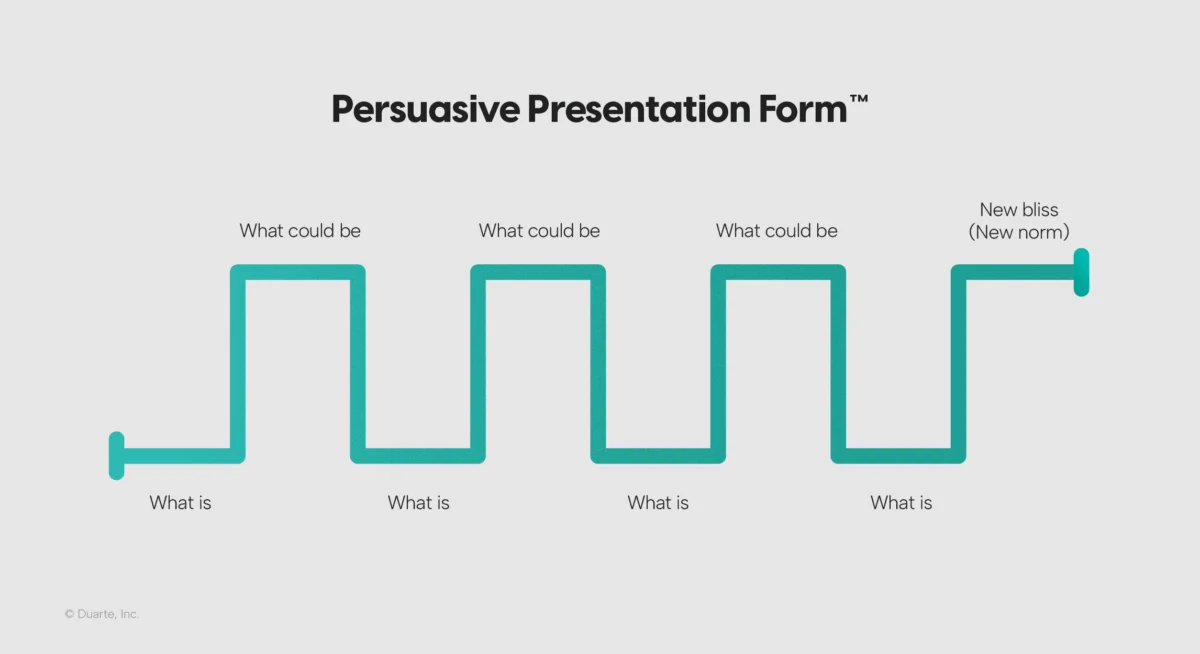
Monotony is the enemy of engagement. Linear presentations, which follow a predictable "and then… and then…" progression, quickly lose an audience’s attention. The power of storytelling lies in its ability to introduce contrast, shifting between "what is" and "what could be" to create dramatic tension and maintain audience interest. This technique is brilliantly encapsulated by the Presentation Sparkline framework, developed by communication expert Nancy Duarte.
The Sparkline visually represents the dynamic interplay between the current reality ("what is," often depicted as a lower baseline) and the aspirational future ("what could be," an elevated line).
- The Traditional Report: Often stays predominantly on the "what is" line, detailing current facts, challenges, and analyses, with perhaps a brief upward shift for recommendations at the end. While informative, it lacks persuasive momentum.
- The Pure Pitch: Tends to start with a brief nod to "what is" before soaring almost immediately to "what could be," celebrating a utopian future without fully acknowledging the journey or current realities. This can feel unrealistic or overly optimistic.
- The Persuasive Sparkline: This framework consistently oscillates between "what is" and "what could be." It acknowledges the current challenges, then offers a glimpse of the potential solution, dips back to explore the implications of the current state, and then rises again to illustrate the benefits of the proposed future. This rhythmic contrast creates a compelling narrative flow, mirroring the natural ebb and flow of human thought and emotion.
Iconic presentations, such as Steve Jobs’ 2007 iPhone launch and Dr. Martin Luther King, Jr.’s "I Have a Dream" speech, masterfully employ this Sparkline structure. Jobs systematically highlighted the limitations of existing phones ("what is") before unveiling the revolutionary capabilities of the iPhone ("what could be"). King vividly depicted the injustices of racial inequality ("what is") against the backdrop of his profound vision for a just and equitable society ("what could be"). This constant oscillation keeps the audience mentally and emotionally invested, driving home the urgency for change and the promise of a better future.
Crafting Unforgettable Moments: The S.T.A.R. Principle
In an age of information overload, the ability to create "Something They’ll Always Remember" – or S.T.A.R. Moments – is paramount. While detailed information can be easily forgotten, a powerful, sensory, or emotionally resonant moment etches itself into an audience’s memory. These moments are not merely illustrative; they are integral to embedding key messages within the narrative.
One of the most compelling examples is Al Gore’s presentation on climate change, which formed the basis of his Academy Award-winning documentary, An Inconvenient Truth. Faced with the challenge of communicating the dramatic projected rise in CO2 concentration over 50 years, Gore moved beyond a simple chart. He used a lift to physically ascend alongside the soaring data curve, making the abstract concept of exponential growth tangible and viscerally impactful. This physical demonstration created an unforgettable S.T.A.R. Moment that transformed data into a profound, personal experience for the audience.

S.T.A.R. Moments can take various forms: a powerful analogy, a surprising statistic delivered with dramatic flair, a personal anecdote, a prop demonstration, or a direct audience interaction. The key is to break the pattern of conventional delivery and introduce an element that evokes wonder, shock, empathy, or clarity, making the core message indelible. Research into cognitive psychology suggests that novelty and emotional activation significantly enhance memory encoding, making S.T.A.R. Moments powerful tools for retention.
Transforming Raw Data into Compelling Narratives: The Art of Data Storytelling
Data is the bedrock of business decisions, but raw data rarely speaks for itself. The challenge for modern presenters is to transform complex datasets into digestible, meaningful narratives that drive action. Data storytelling is the art of giving context and meaning to numbers, helping audiences understand not just what the data says, but what it means for them and what they should do about it.
Effective data storytelling employs several techniques:
- Marvel at Magnitude: Highlighting the sheer scale or significance of a data point. Instead of stating "revenue increased by 15%," contextualize it: "Our 15% revenue increase translates to X new jobs created and enough investment to launch three new product lines."
- Humanize the Data: Connecting statistics to individual experiences. Rather than "20% of customers churned," say "Imagine 200 of our loyal customers, individuals like [customer persona], choosing to leave us last quarter. This represents X amount in lost revenue and countless missed opportunities for feedback."
- Surprise with the Unexpected: Presenting data in a novel or counter-intuitive way that challenges assumptions. Steve Jobs’ 2008 MacBook Air reveal is a prime example. Instead of simply stating its thickness (0.76 inches), he famously slid the laptop out of a standard manila envelope. This unexpected demonstration instantly communicated the device’s revolutionary thinness in a way that numbers alone could not.
The goal is to move beyond simply presenting charts and graphs to interpreting them, explaining their implications, and integrating them into the broader narrative of the audience’s challenge and the proposed solution. Data, when woven into a story, becomes evidence supporting the narrative, making the argument more robust and credible.
Visualizing the Future: Ending with a "New Bliss"
Every compelling story culminates in a resolution, a vision of what life looks like after the hero has overcome their challenges. In business presentations, this resolution is the "new bliss"—an attainable, desirable future that the audience can realistically achieve by adopting the presenter’s solution. It’s the "happily ever after," grounded in reality.
The "new bliss" is more than just a summary of benefits; it’s a vivid depiction of the transformed state. It paints a picture of improved efficiency, enhanced profitability, resolved pain points, or realized opportunities. As the mentor, the presenter is not merely selling a product or an idea; they are offering a pathway to this improved future.
For instance, a presentation on a new cybersecurity solution wouldn’t just end with "our software protects your data." Instead, it would conclude with a vision of "your team operating with complete peace of mind, free from the constant threat of breaches, able to innovate faster and serve your clients with unwavering confidence." This positive vision serves as a powerful call to action, motivating the audience to embrace the solution and embark on their journey towards this promised future. It reinforces the value proposition by connecting it directly to the audience’s ultimate aspirations.
The Enduring Impact of Storytelling in Business
Business storytelling is far more than a stylistic choice; it is a strategic imperative that underpins organizational success. Every major business achievement—from closing a critical deal to successfully implementing a company-wide change initiative, or fostering deeper team alignment—is often catalyzed by a well-told story delivered at the opportune moment.
By adopting these seven storytelling principles, leaders can elevate their communication from informative to transformative. They can cut through the noise, forge stronger connections, and inspire meaningful action. In an increasingly complex and competitive landscape, the ability to articulate a compelling narrative that resonates emotionally and intellectually is the hallmark of effective leadership and a cornerstone of sustained organizational growth and influence. As businesses continue to navigate rapid change and unprecedented challenges, the power of a well-crafted story will only grow in importance, solidifying its place as an indispensable tool for driving progress and shaping the future.
