

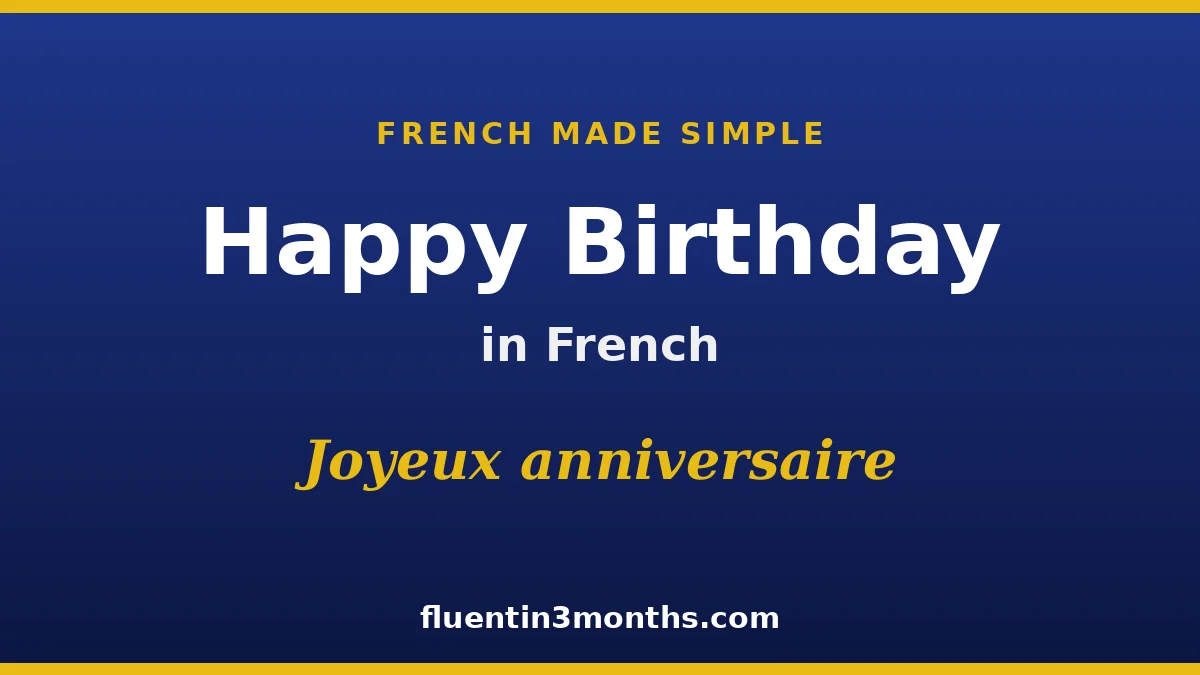
While English-speaking cultures rely almost exclusively on the singular phrase "Happy Birthday" across all social strata, the French language offers a more nuanced architectural framework for celebratory greetings. Navigating the linguistic landscape of France and Francophone regions requires an understanding of not only the vocabulary—primarily "Joyeux anniversaire" and "Bon anniversaire"—but also the rigid cultural protocols that dictate when and how these sentiments are expressed. In the context of increasing global mobility and international business, mastering these subtle distinctions is essential for effective social integration and professional rapport within the French-speaking world, which currently encompasses over 300 million speakers globally.
The Linguistic Framework: Joyeux versus Bon
The foundation of French birthday greetings rests on two primary expressions: "Joyeux anniversaire" and "Bon anniversaire." Linguistically, these phrases are categorized as interchangeable in most formal and informal settings, yet they provide a choice that reflects the inherent flexibility of the French language.
"Joyeux anniversaire" translates literally to "Joyous anniversary." The adjective "joyeux" (joyous/happy) is paired with "anniversaire," a masculine noun that serves as the catch-all term for both birthdays and anniversaries of events. Conversely, "Bon anniversaire" (Good birthday/anniversary) utilizes the adjective "bon," which is more commonly found in standard French greetings such as "Bonjour" or "Bonne journée."
According to linguistic experts, the choice between the two often comes down to regional preference or personal cadence rather than a strict hierarchy of formality. However, a significant shift occurs in digital and casual communication. In the modern era of instant messaging and social media, the French youth and urban populations have popularized the truncated form "Joyeux anniv" or simply "Bon anniv." This abbreviation—clipping the four-syllable "anniversaire" down to the two-syllable "anniv"—is strictly reserved for peer-to-peer interactions and would be considered an administrative or social faux pas if used in a formal letter or when addressing an elder or superior.
A Chronology of the French Birthday Celebration
To understand the impact of these phrases, one must examine the chronological progression of a typical birthday within French society. Unlike the American tradition, where celebrations may be organized by friends as a surprise for the guest of honor, the French tradition often places the logistical and financial onus on the individual celebrating the birthday.
In a professional setting, the chronology typically begins in the morning. If an employee is celebrating a birthday, it is culturally expected that they provide "le gâteau" (the cake) or "des viennoiseries" (pastries) for their colleagues. This reversal of the "treat" culture serves as a social equalizer, where the individual shares their milestone with the collective.
The social greeting follows a specific ritual known as "la bise." This involves a varying number of cheek kisses, depending on the department or region of France. In Paris, two kisses are standard, while in parts of the south or the north, three or four may be expected. Failing to perform "la bise" during a birthday greeting can be perceived as cold or exclusionary.
The evening ritual culminates in the "souffler les bougies" (blowing out the candles). While the international melody of "Happy Birthday to You" is frequently used with the French lyrics "Joyeux anniversaire, nos vœux les plus sincères," France also maintains a traditional, homegrown song. The classic "Bon anniversaire," popularized by singers like André Claveau, remains a staple in multi-generational households. This song represents a deeper cultural heritage, separate from the Anglo-American influence that dominates global pop culture.
The Quebec Distinction: A Case of Linguistic Divergence
One of the most critical pitfalls for a non-native speaker involves the regional variation between Metropolitan French and Canadian French (Québécois). In Quebec, the phrase "Bonne fête" is the standard, everyday greeting for a birthday. However, in mainland France, "Bonne fête" carries a vastly different meaning rooted in the Roman Catholic tradition.
Historically, the French calendar assigns every day of the year to a specific saint. A person’s "fête" is the day associated with the saint they were named after. For example, a man named Jean would celebrate his "fête" on June 24th (St. Jean Baptiste Day), regardless of his actual birth date. In France, wishing someone "Bonne fête" on their birthday is technically incorrect and may lead to confusion, as the recipient might assume the speaker is referring to their patron saint’s day.
This divergence highlights the importance of geographic context in linguistics. Data from the Organisation Internationale de la Francophonie (OIF) suggests that as the French language continues to expand, particularly in Africa and North America, these regional "gotchas" will become increasingly significant for diplomats and business travelers.
Supporting Data: The Impact of Cultural Superstition
A unique aspect of French birthday etiquette is the strict adherence to the date of the event. In many English-speaking countries, it is common to send a card or offer a greeting a few days early if the parties will not see each other on the actual date. In France, this is often viewed through the lens of a "porte-malheur"—a harbinger of bad luck.
Sociological studies on European superstitions indicate that wishing someone a happy birthday before the clock strikes midnight on the day of the event is considered "tempting fate." This cultural nuance is so pervasive that even non-superstitious French citizens will often wait until the exact date to send a text or make a phone call. For those managing international teams, understanding this timeline is vital to avoiding unintended offense or the appearance of cultural insensitivity.
Phonetic Analysis and the Role of Liaison
The technical execution of these phrases is as important as the timing. French is a language defined by its flow, or "enchaînement." In the phrase "Bon anniversaire," the final ‘n’ of "bon" (which is usually a nasal vowel) is carried over to the initial vowel of "anniversaire." This creates a phonetic bridge: [bo-nan-ni-ver-sair].
Omitting this liaison results in a stilted, "textbook" sound that immediately identifies the speaker as an outsider. Furthermore, the pronunciation of "Joyeux" [zhwa-yuh] requires the mastery of the French "j" (a soft ‘zh’ sound) and the "eu" vowel, which does not have a direct equivalent in English. Linguistic data suggests that native-like fluency in these small celebratory phrases significantly improves the "social comfort" scores of expatriates living in Francophone territories.
Broader Implications for Global Integration
The study of French birthday traditions is more than a lesson in vocabulary; it is an exercise in cultural intelligence (CQ). As the world becomes more interconnected, the ability to navigate these specific social rituals becomes a form of "soft power."
For the international community, the implications are clear. Whether in a diplomatic mission in Brussels, a tech hub in Montreal, or a corporate office in Lyon, the correct application of "Joyeux anniversaire" or "Bonne fête" serves as a signal of respect for local heritage.
In conclusion, the French birthday is a structured event governed by historical precedents, religious remnants, and specific linguistic rules. From the "liaison" in "Bon anniversaire" to the regional specificity of Quebec and the avoidance of early greetings, these nuances form a complex social fabric. By adhering to these standards, speakers do more than communicate a date; they demonstrate a sophisticated understanding of the Gallic way of life, fostering deeper connections across borders. As French continues its trajectory as a leading language of international discourse, these cultural competencies will remain indispensable for anyone seeking to engage meaningfully with the Francophone world.
