

Storytelling, a concept frequently invoked in contemporary business discourse, has emerged as an indispensable skill for effective leadership and strategic communication. Its significance transcends mere rhetorical flair, serving as a powerful mechanism for influencing decisions, securing resources, and guiding organizational transformation. Leaders adept at weaving information into compelling narratives consistently outperform those who rely solely on factual dissemination, achieving higher rates of deal closure, budget approval, and successful change implementation. Business storytelling is not confined to anecdotal openings; rather, it represents a fundamental shift in presentation methodology, framing data and proposals within a narrative arc that captivates audiences and compels them towards desired actions. This approach leverages established psychological principles to enhance engagement and drive measurable outcomes.
The evolution of business communication has seen a marked transition from purely informational delivery to highly persuasive and engaging narrative structures. In an era of information overload, where attention spans are increasingly fragmented, the ability to craft memorable and impactful presentations is paramount. Research consistently demonstrates that information presented in story form is significantly more memorable and emotionally resonant than data presented as a flat list of facts. For instance, studies from institutions like Stanford Graduate School of Business indicate that stories are remembered up to 22 times more than facts alone. This cognitive advantage underscores why business storytelling is no longer a soft skill but a critical competency for any professional seeking to lead, innovate, or inspire within their organization. The following seven strategies provide a framework for integrating powerful storytelling into your next business presentation, ensuring your message not only informs but also resonates and motivates.
1. Embracing the Hero’s Journey as Your Presentation Blueprint
The foundational structure of compelling narratives, universally recognized as the Hero’s Journey, offers a robust framework for business presentations. This archetypal pattern, elucidated by mythologist Joseph Campbell, begins with a protagonist (the hero) in their ordinary world, who then encounters a significant challenge or "call to adventure." Unable to overcome this obstacle independently, the hero seeks guidance, receiving tools and wisdom from a mentor. Ultimately, the hero confronts and triumphs over the challenge, returning to a transformed world.
Translating this structure to a business context is profoundly effective. A successful storytelling presentation must possess a clear beginning, middle, and end, mirroring the hero’s progression. The "beginning" establishes the current state, highlighting the hero’s existing problem or dilemma. The "middle" introduces the mentor (you, the presenter, or your solution) and the tools or strategies necessary for resolution. The "end" vividly portrays the "happily ever after"—the desirable future state once the challenge is overcome. The critical prerequisite for employing this structure successfully is a precise understanding of who embodies the hero and who assumes the role of the mentor within your specific narrative. Without this clarity, the presentation risks becoming self-serving rather than audience-centric.
2. Positioning Your Audience as the Central Hero
A common pitfall in business presentations is the presenter inadvertently assuming the role of the hero. This often manifests as lengthy recitations of company history, impressive client lists, or accumulated accolades, all designed to showcase the presenter’s or their organization’s brilliance. While establishing credibility is important, an excessive focus on self-aggrandizement can alienate the audience, who are inherently more interested in their own challenges and aspirations.
The most impactful storytelling presentations strategically position the audience as the hero. This approach is rooted in a fundamental understanding of human psychology: people are most engaged when they see themselves reflected in the narrative. Your audience is the entity grappling with a problem, seeking a solution, and striving for a better future. By making them the protagonist, you tap into their intrinsic desire for improvement and resolution. This shift in perspective transforms the presentation from a monologue about your achievements into a collaborative journey toward their success. Industry leaders and communication strategists, such as those at Duarte, consistently advocate for this audience-centric model, citing increased audience retention and higher rates of persuasion. When the audience perceives themselves as the hero, they become emotionally invested in the narrative, eager to see how their journey unfolds and how your proposed solution can guide them to their desired "happily ever after."
3. Embracing the Strategic Role of the Mentor

If the audience is the hero, then the presenter’s most effective role is that of the mentor. Observing seasoned presentation storytellers reveals a consistent pattern: they prioritize empowering their audience over self-glorification. Their objective is not to bask in accolades but to equip the audience with the knowledge, tools, and strategies necessary to surmount their challenges. This mentor archetype builds profound trust and credibility, positioning the presenter as a reliable guide rather than a self-promoter.
Consider the stark contrast in presenting a meal kit delivery service. A "hero" presenter might declare, "We are the industry leader with the freshest ingredients, the most innovative menus, and over a thousand five-star reviews." This narrative, while highlighting strengths, centers entirely on the company’s achievements, failing to acknowledge the customer’s pain points. Conversely, a "mentor" presenter would adopt a different tone: "One of the most profound dilemmas for modern parents is balancing precious time with children against the desire to prepare fresh, healthy family meals. What if a partner could significantly reduce your cooking time, enabling more quality moments with your family? Our meal kit service addresses this directly. By delivering meticulously prepared, fresh ingredients to your doorstep, we empower the average family to reclaim five hours weekly. You no longer have to choose between kitchen time and family time; we enable you to embrace both." This example vividly illustrates how shifting the focus to the audience’s problems and the solutions you provide as a mentor creates a far more compelling and resonant message. This approach inherently frees the presenter to focus on value delivery, strengthening the emotional connection and persuasive power of the presentation.
4. Leveraging Contrast with the Presentation Sparkline™ Framework
A pivotal element of masterful storytelling, particularly in presentations, is the strategic incorporation of contrast. Linear narratives, which simply connect events with "and" (e.g., "Sarah wakes up and goes to work and attends a meeting"), often lack the dynamism required to sustain audience engagement. The most effective stories introduce tension and dynamism by replacing "and" with "but then." For instance: "Sarah wakes up and gets in her car to go to work, but then she discovers a flat tire. She manages to catch a ride to the office for an important meeting, but then realizes she’s in the wrong conference room…" This injection of contrast creates a more engaging, unpredictable, and memorable narrative.
In the context of business presentations, contrast is crucial for maintaining audience attention and driving home the urgency of a solution. Traditional presentation structures often fall into two predictable patterns:
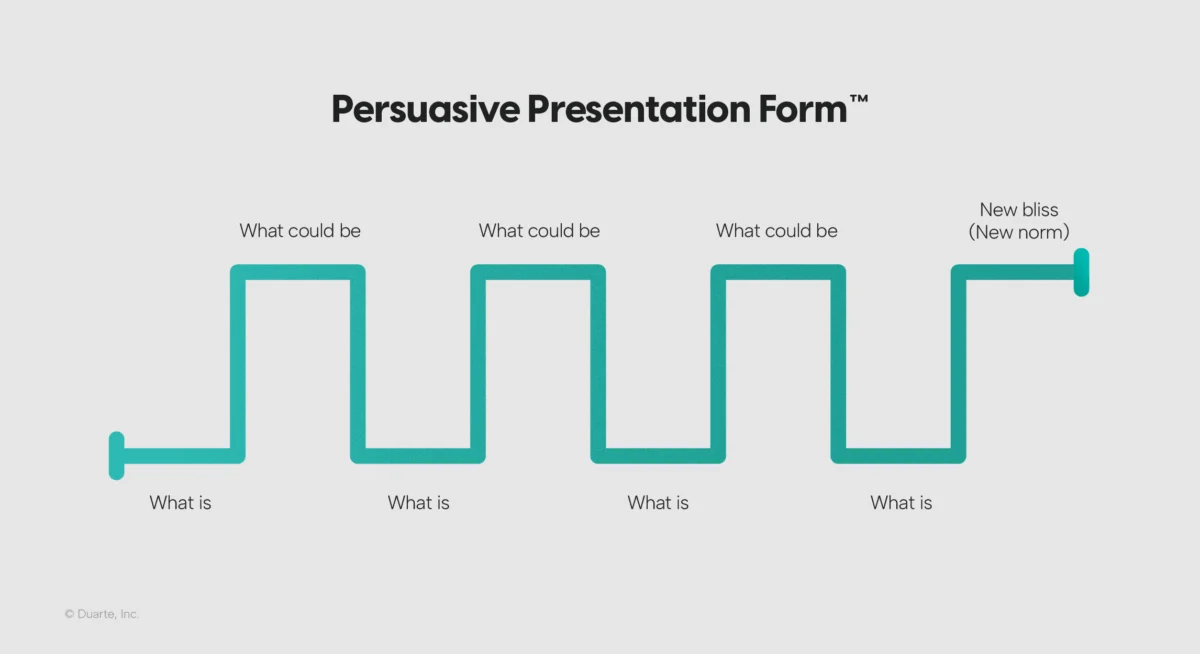
- The Classic Report: This structure predominantly focuses on "what is"—the current state of affairs, detailing existing problems, successes, and challenges. A recommendation for "what could be" is often relegated to the very end, resulting in a largely flat, descriptive narrative. Industry data indicates that presentations adhering solely to this linear, descriptive model often lead to decreased audience retention and decision paralysis due to a lack of emotional urgency.
- The Classic Pitch: This model typically opens with a brief nod to "what is" before spending the majority of the time extolling the virtues of "what could be"—a future state made possible by adopting the proposed idea, product, or service. While aspirational, this can sometimes feel overly optimistic or "too good to be true," lacking the grounding in current reality that builds trust.
Neither of these linear approaches optimally leverages the power of contrast. The Presentation Sparkline™ framework, or Persuasive Presentation Form™, developed by Nancy Duarte, offers a superior model. This dynamic structure constantly alternates between depicting "what is" (the current reality, with its problems and limitations) and "what could be" (the desirable future state, enabled by your solution). This rhythmic oscillation between reality and aspiration creates a compelling tension that keeps the audience actively engaged, intellectually stimulated, and emotionally invested. Nancy Duarte’s analysis of iconic speeches, such as Steve Jobs’ 2007 iPhone launch and Dr. Martin Luther King, Jr.’s "I Have a Dream" speech, reveals that both masterfully employed the Sparkline framework, demonstrating its universal power to persuade and inspire change. This constant interplay of current pain and future potential is what drives an audience to action.
5. Crafting Unforgettable S.T.A.R. Moments™
While a strong narrative structure is essential, truly memorable presentations are punctuated by S.T.A.R. Moments™—"Something They’ll Always Remember." These are specific, impactful instances designed to cut through information overload and etch themselves into the audience’s long-term memory. The human brain struggles to retain vast quantities of undifferentiated data, but it excels at recalling distinct, emotionally charged moments.
A quintessential example of a S.T.A.R. Moment™ comes from Al Gore’s presentation on climate change, which formed the basis of his Academy Award-winning documentary, An Inconvenient Truth. Faced with the challenge of communicating the alarming projected rise in CO2 concentration over the next half-century, Gore collaborated with Duarte to create a visual metaphor that transcended mere data points. Instead of simply displaying a graph, Gore stood beside a massive, multi-story chart, and as the projected CO2 levels soared beyond the conventional graph’s limits, he physically ascended a lift alongside the rising data line. This dramatic, immersive experience transformed abstract numbers into a tangible, visceral representation of impending crisis, creating an indelible memory for the audience and powerfully conveying the urgency of his message. Such moments are not just visual aids; they are carefully engineered experiences that deepen understanding and foster emotional resonance, making the data unforgettable.
6. Integrating Compelling Data Storytelling

One of the significant hurdles in adopting storytelling for business presentations is effectively communicating complex data in an engaging and meaningful way. Raw data, in isolation, lacks inherent meaning or emotional impact. It requires the presenter to provide context, interpretation, and narrative to transform it into actionable insight. Data storytelling involves three primary strategies: marveling at the magnitude, humanizing the data, and surprising the audience with the unexpected.
- Marveling at the Magnitude: This involves presenting data in a way that emphasizes its sheer scale or significance, often through relatable comparisons or analogies. For example, instead of stating a budget figure, compare it to something tangible like "enough to build X number of schools."
- Humanizing the Data: This strategy connects abstract numbers to real-world impacts on individuals or communities. Instead of reporting "a 15% increase in customer satisfaction," share a brief anecdote about how this translates to a specific customer’s positive experience.
- Surprising the Audience with the Unexpected: This is arguably the most powerful technique. It involves presenting data or an insight in a manner that defies expectations, creating a moment of cognitive dissonance that captures attention and enhances recall.
A classic illustration of surprising the audience comes from Steve Jobs’ 2008 reveal of the MacBook Air. Rather than simply stating the laptop’s slimmest point was 0.76 inches—a number that might not immediately resonate—Jobs dramatically slid the device out of a standard manila office envelope. This simple, unexpected action provided an instant, universally understood unit of measurement, shocking the audience with the device’s unprecedented thinness and making a dry technical specification an unforgettable, tangible marvel. This approach effectively translates quantitative information into a qualitative, emotional experience, ensuring the data is not just heard, but truly understood and appreciated.
7. Concluding with a Vision of "New Bliss"
Every effective story culminates in an ending, and in business storytelling, this conclusion is not merely a summary but a powerful vision of "new bliss." This "happily ever after" is not a fantastical fairytale but a tangible, achievable future state that directly addresses the hero’s (audience’s) challenges. It’s the compelling picture of what life or business will be like once the proposed solution is adopted and the mentor’s guidance is followed.
The "new bliss" serves as the ultimate motivator, providing the audience with a clear, desirable destination for their journey. It’s where their problems are resolved, their aspirations realized, and their lives or operations are significantly improved. This concluding vision must be credible and grounded in the real solutions that you, as the mentor, have presented. It reinforces the value proposition and provides a powerful call to action, inspiring the audience to embrace the proposed change and move forward with confidence. By articulating a clear, positive future, presenters empower their audience to envision and actively pursue the benefits of their solutions, cementing the persuasive impact of the entire narrative.
The Broader Impact of Business Storytelling
The mastery of business storytelling transcends individual presentation skills; it is a fundamental driver of organizational success. In today’s dynamic global marketplace, the ability to articulate a clear, compelling narrative is critical for every aspect of an enterprise, from product development and marketing to internal communications and investor relations. Every successful deal closure, every instance of team alignment, and every smoothly implemented change initiative can be traced back to someone telling the right story, in the right way, at the opportune moment.
Corporate storytelling shapes brand identity, fosters internal culture, and guides strategic direction. Organizations that integrate narrative principles into their communication frameworks report enhanced employee engagement, stronger customer loyalty, and improved market positioning. For example, companies that consistently communicate their mission and values through compelling stories often experience higher employee retention rates and a more unified corporate vision. In an increasingly competitive landscape, a powerful corporate story can differentiate a brand, attract top talent, and build enduring relationships with stakeholders.
Developing this vital muscle, whether for individual leaders or entire teams, is an investment in future success. Training programs focused on "Storytelling for Business Presentations" offer structured methodologies to hone these skills, transforming presenters from mere information providers into inspiring catalysts for change. Whether through tailored training or expert crafting of key presentations, embracing the art of storytelling is the definitive pathway to unlocking unprecedented levels of audience engagement, organizational alignment, and sustained growth.
