

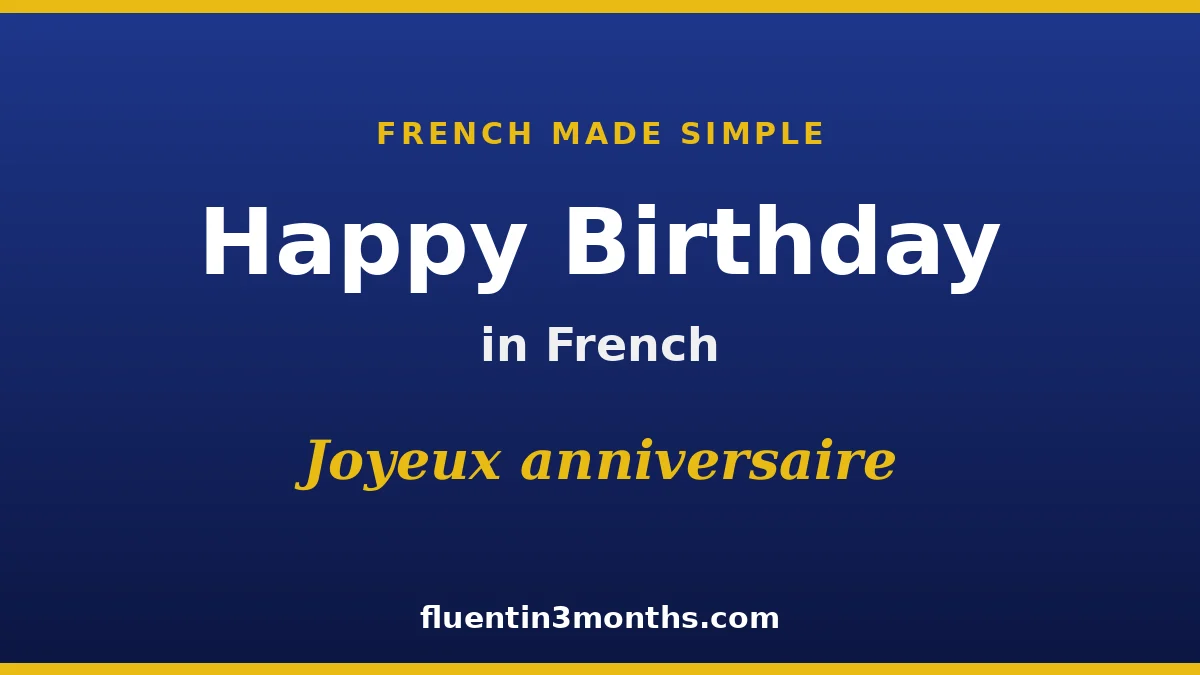
The linguistic landscape of the Francophone world offers a complex tapestry of social etiquette, regional dialects, and historical influences, particularly visible in the seemingly simple act of wishing someone a happy birthday. While the English language relies heavily on a singular, standardized phrase, the French language employs a variety of expressions that vary based on geography, level of formality, and the specific nature of the relationship between the interlocutors. The primary phrases, Joyeux anniversaire and Bon anniversaire, serve as the foundation of these greetings, yet their application is governed by nuanced rules of phonetics and social protocol that reflect broader trends in French culture and linguistics.
The Linguistic Foundation of French Birthday Greetings
In standard French, the most widely recognized greeting is Joyeux anniversaire, a phrase that combines the adjective joyeux (joyful) with the masculine noun anniversaire (anniversary/birthday). Etymologically, anniversaire is derived from the Latin anniversarius, which signifies the annual return of a specific date. Unlike the English word "birthday," which specifically highlights the act of birth, the French term emphasizes the cyclical nature of the event.
A secondary, equally prevalent option is Bon anniversaire, where the adjective bon (good) replaces joyeux. According to linguistic experts, there is no inherent difference in the level of formality between these two expressions. Instead, the choice often rests on personal preference or the phonetic flow of the sentence. In both instances, the phrases are subject to the linguistic phenomenon known as liaison. When pronouncing Joyeux anniversaire, the normally silent final "x" of joyeux is articulated as a /z/ sound to bridge the gap with the following vowel, resulting in /ʒwa.jø.za.ni.vɛʁ.sɛʁ/. Similarly, in Bon anniversaire, the final "n" of bon links to the initial "a" of anniversaire, causing the vowel in bon to lose its nasal quality and transition into a clear /n/ sound.
Regional Variations and the Quebec Distinction
One of the most significant divides in French birthday greetings is found between European French and Canadian French, specifically within the province of Quebec. While Joyeux anniversaire is understood globally, the Office québécois de la langue française (OQLF) notes that Bonne fête is the standard and preferred greeting in North American French contexts.
In France and other European Francophone nations, Bonne fête is traditionally reserved for a person’s "Name Day" or "Saint’s Day." This custom involves celebrating the feast day of the saint for whom a person is named, as dictated by the Roman Catholic calendar. Historically, the Name Day was often considered more significant than the actual date of birth in many French households. In modern, more secular French society, the importance of Name Days has waned, yet the distinction remains linguistically vital. Using Bonne fête to wish someone a happy birthday in Paris may lead to confusion, as the recipient might assume the speaker is referring to their patron saint rather than their birth date. Conversely, in Quebec, the phrase is the ubiquitous standard for birthdays, reflecting a localized evolution of the language that deviates from Hexagonal (French) norms.
Historical and Musical Context of Birthday Traditions
The cultural rituals surrounding birthdays in France have been influenced by both internal traditions and external Anglo-American exports. The globally recognized melody of "Happy Birthday to You" is frequently used in France, with the lyrics translated directly as "Joyeux anniversaire, joyeux anniversaire, joyeux anniversaire [Name], joyeux anniversaire."
However, France also possesses a unique musical heritage regarding this celebration. In 1951, the song "Bon anniversaire" was composed by Louiguy with lyrics by Jacques Larue for the film Au fil des ondes. Performed by André Claveau, this song became a staple of French culture in the mid-20th century. Unlike the translated English version, this song features a distinct melody and more elaborate lyrics, such as "Nos vœux les plus sincères" (Our most sincere wishes). While less common among younger generations who favor the shorter, international tune, the Claveau version remains a significant cultural touchstone for older demographics and formal gatherings.
Social Etiquette and Formal vs. Informal Usage
The French language’s inherent distinction between the informal tu and the formal vous plays a critical role in how birthday wishes are delivered. This grammatical choice is dictated by the relationship between the speakers, their relative ages, and the professional or social setting.
In casual environments, particularly among younger speakers or via digital communication such as SMS and social media, the term anniversaire is frequently truncated to anniv. This follows a broader linguistic trend in French known as apocope, where the end of a word is deleted to create a shorter, more colloquial version. Common examples include "Bon anniv !" or "Joyeux anniv !" While these are acceptable among peers, they are strictly avoided in professional correspondence or when addressing elders.
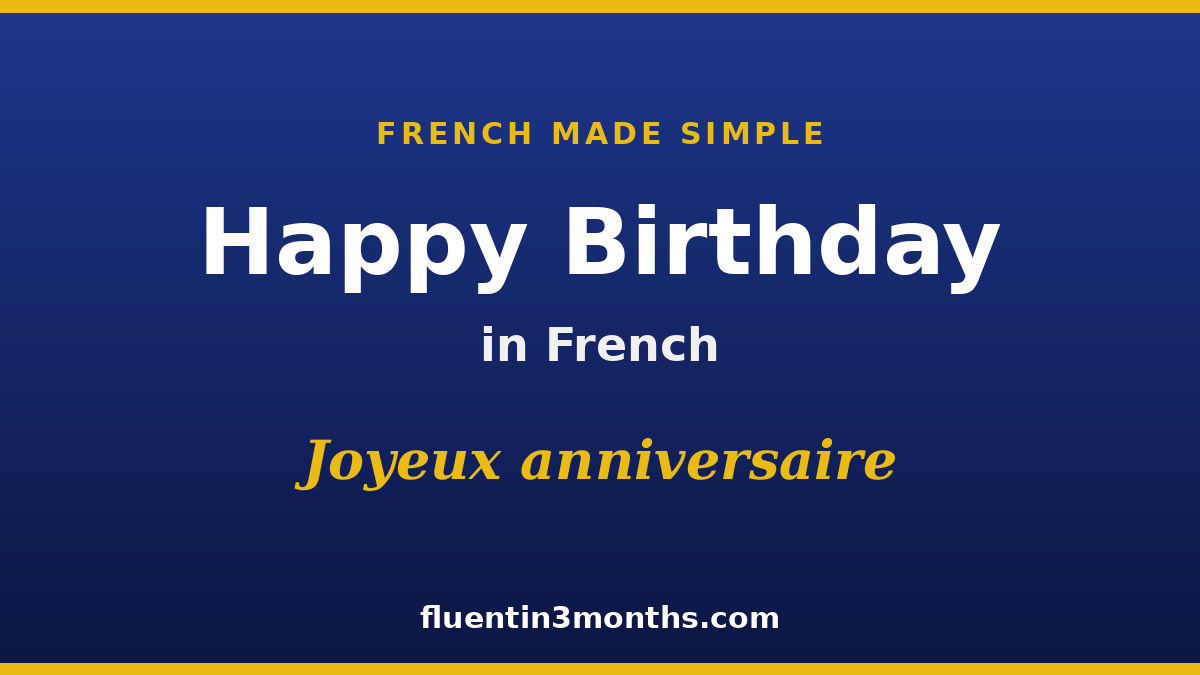
For more formal or sentimental occasions, the language expands to include sophisticated well-wishes. Phrases such as "Je te souhaite un très joyeux anniversaire" (I wish you a very happy birthday) or "Que tous tes souhaits se réalisent" (May all your wishes come true) are common in written cards. In professional settings, "Meilleurs vœux" (Best wishes) is often employed to maintain a respectful distance while still acknowledging the occasion.
Workplace Dynamics and French Customs
Birthday customs in France often differ from those in the United Kingdom or the United States, particularly regarding the "birthday cake" protocol. In many French workplaces and schools, the onus is on the person celebrating the birthday to provide the treats. This practice, known as bringing le gâteau, is seen as a way for the individual to thank their colleagues or friends for their companionship.
Furthermore, the physical greeting associated with a birthday wish can vary. While la bise (the traditional cheek kiss) is common among friends and family, the number of kisses depends heavily on the region of France—ranging from two in Paris to four in parts of the north and south. In a professional context, a handshake remains the standard, though the "birthday hug" is increasingly common in urban centers influenced by international customs.
A notable cultural nuance is the superstition regarding "early wishes." In certain French circles, wishing someone a happy birthday before the actual date is considered bad luck (porter la poisse). While this sentiment is not universal, it is prevalent enough that many French speakers will wait until the day of the event or even a day after to deliver their greetings, rather than risk offending the recipient with premature well-wishes.
Statistical Overview of the Francophone World
The importance of understanding these linguistic nuances is underscored by the growth of the French language globally. According to data from the Organisation Internationale de la Francophonie (OIF), there are approximately 321 million French speakers worldwide as of 2022. French is the fifth most spoken language globally and the fourth most used on the internet.
| Region | Primary Birthday Greeting | Context |
|---|---|---|
| France / Europe | Joyeux anniversaire | Standard |
| Quebec / Canada | Bonne fête | Standard |
| North Africa (Maghreb) | Joyeux anniversaire | Often used alongside Arabic |
| West Africa | Joyeux anniversaire | Standard in formal/educational settings |
As the number of French speakers is projected to reach over 700 million by 2050—largely due to demographic growth in Africa—the standardization of greetings like Joyeux anniversaire serves as a vital tool for international communication, even as regional variations like Quebec’s Bonne fête persist.
Broader Implications and Linguistic Evolution
The evolution of French birthday greetings reflects the ongoing tension between linguistic preservation and modernization. The Académie Française, the preeminent body on French language matters, generally promotes the use of full, traditional forms. However, the rise of "Textspeak" and the influence of English-language social media have accelerated the adoption of informal versions like anniv and the use of the English "Happy Birthday" in certain metropolitan subcultures.
Analysis suggests that the resilience of phrases like Joyeux anniversaire lies in their rhythmic simplicity and their ability to accommodate the phonetic rules of the language, such as the liaison. Furthermore, the persistence of the Name Day (Bonne fête) tradition in France, even in a diminished capacity, highlights the deep historical roots of French social customs that continue to inform modern linguistic choices.
For students of the language and professionals operating in Francophone environments, mastering these distinctions is more than an exercise in vocabulary; it is an essential component of cultural literacy. Whether navigating the office dynamics of a Parisian firm or attending a family gathering in Montreal, the choice of a birthday greeting serves as a subtle but powerful indicator of one’s respect for local tradition and linguistic precision. As the Francophone world continues to expand and diversify, these "sincere wishes" remain a universal bridge across cultures.
