

The Spanish verb saber represents one of the most significant linguistic hurdles for students of the Romance languages, functioning as a high-frequency pillar of communication while simultaneously exhibiting complex morphological irregularities. While the infinitive translates generally to "to know" in English, its application in Spanish is governed by strict rules of syntax and semantics that distinguish it from its counterpart, conocer. Understanding saber requires more than rote memorization; it necessitates an appreciation of how tense affects meaning and how historical Latin roots have shaped its modern, often unpredictable, forms.
The Functional Significance of Saber in Modern Spanish
In the hierarchy of Spanish verbs, saber consistently ranks within the top 20 most frequently used terms, according to data from the Corpus de Referencia del Español Actual (CREA). This frequency is attributed to its multi-functional role: it expresses the possession of factual information, the awareness of specific data points, and the mastery of skills or "know-how."
Linguists categorize saber as a verb of "cognitive state." Unlike action verbs such as correr (to run) or comer (to eat), saber describes a mental condition. However, this condition is not static. A unique feature of the Spanish language is how the aspect of a verb—whether an action is viewed as a completed event or an ongoing state—can fundamentally alter its definition. This is most evident in the preterite tense, where "yo supe" transitions from the state of "knowing" to the event of "finding out."
Historical Etymology and the Evolution of Irregularity
The irregularities of saber are not arbitrary but are the result of centuries of phonetic evolution from Latin to Castilian Spanish. The verb originates from the Latin "sapere," which originally meant "to taste" or "to have flavor." Over time, the meaning shifted metaphorically to "to have discernment" or "to be wise"—a transition that is still visible in the English word "sapient."
The most jarring irregularity for learners is the first-person singular present indicative form, "sé." This form underwent a radical shortening from the Latin "sapio." Similarly, the shift to "sup-" in the preterite and "sep-" in the subjunctive reflects historical vowel shifts and consonant clusters that were simplified as the language moved toward modern Spanish. For example, the future stem "sabr-" is the result of "syncope," the loss of the interior vowel "e" from the original "saberé," a common occurrence in high-frequency Spanish verbs like "haber" (habré) and "poder" (podré).
Strategic Prioritization for Language Acquisition
Educational experts in second-language acquisition (SLA) suggest that learners should not approach the seventeen Spanish tenses with equal weight. Instead, a "high-utility" approach focuses on the forms that appear most frequently in daily discourse.
The present indicative remains the most critical set for immediate communication. It allows speakers to declare knowledge, ask for information, and describe abilities.
Table 1: Present Indicative of Saber
| Pronoun | Conjugation | English Translation |
|---|---|---|
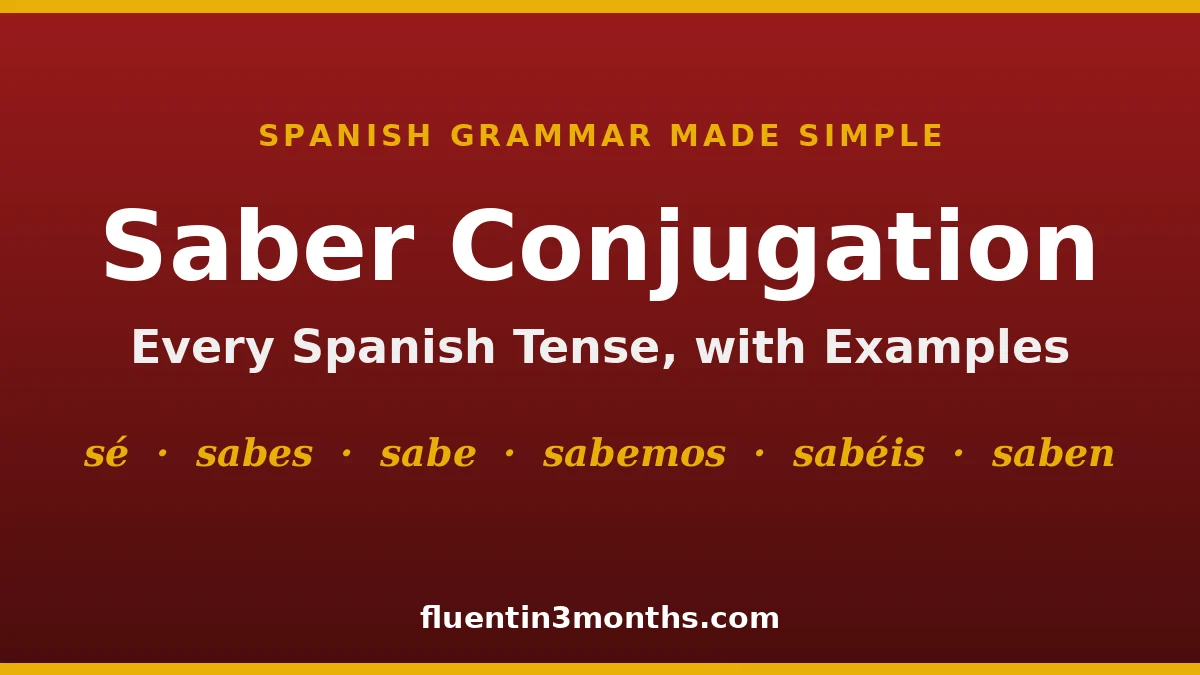
| Yo | sé | I know |
| Tú | sabes | You know (informal) |
| Él / Ella / Usted | sabe | He / She / You (formal) know |
| Nosotros / Nosotras | sabemos | We know |
| Vosotros / Vosotras | sabéis | You all know (Spain) |
| Ellos / Ellas / Ustedes | saben | They / You all know |
Beyond the present tense, the "found out" vs. "knew" distinction in the past tenses represents a critical milestone in Spanish proficiency. In pedagogical settings, this is often referred to as the "aspectual shift." When a speaker uses the imperfect "sabía," they are describing a background state of knowledge. When they use the preterite "supe," they are identifying the specific moment of discovery.
The Saber-Conocer Dichotomy: An Analytical Comparison
A primary source of error for English speakers is the existence of two distinct verbs for "to know." While English uses a single term, Spanish divides the concept of knowledge into two categories: factual/procedural knowledge (saber) and experiential/acquaintance knowledge (conocer).
- Saber (Factual Knowledge): Used for facts, pieces of information, and skills. For example, "Sé la dirección" (I know the address) or "Sé cocinar" (I know how to cook).
- Conocer (Familiarity): Used for people, places, and complex entities that one has "met" or "visited." For example, "Conozco a María" (I know María) or "Conozco París" (I am familiar with Paris).
Linguistic analysis suggests that saber is "digital"—it is binary; you either know a fact or you do not. Conocer is "analog"—it implies a degree of familiarity that can grow or fade over time. Mixing these verbs is a common marker of non-native speech, as saying "Conozco la respuesta" would personify the answer, suggesting a social relationship with a fact rather than a mental grasp of it.
Comprehensive Conjugation: Indicative and Subjunctive Moods
For professional and academic writing, a mastery of the full conjugation suite is required. The following tables outline the simple and compound tenses, reflecting the irregular stems "sup-", "sep-", and "sabr-".
Table 2: Simple Indicative Tenses
| Pronoun | Preterite | Imperfect | Future | Conditional |
|---|---|---|---|---|
| Yo | supe | sabía | sabré | sabría |
| Tú | supiste | sabías | sabrás | sabrías |
| Él/Ella/Ud. | supo | sabía | sabrá | sabría |
| Nosotros | supimos | sabíamos | sabremos | sabríamos |
| Vosotros | supisteis | sabíais | sabréis | sabríais |
| Ellos/Uds. | supieron | sabían | sabrán | sabrían |
Table 3: The Subjunctive Mood
The subjunctive is utilized to express doubt, uncertainty, or emotional reactions to known or unknown facts. Because saber often deals with certainty, its use in the subjunctive is frequently triggered by negation (e.g., "No creo que él lo sepa" — I don’t believe he knows it).
| Pronoun | Present Subjunctive | Imperfect Subjunctive (ra) |
|---|---|---|
| Yo | sepa | supiera |
| Tú | sepas | supieras |
| Él/Ella/Ud. | sepa | supiera |
| Nosotros | sepamos | supiéramos |
| Vosotros | sepáis | supierais |
| Ellos/Uds. | sepan | supieran |
Compound Tenses and the Role of the Past Participle
The compound tenses of saber are formed using the auxiliary verb "haber" and the past participle "sabido." Unlike the simple tenses, these are relatively regular once the speaker has mastered the conjugation of "haber."
- Present Perfect: He sabido (I have known)
- Pluperfect: Había sabido (I had known)
- Future Perfect: Habré sabido (I will have known)
Data from linguistic frequency studies indicates that the Present Perfect is increasingly common in Peninsular Spanish (Spain) to describe recent events, whereas in many Latin American dialects, the simple preterite "supe" is preferred for the same context.
Broader Implications for Learners and Global Communication
The complexity of saber serves as a microcosm for the broader challenges of Spanish grammar. The verb’s transition from a physical sensation (tasting) in Latin to a cognitive function (knowing) in Spanish mirrors the cognitive development of the language itself. For the global community of nearly 500 million native Spanish speakers, the nuances of saber allow for a precision of expression regarding the origins and nature of knowledge that English often lacks.
From a practical standpoint, the incorrect use of saber can lead to professional misunderstandings. In legal or medical contexts, the distinction between "knowing a fact" (saber) and "being familiar with a person" (conocer) is vital for clarity and accuracy. Furthermore, the imperative "sepa" (know/let it be known) is a staple of formal documentation and public notices.
Conclusion and Future Outlook
As Spanish continues to grow as a global lingua franca, the pedagogical methods for teaching irregular verbs like saber are evolving. Modern approaches emphasize "lexical chunks"—learning phrases like "no lo sé" (I don’t know) or "que yo sepa" (as far as I know) as single units rather than analyzing the grammar behind them. This mimics the way native speakers acquire the language, prioritizing functional fluency over theoretical perfection.
Ultimately, saber is more than a vocabulary word; it is a versatile tool for navigating the world. Whether used to describe the moment a secret was revealed or the lifelong mastery of a craft, its irregular forms carry the weight of history and the precision of a highly evolved linguistic system. For the dedicated learner, conquering saber is not merely an academic exercise but a gateway to deeper cultural and intellectual integration within the Spanish-speaking world.
