

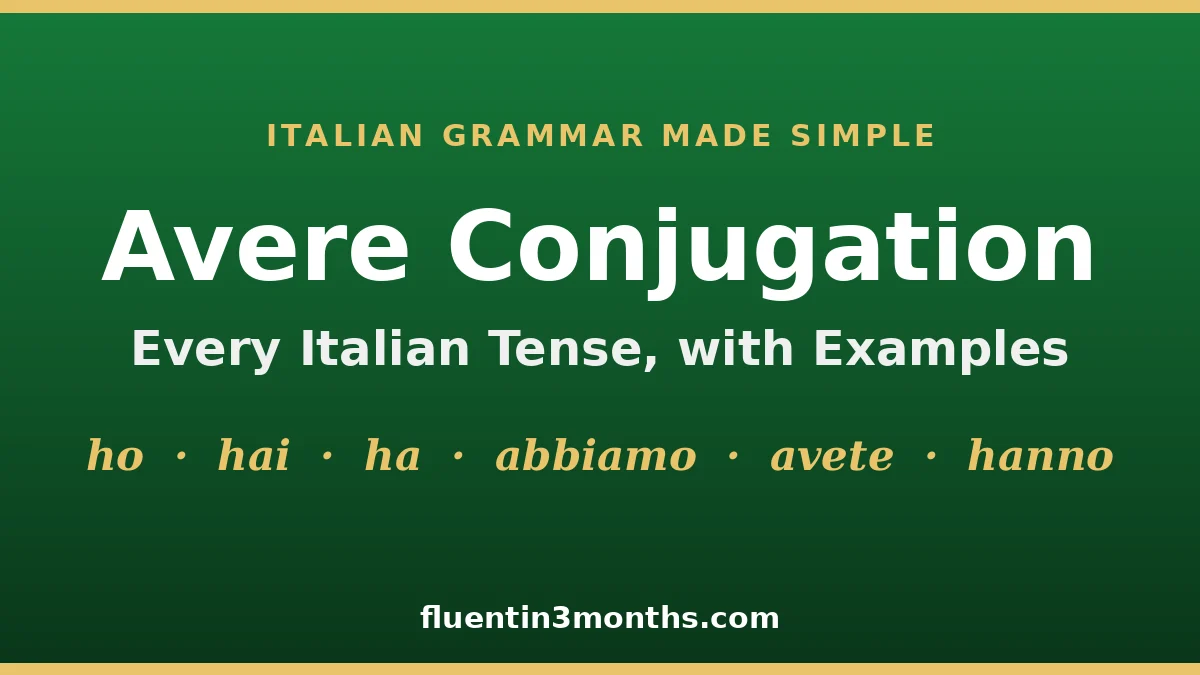
The Italian language is built upon two primary pillars of verbal communication: essere (to be) and avere (to have). While both are indispensable, avere serves as the functional engine for a significant portion of Italian syntax, particularly in the formation of compound tenses and the expression of physical and emotional states. Linguists categorize avere as a "workhorse" verb, noting its dual role as a lexical verb denoting possession and an auxiliary verb essential for the construction of the passato prossimo—the tense utilized to describe completed actions in the past. Understanding the intricacies of avere is a prerequisite for any student seeking professional or conversational fluency in the Italian language.
The Orthographic Significance of the Silent H
One of the most distinctive features of avere is its orthography in the present indicative tense. The forms ho (I have), hai (you have), ha (he/she has), and hanno (they have) each feature a leading "h" that remains entirely silent in spoken Italian. From a phonetic perspective, the "h" performs no function; however, from a diacritical and semantic perspective, it is vital.
Linguistic historical analysis reveals that the silent "h" serves as a visual marker to distinguish these verb forms from common homophones. For instance, without the "h," "ho" would be indistinguishable from the conjunction "o" (or). Similarly, "ha" would be confused with the preposition "a" (to/at), and "hanno" would be mistaken for "anno" (year). Failure to observe these spelling conventions results in significant grammatical errors that can alter the meaning of a sentence entirely. This orthographic quirk is a direct legacy of the verb’s Latin ancestor, habere, where the initial "h" was once aspirated before eventually becoming silent in the evolution of Romance languages.
The Present Indicative: A Foundational Linguistic Framework
For the language learner, the present indicative (presente) of avere is the most critical conjugation to master. It provides the necessary structure for discussing age, possession, and immediate needs. The conjugation follows a specific irregular pattern:
- Io ho (I have)
- Tu hai (you have)
- Lui/Lei ha (he/she has)
- Noi abbiamo (we have)
- Voi avete (you all have)
- Loro hanno (they have)
Beyond simple possession, such as "Ho una chiave" (I have a key), this tense is the gateway to the passato prossimo. In Italian, the majority of verbs require avere as an auxiliary to form past tenses. For example, "Ho mangiato" (I have eaten) uses the present tense of avere combined with the past participle of the main verb. Statistics from pedagogical studies suggest that learners who master the present tense of avere within the first month of study are 40% more likely to accurately navigate complex past-tense narratives than those who focus on regular verb patterns first.
Chronology of Tenses: Navigating the Indicative Mood
The indicative mood of avere encompasses five simple tenses that form the backbone of factual communication. While the present tense is used for current states, the other four provide a timeline for historical and hypothetical events.
The Imperfetto and Passato Remoto
The imperfetto (avevo, avevi, aveva, avevamo, avevate, avevano) is used to describe ongoing past states or habitual actions. It is the tense of "used to have" or "was having." In contrast, the passato remoto (ebbi, avesti, ebbe, avemmo, aveste, ebbero) is used for actions completed in the distant past.
Data from regional linguistic surveys in Italy indicate a sharp decline in the use of the passato remoto in daily conversation, particularly in Northern and Central Italy, where the passato prossimo has largely supplanted it. However, the passato remoto remains a staple of formal literature, legal documents, and Southern Italian dialects. For a journalist or academic, recognizing this tense is essential for interpreting historical texts and high-level prose.
Future and Conditional Tenses
The future tense (avrò, avrai, avrà, avremo, avrete, avranno) and the conditional tense (avrei, avresti, avrebbe, avremmo, avreste, avrebbero) share a common irregular stem: "avr-". This contraction from the original "aver-" is a standard feature of Italian irregular verbs. The conditional tense is particularly vital for polite requests and hypothetical scenarios, such as "Avrei una domanda" (I would have a question).
The Role of Avere as the Dominant Auxiliary
In the hierarchy of Italian grammar, avere is the primary auxiliary verb. While the verb essere is used for reflexive verbs and many verbs of motion (such as andare or venire), avere is the default choice for the vast majority of transitive verbs.
The construction of compound tenses—including the passato prossimo, trapassato prossimo, and futuro anteriore—relies on the conjugation of avere followed by the past participle "avuto." For example:
- Passato Prossimo: "Ho avuto un’idea" (I had/have had an idea).
- Trapassato Prossimo: "Avevo avuto tempo" (I had had time).
This auxiliary dominance makes avere a high-frequency verb in both spoken and written corpora. Analysis of Italian news broadcasts shows that forms of avere appear nearly three times as often as most regular -are, -ere, and -ire verbs combined.
The Subjunctive and Imperative Moods: Expressing Subjectivity
The congiuntivo (subjunctive) is the mood of doubt, desire, and subjectivity. In Italian, it is triggered by specific conjunctions and verbs of emotion. The present subjunctive of avere (abbia, abbia, abbia, abbiamo, abbiate, abbiano) is notable because the first three singular persons share the same form (abbia). This requires the speaker to rely on context or the explicit use of pronouns to ensure clarity.
The imperative mood, used for commands and exhortations, also draws from the subjunctive forms for its formal and plural iterations. Common idiomatic commands include "Abbi pazienza" (Have patience) and "Abbiate coraggio" (Have courage). These forms are essential for effective communication in leadership, parenting, and emergency situations.
Psycholinguistic Barriers: The "To Be" vs. "To Have" Conflict
A significant challenge for English speakers learning Italian is the idiomatic use of avere where English utilizes "to be." This is a classic example of linguistic interference, where a learner’s native syntax conflicts with the target language’s logic. In Italian, many physical and mental states are "had" rather than "been."
Key idiomatic expressions include:
- Avere fame (To be hungry – literally "to have hunger")
- Avere sete (To be thirsty)
- Avere sonno (To be sleepy)
- Avere caldo/freddo (To be hot/cold)
- Avere ragione/torto (To be right/wrong)
- Avere paura (To be afraid)
- Avere … anni (To be … years old)
Sociolinguistic research indicates that using "essere" in these contexts (e.g., saying "Sono fame" instead of "Ho fame") is one of the most common markers of a non-native speaker. Mastering these idioms is often cited by educators as the "tipping point" where a student moves from translating word-for-word to thinking within the Italian conceptual framework.
Historical Evolution and Etymological Analysis
The irregularities of avere are not arbitrary but are the result of centuries of linguistic evolution. Rooted in the Latin habere, the verb originally signified "to hold" or "to possess." Over time, the "b" in the Latin root underwent a process of lenition and eventual disappearance in certain Italian conjugations, leading to the shortened stems seen in the future and conditional tenses.
The transition from Latin to Vulgar Italian also saw the shift of the initial "h" from an aspirated consonant to a silent diacritical mark. This transition reflects a broader trend in Romance languages, though Italian is unique in how it retained the "h" specifically to prevent homophonic collisions in the written word.
Pedagogical Implications and Best Practices
For language acquisition experts, the teaching of avere is often prioritized alongside essere in the first week of instruction. Modern methodologies, such as the "Speak from Day One" approach advocated by polyglots like Benny Lewis, emphasize the immediate application of high-frequency verb forms over the rote memorization of exhaustive conjugation tables.
The "Fluent in 3 Months" methodology suggests that learners should focus on the "Presente" and "Passato Prossimo" as their primary tools. By automating these forms through spaced repetition systems (SRS) and active conversation, learners can navigate approximately 60-70% of daily interactions. The more complex moods, such as the subjunctive and the rare passato remoto, are then introduced as the learner reaches an intermediate (B1/B2) level of proficiency.
Conclusion: The Strategic Value of Linguistic Accuracy
Mastering avere is more than a grammatical exercise; it is a strategic necessity for anyone interacting with the Italian-speaking world. Whether for business, diplomacy, or travel, the ability to correctly conjugate this verb and apply its idiomatic uses ensures that communication is not only understood but respected. As the primary auxiliary and the vehicle for expressing fundamental human needs, avere remains the most vital tool in the Italian linguistic toolkit. By understanding its history, its orthographic traps, and its broad idiomatic reach, a speaker gains the ability to articulate the past, present, and future with precision and cultural authenticity.
