

The concept of business storytelling has transcended buzzword status to become a foundational pillar of effective leadership and communication in the modern corporate landscape. In an era saturated with information, the ability to distil complex data, strategic initiatives, or innovative ideas into a compelling narrative is not merely an advantage; it is a critical skill that distinguishes successful leaders. Those who master the art of shaping information into a resonant story are consistently observed to be more effective at closing deals, securing crucial budget approvals, and guiding their teams through significant organizational change. This strategic approach to communication moves beyond mere recitation of facts, transforming presentations into engaging experiences that captivate audiences and inspire decisive action.
A storytelling presentation fundamentally reframes information, shifting from a flat enumeration of facts to a dynamic narrative arc. This method leverages time-tested psychological principles to communicate ideas in a manner that deeply engages listeners and propels them towards desired outcomes. The efficacy of this approach is supported by extensive research in cognitive science, which indicates that information presented in narrative form is significantly more memorable and persuasive than raw data alone. Humans are intrinsically wired for stories; they activate more parts of the brain, including those associated with emotion and personal experience, making the message more impactful and easier to retain. This article delves into seven illustrative examples and techniques that can empower professionals to seamlessly integrate powerful storytelling into their next business presentation.
The Foundational Structure: Harnessing the Hero’s Journey
At the core of any compelling narrative lies a discernible structure, and perhaps none is more universally recognized or psychologically resonant than the Hero’s Journey. Originating from ancient myths and meticulously cataloged by Joseph Campbell in "The Hero with a Thousand Faces," this archetypal narrative pattern translates remarkably well into a business context. The basic progression involves a protagonist who embarks on an adventure, confronts a significant challenge, and is ultimately transformed through trials and the guidance of a mentor, returning with a newfound wisdom or solution.
In the realm of business presentations, establishing this clear narrative structure is paramount. A truly effective storytelling presentation must possess a distinct beginning, a developing middle, and a conclusive end. This structure isn’t merely about chronological order; it’s about establishing a dramatic arc. The "beginning" sets the stage, introducing the current state or problem (the hero’s ordinary world and call to adventure). The "middle" details the obstacles, challenges, and the introduction of a solution or guidance (the trials, allies, and the mentor’s arrival). Finally, the "end" envisions the successful resolution and the positive future state (the return with the elixir and the new bliss). Crucially, there must be a defined moment when the "hero" – which, as we will explore, is the audience – confronts their problem, a pivotal point where the "mentor" – the presenter – offers a solution, and a clear vision of the "happily ever after" for the audience to aspire to. Achieving this requires a precise understanding of who embodies the hero and who assumes the role of the mentor within the presentation’s narrative.
Audience as Protagonist: Shifting the Spotlight to the Hero
A common pitfall in business presentations is the presenter inadvertently casting themselves or their company as the hero. This manifests as lengthy discourses on corporate history, impressive client rosters, or a litany of accolades. While such details might build credibility, they often fail to truly engage the audience because the focus remains internal to the presenter. Research consistently shows that audiences are most engaged when they see themselves reflected in the narrative, when the story speaks directly to their needs, challenges, and aspirations.

The most impactful storytelling presentations consciously position the audience as the hero. This strategic choice is grounded in a deep understanding of human psychology: people are inherently more interested in their own problems and potential solutions than in someone else’s achievements. The audience is the entity facing a challenge, grappling with an issue, or seeking a path forward. Therefore, they are the ones who require guidance, who need a "mentor" to navigate the complex journey towards a better future. By making the audience the hero, the presenter cultivates empathy and relevance, demonstrating a clear understanding of the audience’s predicament and offering a pathway to their desired "happily ever after." This approach builds trust and rapport far more effectively than self-promotion, as it shifts the narrative from "look how great we are" to "let us help you become great."
The Presenter’s Indispensable Role: Guiding as the Mentor
Following the principle of the audience as the hero, the presenter naturally assumes the role of the mentor. Experienced presentation storytellers consistently demonstrate this approach, eschewing the spotlight for themselves in favor of empowering their audience. Their objective is not personal glory but to furnish the audience with the necessary tools, insights, and solutions to overcome their challenges. This mentor role is characterized by guidance, support, and a focus on problem-solving rather than self-aggrandizement.
Consider the example of a presentation aimed at selling a meal kit delivery service. A "hero" presenter might adopt a boastful tone: "We are unequivocally the best in the business. Our ingredients are unparalleled in freshness, our menu is the most creative, and we proudly boast over 1,000 five-star reviews validating our superiority." This statement, while perhaps factually accurate, centers entirely on the company’s attributes, neglecting the customer’s perspective. It offers no insight into the problems the customer might be experiencing.
In stark contrast, a "mentor" presenter would frame the offering from the audience’s viewpoint: "One of the most profound dilemmas many parents face today is the constant tension between dedicating quality time to their children and the equally demanding task of preparing fresh, nutritious home-cooked meals. But imagine a scenario where a trusted ally could step in, effectively halving the time you spend in the kitchen each week. Our meal kit delivery service is precisely that solution. By delivering fresh, meticulously pre-portioned ingredients directly to your doorstep, we empower the average family to reclaim approximately five precious hours weekly. This means no longer having to choose between cherished moments with your children and providing them with wholesome food. We enable you to embrace both."
This latter approach is fundamentally different. By positioning the audience’s struggle as the central problem, the presenter establishes an immediate connection and credibility. It frees the presenter to focus on the tangible benefits and solutions their product or service provides, directly addressing the audience’s pain points. This empathetic framing is far more persuasive, as it demonstrates understanding and offers a clear path to improvement, solidifying the presenter’s role as a helpful guide rather than a self-serving vendor.
Dynamics of Engagement: The Power of Contrast with the Presentation Sparkline™ Framework
Effective storytelling is rarely a linear progression of events; it thrives on contrast and dynamic shifts that capture and sustain attention. The human mind is naturally drawn to tension and resolution, to the juxtaposition of "what is" against "what could be." A monotonous, linear narrative – akin to "Sarah wakes up, and she gets in her car, and she goes to work, and she attends a meeting…" – quickly loses its audience. The most compelling stories, however, introduce friction, replacing the benign "and" with the impactful "but then." For example: "Sarah wakes up and gets in her car to go to work. But then she has a flat tire on the way. She catches a ride to the office for an important meeting, but then she realizes she went to the wrong conference room…" This injection of contrast creates dramatic interest and maintains engagement.

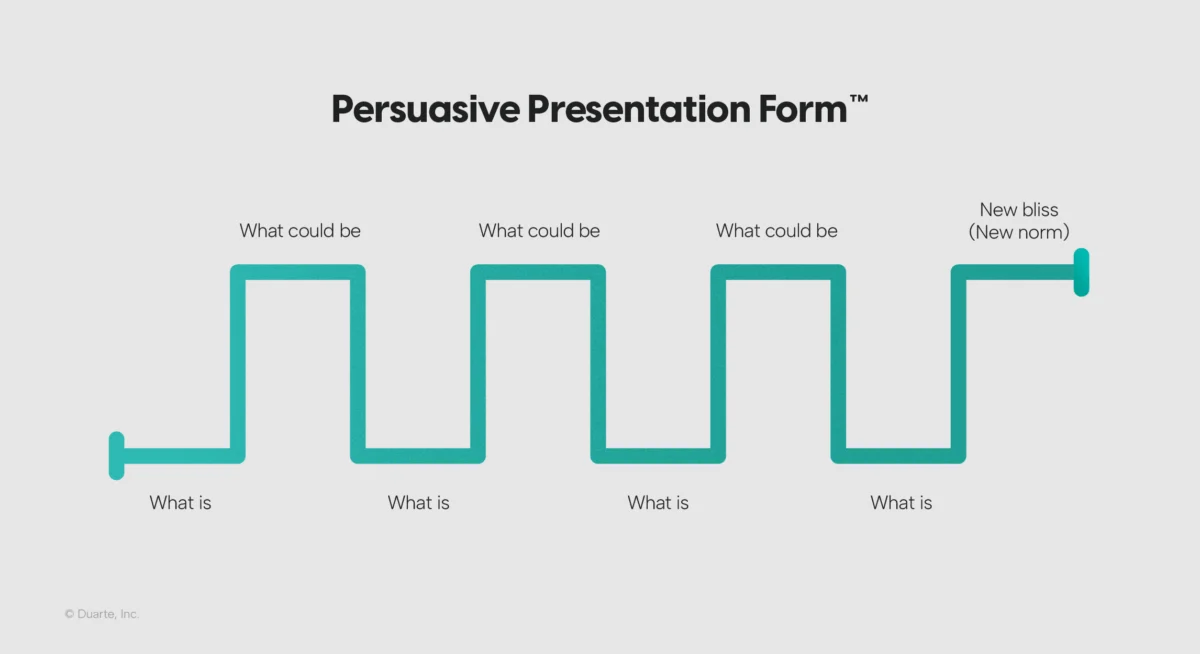
This principle is graphically represented by the Duarte Presentation Sparkline™ framework, also known as the Persuasive Presentation Form™. Conventional business communications often fall into two predictable patterns: the "report" and the "pitch." A typical report largely focuses on "what is," meticulously detailing current conditions, both positive and negative, with a brief suggestion for future improvement at the end. This linear depiction often presents as a largely flat line, occasionally dipping or rising slightly. While comprehensive, it risks being perceived as dry and uninspiring.
Conversely, the classic "pitch" begins with a cursory acknowledgment of the current state ("what is") before soaring into an extended, enthusiastic vision of "what could be" – an ideal future achieved by adopting the proposed idea, product, or service. This shape typically shows a sharp upward trajectory early on, then remains high. While exciting, this format can sometimes sound overly optimistic or detached from present realities, leading to skepticism. Neither the flat report nor the perpetually elevated pitch provides sufficient contrast to truly captivate and persuade.
The Presentation Sparkline, in contrast, advocates for a dynamic oscillation between "what is" (the problem, the current reality) and "what could be" (the solution, the aspirational future). This pattern, visually represented as a series of peaks and troughs, mirrors the natural ebb and flow of dramatic tension and resolution inherent in powerful narratives. Each "what is" moment articulates a problem or a pain point, creating a sense of urgency or dissatisfaction. Each subsequent "what could be" offers a glimpse of a better future, a solution, or an opportunity, providing hope and motivation. This constant switching keeps the audience mentally agile and emotionally invested, guiding them through a journey of understanding and persuasion. Nancy Duarte, a pioneer in presentation design, famously illustrated this framework in her TED Talk, revealing how both Steve Jobs’ iconic 2007 iPhone launch and Dr. Martin Luther King, Jr.’s transformative "I Have a Dream" speech masterfully employed this very pattern of contrast, proving its efficacy across vastly different contexts. This strategic use of contrast ensures that the audience remains engaged, moving them intellectually and emotionally towards the presenter’s desired conclusion.
Creating Unforgettable Moments: The S.T.A.R. Moment™ Framework
In a world drowning in data and information, the ability to create indelible memories is a superpower for presenters. While audiences struggle to retain a torrent of facts and figures, they are remarkably adept at remembering specific, impactful moments. This is the essence of a S.T.A.R. Moment™ – "Something They’ll Always Remember." These moments are strategically embedded within a presentation to punctuate the narrative, provide emotional resonance, and ensure the core message sticks long after the presentation concludes.
S.T.A.R. Moments leverage various techniques, including dramatic visuals, unexpected demonstrations, personal anecdotes, or vivid analogies, to create a powerful impression. They bypass the purely logical processing centers of the brain and tap into emotional and sensory memory, making the information more salient and enduring.
A classic and highly effective example comes from Al Gore’s presentation, which formed the basis for his Academy Award-winning documentary, An Inconvenient Truth. When Gore brought his extensive findings on climate change to Duarte for presentation design, he faced the formidable challenge of communicating the projected, drastic rise in CO2 concentration over the next half-century in a way that would be both comprehensible and emotionally impactful. Simply displaying a graph would have been informative but unlikely to create the necessary urgency. The solution was a brilliant S.T.A.R. Moment: as the data illustrating the exponential increase in CO2 levels climbed off the charts, Gore himself would ascend a hydraulic lift, physically rising alongside the projected numbers. This visceral, experiential demonstration transformed abstract data into a tangible, alarming reality, bringing the audience directly into the story of impending environmental crisis. This dramatic gesture wasn’t just information; it was an experience designed to be remembered, catalyzing a deeper understanding and a call to action.

Transforming Raw Data into Insight: The Art of Data Storytelling
One of the most significant hurdles for professionals attempting to infuse storytelling into their presentations is effectively integrating data. Raw data, in isolation, is often devoid of inherent meaning or emotional resonance. It requires a presenter to contextualize, interpret, and imbue it with significance. This is where the discipline of data storytelling becomes indispensable, transforming inert statistics into persuasive insights. Presenters have several powerful strategies at their disposal to achieve this: they can marvel at the magnitude of a data point, humanize the data to connect with personal experience, or surprise the audience with an unexpected revelation.
Marveling at magnitude involves highlighting the sheer scale or significance of a number, making its implications tangible. For instance, instead of stating a large sum, comparing it to a universally understood benchmark (e.g., "equivalent to the national debt of X country") can amplify its impact. Humanizing data means connecting abstract numbers to individual lives or experiences, making the statistics relatable. This can involve sharing a personal story, presenting a case study, or using composite profiles that represent the data points. For example, rather than stating "X percent of customers experience a certain issue," a presenter might introduce "Sarah, a customer who represents this X percent, and here’s how this issue affects her daily life."
Perhaps one of the most compelling examples of surprising the audience with the unexpected comes from Steve Jobs’ 2008 reveal of the MacBook Air. Instead of merely stating the device’s thinnest point was 0.76 inches – a measurement that, while impressive, might not fully convey its revolutionary slimness to a lay audience – Jobs performed a dramatic, unexpected demonstration. He slid the entire laptop into a standard manila envelope, pulling it out with a flourish. This visual stunt instantly communicated the MacBook Air’s unprecedented thinness in a way that transcended numerical specifications. The manila envelope, a common object, served as an immediate, relatable unit of measurement, shocking the audience with the unexpected possibility that a fully functional laptop could fit inside it. This was data storytelling at its finest: using a surprising visual to underscore a key feature, making a technical specification emotionally resonant and utterly unforgettable.
The Resonant Conclusion: Envisioning the "New Bliss"
Every effective story, whether ancient myth or modern business presentation, requires a satisfying conclusion. For business storytellers, this culmination is not a mere summary but a powerful vision of "what could be," which we term the "new bliss." This is the audience’s "happily ever after," but critically, it is not a fantastical dream. Instead, it is a concrete, attainable vision of a future state that directly addresses the challenges the audience, as the hero, is currently grappling with.
The "new bliss" must be painted with clarity and conviction, demonstrating how the solutions proposed by the presenter (the mentor) will lead to a genuinely improved reality. This involves articulating the specific benefits, the tangible outcomes, and the positive transformations that await the audience if they embrace the presented ideas, products, or services. It reinforces the value proposition by showing the audience not just what they will get, but who they will become or what problems they will overcome.
This concluding vision serves multiple purposes: it provides a strong call to action, inspiring the audience to take the necessary steps to achieve this desirable future. It reinforces the presenter’s credibility by demonstrating a clear pathway from current problems to future solutions. And perhaps most importantly, it leaves the audience with a sense of hope, empowerment, and a clear understanding of the positive impact that lies ahead. The "new bliss" transforms the presentation from a mere information exchange into a transformative experience, where the audience is left with a compelling reason to believe and to act.
Broader Implications and Strategic Imperatives
Business storytelling is far more than a stylistic flourish; it is a strategic imperative that underpins organizational progress and success. In a complex, fast-paced business environment, the ability to articulate a clear, compelling narrative is directly correlated with an organization’s capacity to move work forward. This encompasses every facet of corporate life, from securing individual project approvals to shaping an overarching corporate identity and driving large-scale change initiatives. Every successful deal closure, every instance of team alignment, and every effective change management initiative that truly takes root rather than dissipating, can often be traced back to a skillfully told story. It is the art of communicating the right message, through the right narrative, at the opportune moment.
The mastery of these storytelling techniques — understanding the Hero’s Journey, positioning the audience as the hero, embracing the mentor role, leveraging contrast with the Sparkline, crafting S.T.A.R. Moments, engaging in data storytelling, and envisioning the "new bliss" — equips leaders with the tools to navigate ambiguity, inspire commitment, and drive tangible results. It transforms transactional communication into relational engagement, fostering deeper understanding and stronger conviction among stakeholders. In an increasingly competitive global marketplace, organizations that invest in developing their storytelling capabilities are better positioned to differentiate themselves, attract talent, secure investment, and ultimately, achieve sustainable growth.
For organizations and individuals seeking to cultivate and refine these essential storytelling presentation skills, specialized expertise is invaluable. Whether the objective is to craft a singular, high-stakes presentation with expert guidance, to empower entire teams through comprehensive training programs, or to integrate both approaches, strategic partnerships can accelerate proficiency. Engaging with experts in business communication allows leaders to identify and implement the precise blend of strategies required to transform their presentations into powerful, persuasive narratives that resonate deeply and drive desired actions.
