

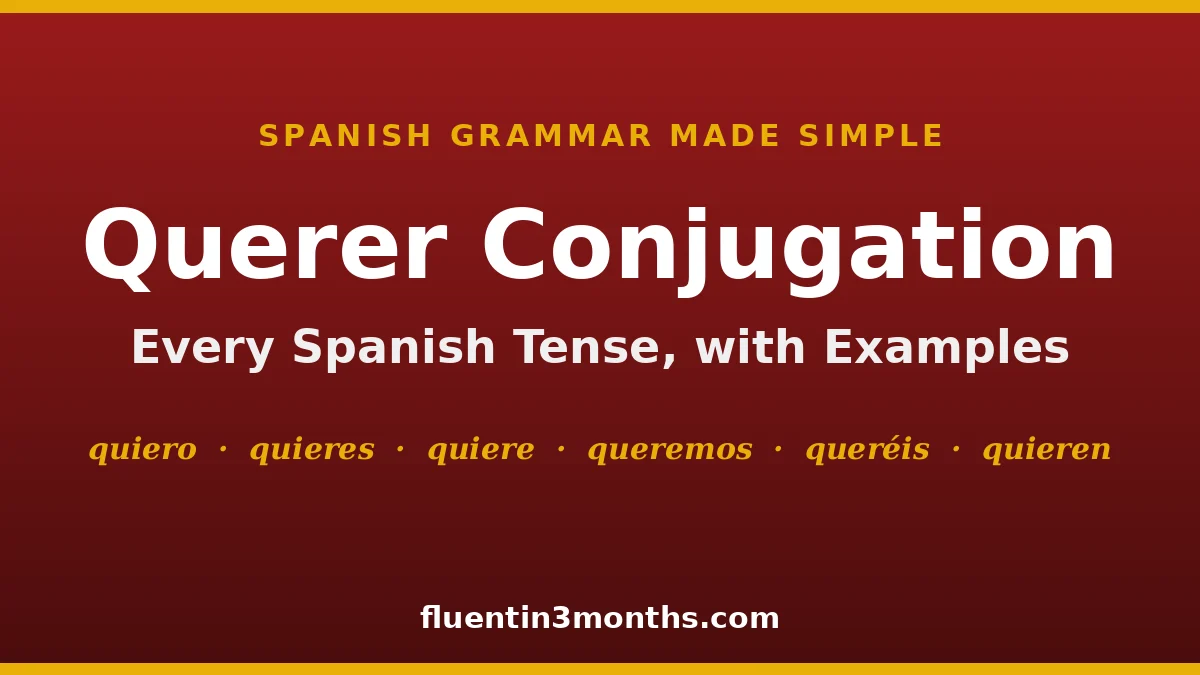
The Spanish verb querer serves as a fundamental pillar of Hispanic communication, functioning as the primary vehicle for expressing both desire and affection. Classified as an irregular, stem-changing verb, its utility spans from basic transactional interactions—such as ordering a meal—to the most profound declarations of human emotion. For the estimated 591 million Spanish speakers worldwide, querer is more than a vocabulary word; it is a versatile tool that navigates the intersection of necessity and sentiment. Understanding its complex morphological structure and its subtle semantic shifts is essential for any student seeking professional or social fluency in the Spanish language.
The Linguistic Foundations and Etymological Evolution of Querer
The origins of querer can be traced back to the Latin verb quaerere, which primarily meant "to seek," "to search for," or "to inquire." Over centuries of linguistic evolution within the Iberian Peninsula, the meaning of the verb shifted from the external act of searching to the internal state of desiring. This transition reflects a broader trend in Romance languages where verbs of motion or inquiry evolved into verbs of volition.
Morphologically, querer belongs to a specific class of Spanish verbs known as "boot verbs" or stem-changing verbs. Specifically, it undergoes an e to ie diphthongization in the present indicative, present subjunctive, and imperative moods, except in the nosotros (we) and vosotros (you all, informal Spain) forms. Furthermore, the verb exhibits a "strong" irregular preterite stem, quis-, which is a vestige of its Latin roots. This irregularity extends into the imperfect subjunctive and the future subjunctive, making querer a high-frequency verb that requires dedicated study to master.
Core Conjugation: The Indicative Mood
The indicative mood is used to state facts, describe reality, and ask questions. Because querer is used so frequently in daily life, its indicative forms are often the first irregular patterns encountered by language learners.
The Present Indicative: The Foundation of Desire
In the present tense, the stem change occurs in all forms except the first and second person plural. This tense is utilized for immediate needs and general statements of affection.
| Pronoun | Conjugation | English Translation |
|---|---|---|
| Yo | quiero | I want / I love |
| Tú | quieres | You want / You love |
| Él / Ella / Usted | quiere | He / She / You (formal) want / love |
| Nosotros / Nosotras | queremos | We want / We love |
| Vosotros / Vosotras | queréis | You all (Spain) want / love |
| Ellos / Ellas / Ustedes | quieren | They / You all want / love |
The Preterite and Imperfect: Navigating the Past
The Spanish language distinguishes between completed actions (Preterite) and ongoing or descriptive states (Imperfect) in the past. With querer, this distinction creates a significant shift in meaning. In the preterite, quise often implies "I tried" or "I attempted," while the negative no quise often means "I refused." Conversely, the imperfect quería describes a continuous state of wanting or a background feeling.
| Pronoun | Preterite (Completed) | Imperfect (Description) |
|---|---|---|
| Yo | quise | quería |
| Tú | quisiste | querías |
| Él / Ella / Usted | quiso | quería |
| Nosotros / Nosotras | quisimos | queríamos |
| Vosotros / Vosotras | quisisteis | queríais |
| Ellos / Ellas / Ustedes | quisieron | querían |
Future and Conditional: Expressing Potentiality
The future and conditional tenses of querer are also irregular. Rather than using the full infinitive as the stem, the "e" is dropped and an additional "r" is added, resulting in the stem querr-.
| Pronoun | Future | Conditional |
|---|---|---|
| Yo | querré | querría |
| Tú | querrás | querrías |
| Él / Ella / Usted | querrá | querría |
| Nosotros / Nosotras | querremos | querríamos |
| Vosotros / Vosotras | querréis | querríais |
| Ellos / Ellas / Ustedes | querrán | querrían |
The Subjunctive Mood: Desires and Hypotheticals
The subjunctive mood is essential when expressing wishes, doubts, or emotions regarding another person’s actions. In Spanish syntax, if a subject wants someone else to do something (e.g., "I want you to go"), the second verb must be in the subjunctive.
Present and Imperfect Subjunctive
The present subjunctive maintains the e to ie stem change. The imperfect subjunctive, however, uses the irregular quis- stem derived from the third-person plural of the preterite.
| Pronoun | Present Subjunctive | Imperfect Subjunctive (Form 1) |
|---|---|---|
| Yo | quiera | quisiera |
| Tú | quieras | quisieras |
| Él / Ella / Usted | quiera | quisiera |
| Nosotros / Nosotras | queramos | quisiéramos |
| Vosotros / Vosotras | queráis | quisierais |
| Ellos / Ellas / Ustedes | quieran | quisieran |
Notably, quisiera is frequently used as a polite substitute for quiero. In retail or hospitality settings, using the imperfect subjunctive softens the request, translating effectively to "I would like" rather than "I want."
Compound Tenses and the Role of the Past Participle
The compound tenses are formed by combining the auxiliary verb haber with the past participle of querer, which is querido. Unlike the simple tenses, the past participle remains constant regardless of the subject.
- Present Perfect: He querido (I have wanted/loved)
- Pluperfect: Había querido (I had wanted/loved)
- Future Perfect: Habré querido (I will have wanted/loved)
- Conditional Perfect: Habría querido (I would have wanted/loved)
The term querido also functions as an adjective meaning "dear" or "beloved," commonly used in the salutations of letters (Querido Juan) or to describe a loved one.
Semantic Analysis: "Te Quiero" vs. "Te Amo"
One of the most nuanced aspects of the verb querer is its use in expressing affection. For English speakers, the distinction between te quiero and te amo often presents a challenge, as both are translated as "I love you." However, linguistic data and cultural norms dictate specific boundaries for each.
- Te quiero: This is the most common way to express love in the Spanish-speaking world. It is used between romantic partners, family members, and close friends. It signifies a deep caring and desire for the other person’s well-being. It is neither "weak" nor "casual"; rather, it is the standard emotional baseline for significant relationships.
- Te amo: This expression carries a higher degree of intensity and is often reserved for profound, often poetic, romantic love. While its usage varies by region—with some Latin American cultures using it more liberally than speakers in Spain—it generally implies a more formal or grand declaration of devotion.
Statistical surveys of language learners indicate that misusing these terms can lead to social awkwardness, highlighting the importance of understanding the "weight" of querer in an emotional context.
Tactical Usage: The "Quisiera" Protocol
In professional and formal environments, the directness of the present indicative quiero can be perceived as blunt or demanding. Linguistic experts recommend the "Quisiera Protocol" for non-native speakers. By utilizing the imperfect subjunctive form quisiera, speakers adhere to the Spanish cultural value of cortesía (courtesy).
Example in a Professional Context:
- Blunt: Quiero hablar con el gerente. (I want to speak with the manager.)
- Polite: Quisiera hablar con el gerente, por favor. (I would like to speak with the manager, please.)
This subtle shift in conjugation demonstrates a higher level of linguistic competency and cultural awareness, which is vital in international business and diplomatic relations.
Common Pitfalls and Morphological Errors
Data from pedagogical studies suggest that learners frequently struggle with two specific areas of querer conjugation:
- The Preterite Stem: Learners often mistakenly apply the regular -er ending to the stem quer- (resulting in querí), rather than using the correct irregular stem quis- (quise).
- The Future/Conditional Double ‘R’: Because the future and conditional stems drop a vowel, the resulting "rr" must be trilled. Failing to include the second "r" can lead to confusion with other verb forms or simply sound non-native.
Implications for Global Fluency
As Spanish continues to expand as a global lingua franca, particularly in the United States and across European trade sectors, the mastery of high-utility verbs like querer becomes a strategic asset. The verb’s ability to bridge the gap between transactional necessity (commerce) and interpersonal connection (networking) makes it a unique study in linguistic versatility.
The Real Academia Española (RAE), the official regulator of the Spanish language, continues to monitor the evolution of such verbs. While the core conjugation remains stable, the social application of querer continues to adapt to modern communication styles, including its ubiquitous presence in digital media and short-form messaging.
In conclusion, querer is more than a mere entry in a dictionary; it is a complex linguistic system. Mastery requires a dual approach: a rigorous memorization of its irregular morphological patterns and a sensitive understanding of its emotional and social applications. For the serious student of Spanish, querer is not just a verb to be learned, but a tool to be felt and practiced, serving as the heartbeat of Spanish expression.
