

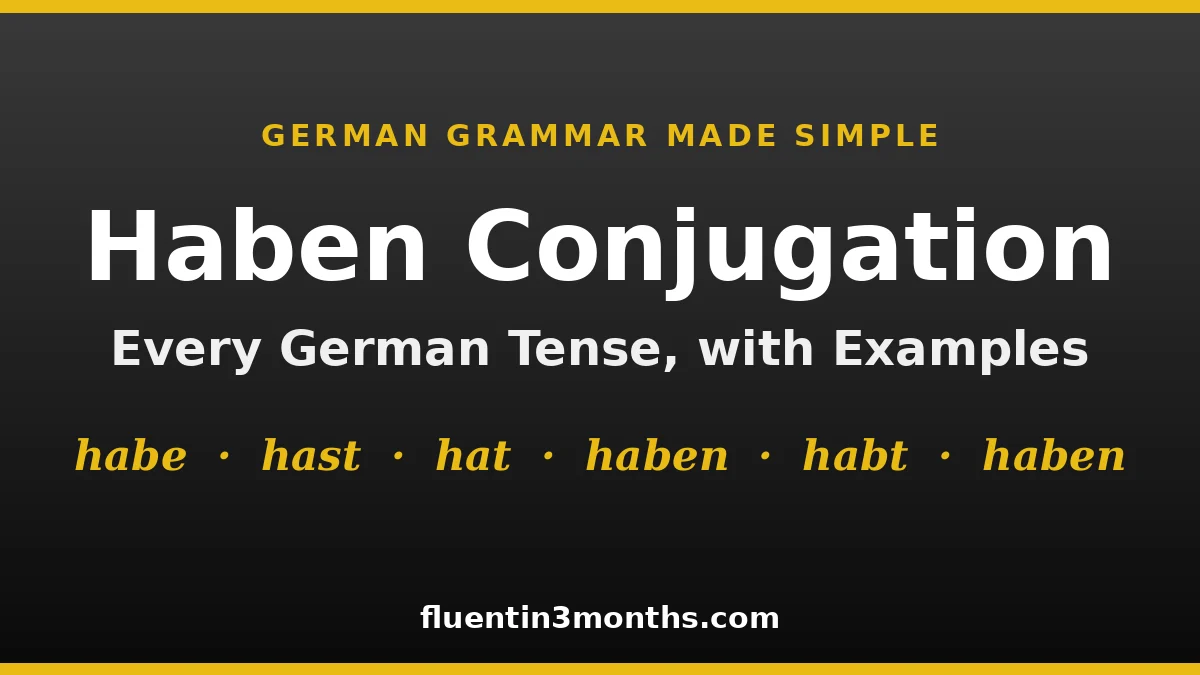
The German verb haben (to have) has been identified by linguistic experts and pedagogical researchers as one of the most significant structural pillars in the acquisition of the German language. Far exceeding its primary role as a marker of possession, haben functions as the dominant auxiliary verb required to construct the Perfekt (present perfect) tense. This tense serves as the primary vehicle for spoken communication regarding past events in modern German. Consequently, the mastery of haben is not merely a vocabulary requirement but a prerequisite for functional fluency, enabling learners to bridge the gap between simple present-tense statements and complex historical narratives.
Linguistic data suggests that haben is consistently ranked among the top five most frequently used verbs in the German language, alongside sein (to be) and werden (to become). Its versatility allows it to function in three distinct capacities: as a full verb indicating ownership, as an auxiliary verb for compound tenses, and as a core component of idiomatic expressions that differ significantly from English syntactic structures.
The Structural Mechanics of Haben in the Present Tense
The initial challenge for language learners involves the irregular conjugation of haben in the Präsens (present tense). While most German verbs follow a predictable pattern of appending suffixes to a stable stem, haben undergoes a phonetic contraction in the second and third-person singular forms.
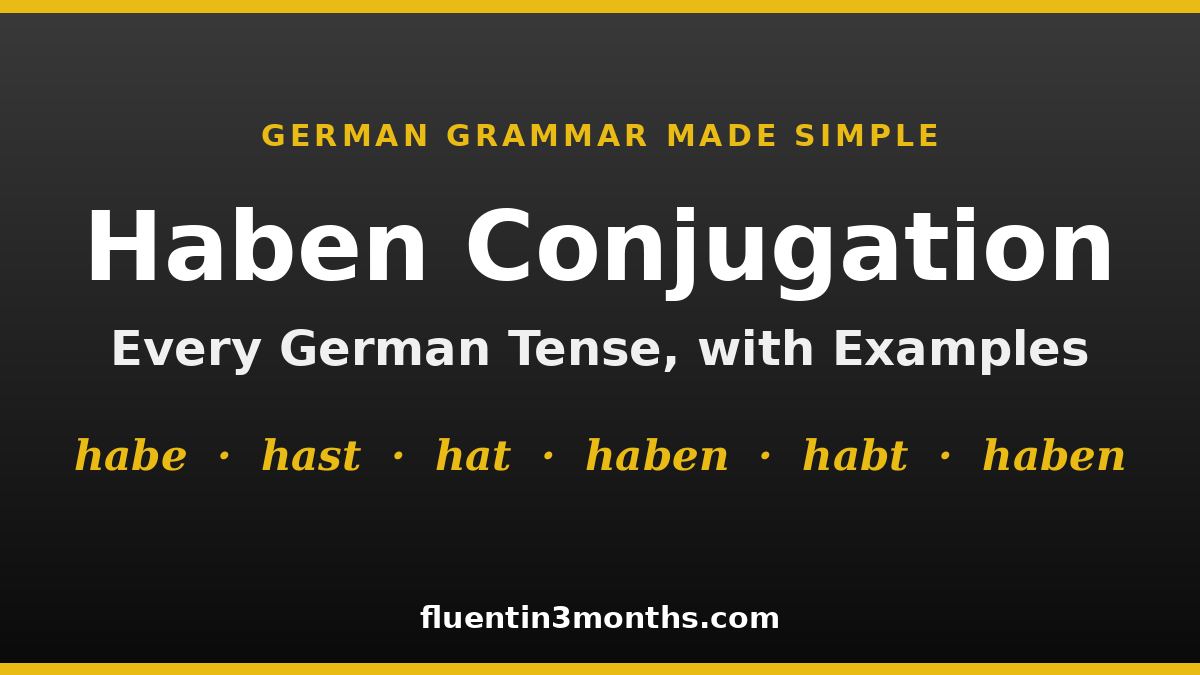
In the standard conjugation table, the first-person singular remains regular (ich habe), as do the plural forms (wir haben, ihr habt, sie/Sie haben). However, the forms for du (you, informal) and er/sie/es (he/she/it) deviate by dropping the medial consonant ‘b’. This results in du hast and er hat, rather than the theoretically regular "habst" or "habt."
Philologists attribute this irregularity to high-frequency usage over centuries. Similar to the English evolution of "have" into "has" (rather than "haves"), the German ‘b’ was eroded by the demands of rapid oral communication. For the learner, this "dropped-b" represents a critical diagnostic marker; failure to internalize these forms often signals a lack of foundational grounding in the language’s core irregularities.
Chronology of Tense Development: From Present to Past
The acquisition of haben follows a specific chronological path in most standardized curricula, such as those outlined by the Common European Framework of Reference for Languages (CEFR).
Phase I: The Present Tense and Possession
At the A1 level, learners utilize haben primarily for literal possession. Sentences such as Ich habe ein Auto (I have a car) establish the verb’s relationship with the accusative case, as haben is a transitive verb that requires a direct object.
Phase II: The Präteritum (Simple Past)
As learners progress, they encounter the Präteritum, or simple past. For haben, this form is hatte. Unlike many other verbs where the Präteritum is reserved for formal writing or literature, haben and sein are unique in that their simple past forms are frequently used in everyday speech. Linguists note that while a German speaker might say Ich habe gegessen (I have eaten) using the Perfekt, they are statistically more likely to say Ich hatte Angst (I was afraid) using the Präteritum.
Phase III: The Perfekt (Present Perfect)
The Perfekt is constructed by combining a conjugated form of haben with the Partizip II (past participle) of the main verb. For example, Ich habe das Buch gelesen (I have read the book). In this context, haben loses its meaning of "possession" and functions purely as a grammatical engine. Data indicates that approximately 80% of German verbs utilize haben as their auxiliary, while the remaining 20%—primarily verbs of motion or change of state—utilize sein.
The Role of Haben in Hypothetical Discourse: Konjunktiv II
A significant turning point in language proficiency occurs with the introduction of the Konjunktiv II, the mood used for hypotheticals, wishes, and polite requests. The verb haben transforms into hätte in this mood.
Educational experts emphasize the phrase Ich hätte gern… (I would like to have…) as a vital tool for social integration. It serves as the standard polite formula for ordering in restaurants or requesting assistance in retail environments. Without the mastery of this subjunctive form, learners often rely on Ich will (I want), which can be perceived as blunt or culturally inappropriate in many German-speaking regions.
Furthermore, the Konjunktiv II is essential for "unreal" past conditions, such as Wenn ich Zeit gehabt hätte, wäre ich gekommen (If I had had time, I would have come). This level of grammatical complexity is typically mastered at the B1 and B2 levels, representing a sophisticated understanding of the language’s temporal flexibility.
Comparative Linguistic Analysis: German vs. Other European Languages
The usage of haben provides a fascinating point of contrast with other major languages. While English, French, and Spanish share a common Indo-European root for "to have," their application in idiomatic expressions varies significantly.
In English, physical states are often described using "to be" (I am hungry, I am afraid). Conversely, German utilizes haben for these states: Ich habe Hunger (literally: I have hunger) and Ich habe Angst (I have fear). This distinction often leads to interference errors, where English speakers incorrectly say Ich bin Hunger.
Interestingly, German aligns with English regarding age, using sein (Ich bin 20 Jahre alt), whereas Romance languages such as French (J’ai 20 ans) and Spanish (Tengo 20 años) utilize their respective versions of "to have." This tripartite divergence requires learners to compartmentalize their native linguistic instincts when navigating German idiomatic territory.
Statistical Prevalence and Error Analysis
Data from language learning platforms and university linguistics departments highlight common pitfalls associated with haben. The most frequent error among beginners is the "analogical leveling" of the present tense, where students attempt to apply regular conjugation rules to the irregular du and er/sie/es forms.
A second common error involves the selection of the auxiliary verb in the Perfekt. While the rule states that haben is the default, learners often struggle with verbs that inhabit a "gray area" of motion. For instance, the verb tanzen (to dance) usually takes haben (Ich habe getanzt), but if a specific direction is indicated, some dialects or older forms might lean toward sein. However, for 21st-century Standard German (Hochdeutsch), haben remains the overwhelming choice for any verb that does not explicitly involve a change of location or state.
Broader Impact on Communicative Competence
The implications of mastering haben extend beyond mere grammatical correctness; it is a matter of communicative agency. Because haben is the auxiliary for almost all transitive verbs (verbs that take a direct object), a learner who cannot conjugate haben is effectively silenced when attempting to describe any past action involving an object.
Market research from educational publishers suggests that instructional materials which prioritize the "Haben-Sein" distinction early in the curriculum result in higher retention rates among adult learners. By framing haben as a multi-functional tool rather than a single vocabulary word, educators can provide students with a "macro" view of German syntax.
Conclusion: The Indispensable Nature of Haben
As the German language continues to be a leading medium for science, commerce, and philosophy in Europe, the pedagogical focus on its core verbs remains intense. Haben stands as a testament to the language’s history—retaining its irregular contractions from the Middle Ages—while serving as the modern engine for daily conversation.
For the student of German, the transition from ich habe to ich hätte gehabt represents a journey from basic survival communication to nuanced, expressive fluency. The data is clear: those who invest the time to "drill" the irregularities of haben early in their studies bypass months of potential confusion and error. In the architectural framework of the German language, haben is not just a brick; it is the mortar that holds the past, present, and hypothetical future together.
