


The rapid integration of Artificial Intelligence into the modern workplace has initiated a complex and often discordant dialogue between organizational leaders and their workforces. This pivotal shift, far from being a seamless technological upgrade, represents a delicate dance between innovation and apprehension, where the successful adoption of AI hinges critically on effective communication. While a segment of the workforce envisions AI as a panacea for grand challenges like disease eradication and climate change, others harbor deep-seated fears, ranging from job displacement—evoking dystopian imagery reminiscent of The Terminator—to concerns over the erosion of truth, akin to "tears in rain." Amidst this spectrum of enthusiasm, skepticism, and outright ambivalence, organizations face the formidable task of forging a unified vision for AI adoption.
The AI Adoption Conundrum: A Spectrum of Perceptions
The current landscape of AI integration is characterized by a significant perceptual divide within companies. For many organizations, the specter of "Fear Of Missing Out" (FOMO) looms large, a direct consequence of past tech revolutions where delayed adaptation proved detrimental. This pressure often leads to a scramble for AI-enablement as an end in itself, rather than a means to a strategically defined goal. Questions that should precede deployment—such as the genuine necessity of an AI tool, the potential loss from automating specific workflows, or even the appropriateness of AI agents managing company resources—are frequently overlooked. This unguided momentum, coupled with wildly divergent employee perspectives, underscores the urgent need for an era-defining narrative to achieve AI adoption at scale.
The Imperative for Unified Communication
In this environment of technological flux and human apprehension, the ability of leaders to unite diverse stakeholders around a shared AI message becomes paramount. Drawing lessons from Fortune 50 companies and global brands, core communication skills remain indispensable for sparking and sustaining significant organizational change. Leaders must adeptly acknowledge difficulties, address pushback constructively, and build momentum behind their strategic vision. This demands a powerful combination of time-tested storytelling structures, meticulous design principles, and compelling presentation strategies to cultivate a sense of collective investment in the desired outcome. Critically, these profoundly human qualities—the capacity to inspire, empathize, and persuade—cannot be automated. The nuanced art of capturing a moment with a resonant story or moving a reluctant audience to action transcends the capabilities of prompt engineering or "vibe-coding," which can only offer superficial solutions to deep-seated human concerns.
Understanding the Workforce Landscape: Data on AI Sentiment
To craft an effective AI vision, leaders must first gain a granular understanding of their target audience’s sentiments. Broader polls and academic studies provide a general understanding of public opinion, but localized data reflecting employee perspectives is crucial for tailoring an appropriate communication strategy.

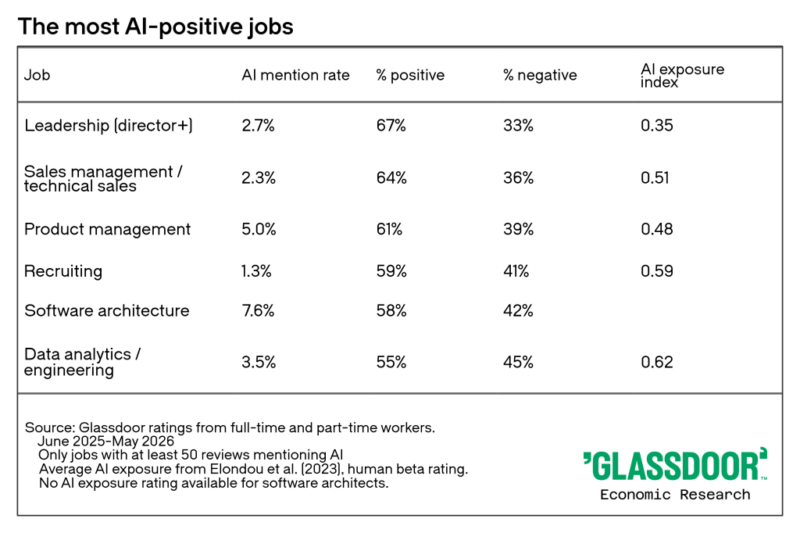
A revealing August 2026 study by Glassdoor, analyzing employer reviews, highlighted significant variations in AI sentiment across different roles, demographics, and industries. The data showcased a strong favorable outlook among certain professional categories:
- Leadership (Director+): 67% positive mentions
- Sales Management / Technical Sales: 64% positive mentions
- Product Management: 61% positive mentions
- Recruiting: 59% positive mentions
- Software Architecture: 58% positive mentions
- Data Analytics / Engineering: 55% positive mentions
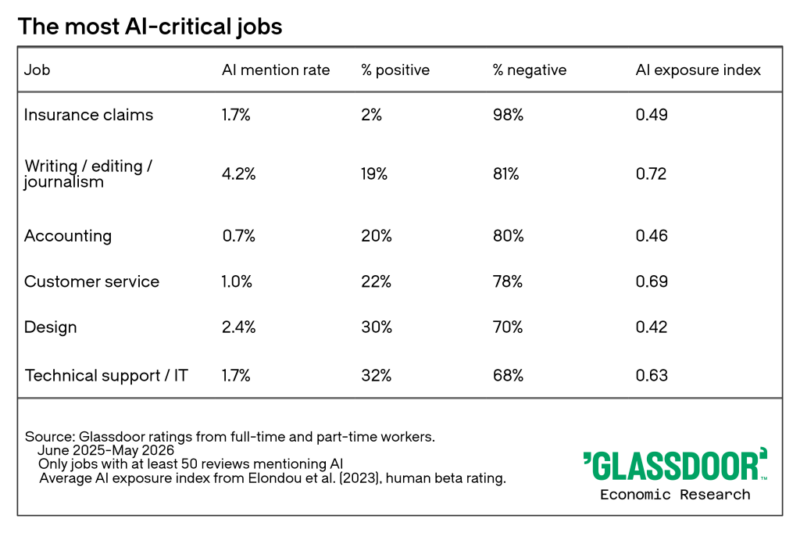
Conversely, roles demanding high precision in language, meticulous numerical accuracy, or relying heavily on interpersonal relationships exhibited considerable skepticism or outright negativity:
- Insurance Claims: 98% negative mentions
- Writing / Editing / Journalism: 81% negative mentions
- Accounting: 80% negative mentions
- Customer Service: 78% negative mentions
- Design: 70% negative mentions
- Technical Support / IT: 68% negative mentions
This stark divergence underscores a fundamental challenge: leadership, often highly positive about AI, needs to bridge a significant perceptual gap with key cross-sections of the workforce.
Beyond mere perception, a study from the University of Konstanz further illuminated a critical misalignment in AI implementation. Professor Florian Kunze, head of the study, noted, "In many organizations, the major AI revolution has not unfolded as a planned transformation process so far. Instead, many employees are experimenting with AI, while employers are still lagging behind when it comes to establishing clear policies, providing training and implementing secure AI solutions." This observation paints a picture of organic, often unguided, experimentation, contrasting sharply with the structured, top-down approach required for enterprise-wide transformation.
Compounding these challenges, a Gallup poll revealed that a staggering "only 25% of workers say their company has communicated a clear plan for AI integration." This implies that the vast majority of businesses are providing insufficient guidance, issuing confusing mandates, or offering no support whatsoever for their AI initiatives. The consequences of such unfocused usage are tangible and detrimental: potential skills atrophy as humans over-rely on AI, the proliferation of inconsistent or "sloppy" brand assets, and runaway token spend due to inefficient AI interactions.
In their haste for progress, leaders often inadvertently send mixed messages or fail to address the concerns of AI-averse or agnostic employees. Without a scalable, coherent message, AI strategies are destined to flounder, unable to secure comprehensive buy-in. Leaders must proactively anticipate resistance, genuinely consider feedback, and transparently articulate a clear, achievable path forward. A vision that is incomplete, incoherent, or detached from organizational values will inevitably lead to stalled progress, derailed roadmaps, and disillusioned talent.
Navigating the Transformation Journey: The Illuminate™ Framework
Fortunately, a structured approach to change communication can provide the necessary support for AI initiatives to take root and deliver measurable return on investment. Duarte’s Illuminate™ methodology offers a proven blueprint for motivating teams to boldly embrace the AI era. This robust 5-part process, requiring dedication, grit, and grace, serves as a pathway to success for an organization’s AI adoption journey. It acknowledges that while the destination is a dream, the journey begins with a clear-eyed assessment of reality.
Stage 1: Envisioning a Winnable Dream
The inaugural stage of the Illuminate™ framework, "Dream," transforms an initial spark of inspiration into a foundational commitment for change. Visionary leaders, or "torchbearers," illuminate a plausible future, inviting their organizations, industries, and even humanity at large to collectively envision it. To ignite this transformative process, leaders must powerfully contrast "what is" with "what could be," thereby cultivating an acknowledgment and craving for a "new bliss." This new bliss could manifest as improved workflows, innovative products, or a refined mindset towards a revolutionary concept like AI. Such juxtapositions are crucial for building tension and persuading audiences to rally behind the vision.
The Dream stage often involves impactful vision speeches and persuasive communication designed to establish the stakes and galvanize teams around the possibilities. However, crafting truly moving content necessitates a deep understanding of the audience’s hopes and fears. Leaders should discreetly "test the waters" around their vision before any formal announcements, engaging in adaptive listening to discern what their teams are truly thinking and feeling.
Glassdoor’s research on AI resistance further informs this stage, identifying eight key concerns. The most prominent include fears of job displacement (20% of negative replies), AI distracting from core business objectives (13%), and the alienating use of AI for workplace surveillance or as a substitute for executive communications (10%). Confronting these anxieties requires an AI adoption vision that transcends a simple "just use it" mandate.
Consider this refined framing:
- What Is: Teams are burdened by the manual tracking of data updates, the grind of content brainstorming, and exhaustive buyer research within an increasingly fragmented information landscape. While AI presents challenges, competitors who strategically embrace and clearly define its adoption are achieving greater speed and reach through AI-enabled workflows.
- What Could Be: With meticulously developed AI Standard Operating Procedures (SOPs), seamless IT-supported integration, and regular feedback mechanisms, teams can eliminate superfluous steps from established processes, enhance systems maintenance, and consistently deliver high-quality results that match or surpass competitive benchmarks.
- The New Bliss: Empowered by AI, teams can now optimize their workflows, enjoy liberated schedules to cultivate deeper customer relationships, engage additional accounts, and explore innovative creative projects with newfound bandwidth.
For optimal results in the Dream stage, leaders must engage in clear-eyed reflection, considering the current state, the aspirational future, and the compelling justification for the "new bliss." With this solid foundation, the organization is ready to take the "Leap" toward change.
Stage 2: The Leap of Commitment
Organizations enter the "Leap" stage when torchbearers successfully inspire their teams to commit to decisive action. At this juncture, the AI message begins to resonate and amplify across teams, marked by action-oriented language signifying growing consensus. AI processes are actively being rolled out, and all-hands meetings or team syncs transform into shared adventures. Maintaining a steady pace and consistently celebrating milestones are crucial during this phase to mitigate "FUD" (fear, uncertainty, and doubt).
Leaders can reinforce a sense of collective purpose through speeches that further contextualize the vision or reiterate the stakes involved. Given that comprehensive AI adoption requires broad buy-in and participation, structuring the AI strategy as an internal incubator, rather than a purely top-down solution, can be highly effective. During this period of discovery, employees should feel empowered to explore their own AI approaches and actively contribute to the company’s evolution. Crafting the right narrative from the outset can firmly lock in commitment.
Duarte’s own journey included a summer "vibe-coding" experiment, which prioritized dedicated time for exploration. Weekly "AI Office Hours" fostered curiosity, providing a safe space to share knowledge, pool strategies for optimizing token spend, and collectively refine outputs. Teams collaborated to maintain a prompt library, update brand guidelines, and rigorously test guardrails. With AI positioned as a thought-partner, teams were encouraged to brainstorm and pressure-test ideas across their various workflows.
While giving a tech stack an AI makeover may lack the immediate glamour of a new product launch or a grand headquarters, with sustained support and ongoing commitment, organizations can strategically position themselves to harness emerging tools, remain agile in dynamic environments, and brace for both foreseen and unforeseen challenges.
Stage 3: Confronting Challenges and Adapting Strategies
In any transformative quest, setbacks are inevitable. With AI, the potential pitfalls are manifold: inadequate prompts yielding unusable outputs, pervasive accuracy issues and "hallucinations," "AI-Optimized" workflows that ironically consume more time, or the ceaseless stream of conflicting news stories regarding adoption. Rather than minimizing hardship or suppressing dissent, leaders committed to AI adoption should view resistance or exasperation as valuable opportunities to check in with teams and refine their change plan.
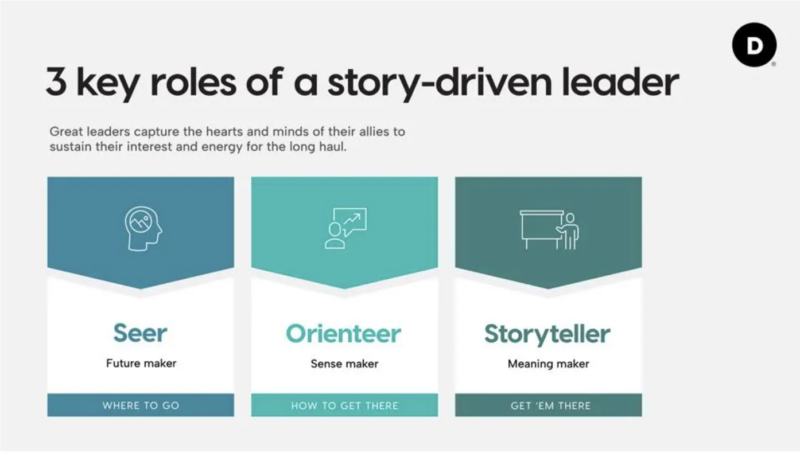
In a September 2026 C200 column for Forbes, Duarte CEO Nancy Duarte reflected on her experience announcing a bold AI vision at a company kickoff. Over subsequent months, a blend of "eureka moments" and periods of "rough air" crystallized a refined vision for change. To successfully launch and implement such a vision, leaders must embody three critical personas that spark and sustain change: the Seer, the Orienteer, and the Storyteller.
- The Seer: The future-maker, defining "where to go."
- The Orienteer: The sense-maker, charting "how to get there."
- The Storyteller: The meaning-maker, inspiring people to "get ’em there."
Every challenge will demand that leaders revisit one or more of these personas. When the destination becomes obscured, Seers provide clarity. If a pathway stalls, Orienteers devise a new course. When competitors seemingly outpace AI outputs, Storytellers imbue the struggle with meaning. Once in motion, successful change requires consistent, transparent communication to maintain alignment and equip teams with up-to-date information.
During the "Fight" stage, leaders must continuously reevaluate whether perseverance or a strategic pivot is the most prudent path through a rough patch. Regular, open engagement with teams—such as AI Office Hours—or powerful "battle speeches" at critical junctures are vital for maintaining morale. Unacknowledged problems, delays in progress, and a lack of clear guidance are fertile ground for FUD. Sustaining the right narrative can keep teams focused on the long haul, preparing them for the arduous "Climb."

Stage 4: Sustaining Momentum Through the Climb
Initiatives invariably lose steam. Deadlines shift. Seemingly foolproof solutions prove inadequate. The "messy middle" of transformation can derail even the most meticulously crafted plans and overwhelm organizations of all sizes. When teams begin to question their capacity to continue, they have entered the "Climb" stage. This phase often runs concurrently with the "Fight" stage, testing leaders to discern the appropriate intervention. The Climb stage is characterized by a seemingly endless slog between sites of conflict, where the objective is to diligently mark progress. It is arguably the most trying stage for both teams and leaders: an uphill battle without the immediate adrenaline of direct conflict.
Where AI appears to offer infinite possibilities, human endurance is finite. Teams can experience exhaustion, burnout, and discouragement. During the Climb, workloads intensify against AI-related obstacles, AI-generated results might prove underwhelming, and new workflows can inadvertently create new problems. Adoption slows. Teams may backslide into familiar habits, while competitors appear to surge ahead. Leaders themselves might begin to wonder: "Will we ever truly achieve AI adoption?"
Balancing the right approach demands a holistic understanding of the situation. Open communication channels—through one-on-one meetings with team leaders, anonymous surveys, and live Q&As—are essential for gathering context and assessing the scope of emerging problems. While "Fight" messaging prepares teams for battle, the "Climb" is about leveraging past accomplishments to refuel change efforts. As a guiding principle, leaders must "keep reminding people how far they’ve come and why the destination is still worth reaching."
Each "temperature check" offers an opportunity to revitalize the message, acknowledge the hard work of those staying the course, and gain insight into what might be undermining the vision. It’s crucial to help stragglers understand they are not alone, that transformation is an iterative process, and that the investment of time, energy, and resources is indeed yielding dividends. If leaders find themselves struggling to defend their decisions for change, they might be falling victim to the sunk cost fallacy. Comprehensive 360-degree organizational awareness is paramount for diagnosing problems, knowing when to strategically abandon an effort, and recognizing when perseverance is finally paying off.
Stage 5: Establishing Enduring AI Agility
At last, the delicate balance between dreaming, delegating, and doing achieves harmony. Leaders have envisioned and articulated a future, and the workforce has mobilized to realize it. After all the leaping, fighting, and climbing, the "new bliss" becomes reality. Teams are AI-optimized, workflows are streamlined, and outputs are consistently generated at an accelerated pace. While dissenters and critics may retain private reservations, the unified message has prevailed. Is the mission accomplished?
In part, yes. However, unlike launching a new product or migrating to a new CRM, becoming AI-enabled demands an ongoing commitment to staying current with innovations and best practices. Much like cybersecurity requires regular re-education and updated procedures, AI necessitates continuous engagement. New models and capabilities emerge constantly, while vulnerabilities and exploits keep organizations on high alert.
This continuous evolution should not diminish the sense of accomplishment. Retooling how teams interact with their work, adopting new Standard Operating Procedures, and successfully defining and then achieving success are all significant causes for celebration. Even in organizations averse to elaborate festivities, teams need dedicated time to reflect on and process their journey. Scheduling an open mic session or a fireside chat where individuals can share their experiences contributes to the vital "mythmaking" that enriches workplace culture. After the metaphorical closing ceremony, it’s time to solidify and sustain the change, allowing workers to refine their AI agility while leaders prepare to pull their next transformative initiative from the clouds.
The Continuous Evolution of Organizational Readiness
Organizations once enjoyed longer runways for reinvention. Today, industry evolution can unfold overnight, a testament to the accelerated uncertainty that defines the modern era. Geopolitical friction, supply chain disruptions, and relentless technological advancements are now inherent aspects of daily life. Companies must remain nimble, constantly recalibrating to each new normal. In an environment where everyone is pulled in multiple directions, team alignment requires a message meticulously crafted, expertly delivered, and robustly supported to withstand the headwinds of constant flux.
Whether an organization is proactively embracing an emerging opportunity like AI or strategically repositioning to navigate turbulence, committing to a proven framework for change communication can significantly ease the transition. If an organization feels adrift amidst change, expert guidance can provide clarity, composure, and conviction. Strategists, designers, speaker coaches, and training facilitators can help rally teams with a compelling narrative that they instinctively want to share, thereby placing the future in clear perspective.
