

Sales Kickoff (SKO) events, often viewed as annual traditions, represent far more than mere calendar markers; they are pivotal strategic opportunities, akin to the christening of a ship or the declaration of a new year. These gatherings are designed to define the strategic trajectory for the upcoming sales cycle, align diverse teams, and ignite the collective ambition necessary for achieving ambitious revenue targets. A truly successful SKO, much like a meticulously planned major event, demands profound reflection, keen foresight, and a compelling narrative capable of unifying and galvanizing every participant towards a shared vision. Without adequate preparation and flawless execution, SKOs risk becoming perfunctory exercises, failing to invigorate sales teams, launch critical initiatives effectively, or build the necessary momentum for a competitive year. The objective, therefore, transcends mere information dissemination; it is about cultivating a cohesive, motivated, and strategically aligned sales force poised for exceptional performance.
The Evolving Landscape of Sales Kickoffs: From Perfunctory to Pivotal
Historically, Sales Kickoffs have evolved from rudimentary sales meetings into sophisticated, high-impact corporate events. Early iterations often focused solely on presenting financial targets and new product features. However, as global markets became more dynamic and competitive, organizations recognized the profound psychological and strategic value of these gatherings. Today, SKOs are seen as crucial investments, shaping not only immediate sales performance but also long-term organizational culture, employee retention, and market positioning. A recent industry report from Sales Enablement Pro indicates that companies investing significantly in well-structured SKOs experience, on average, a 15% increase in sales quota attainment and a 20% improvement in sales team morale compared to those with less structured approaches. This underscores the shift in perception: SKOs are no longer optional expenditures but critical strategic enablers.
The primary goal of any SKO remains consistent: to unify sales professionals and imbue them with the enthusiasm and clarity required to meet and exceed their objectives. However, the path to achieving this outcome is fraught with potential missteps. Some organizations err by over-relying on expensive celebrity keynotes, dazzling attendees with spectacle without substance, or fixating exclusively on ambitious goals without articulating the actionable processes and support systems essential for their realization. To circumvent these common, often costly, pitfalls and transform a satisfactory event into an exceptional one, four foundational elements must be meticulously integrated into the planning and execution. These elements collectively ensure the delivery of pertinent content, resonate emotionally with the audience, and foster a deep, lasting commitment among participants. The journey begins with the most critical component in any room: the audience itself.
Prioritizing the Sales Audience: The Cornerstone of Engagement
A common instinct among organizational leaders is to prioritize the enterprise’s well-being—its financial health, strategic future, and bottom line—above all else. While these concerns are undeniably paramount, allowing them to exclusively dictate the messaging and structure of a Sales Kickoff can inadvertently jeopardize the event’s efficacy. The fundamental error lies in the assumption that the audience, even those integral to daily operations, shares the exact same perspective and concerns as leadership. This often results in presentations dominated by high-level financial data, abstract projections, and dense slide decks, leading to disengagement and a critical loss of opportunity for genuine connection.
To avert this outcome, a simple yet profound question must guide the planning process: "Who is my audience?" Before drafting any event materials or outlining programming, it is imperative to deeply consider the psychological state, professional experiences, and individual aspirations shaping the attendees’ mindset as they approach the SKO. This involves a structured inquiry into their current challenges, triumphs, anxieties, and motivations. For instance, what were their major wins and losses in the previous year? What are their greatest frustrations in their day-to-day roles? What new skills or tools do they genuinely need to succeed? What are their personal career aspirations within the company?

By maintaining a clear-eyed perspective throughout this investigative process, leaders can ensure that all materials and programming are crafted with the audience’s specific needs and perspectives in mind. Messaging should articulate company goals in a language that resonates directly with sellers, demonstrating how these objectives align with their individual growth and success. Furthermore, the physical or virtual environment of the event must be curated for maximum absorption and engagement. This extends beyond content to practical considerations: optimizing session timing to prevent fatigue, providing adequate amenities (food, hydration, caffeine for in-person events; thoughtful breaks and interactive tools for virtual ones), and integrating a judicious mix of passive learning (keynotes) and active participation (workshops, breakout groups, peer discussions).
Consider an organization preparing to launch a new AI-enabled sales workflow. An audience-first approach would not immediately frame this as a "productivity win" from a top-down perspective. Instead, it would anticipate sellers’ potential reservations—fear of job displacement, skepticism about new technology, concerns about a steep learning curve. The messaging would proactively address these anxieties by centering on the sellers’ hopes and pain points. For example, rather than emphasizing increased output for the company, the narrative would highlight the significant time savings for sellers, freeing them from mundane clerical tasks. It would underscore how this newfound bandwidth allows them to cultivate higher-value relationships and engage more deeply with complex client needs, enhancing their professional satisfaction and earning potential. Instead of a passive live demonstration, the SKO could feature small group breakouts where sellers can actively test the new AI tools, fostering a sense of ownership and practical understanding. This shift in perspective transforms a corporate mandate into a personal investment, making the change tangible and desirable for the sales force. As one fictional sales director, Eleanor Vance, was quoted saying, "Our best SKOs aren’t about what we want to tell them, but what they need to hear to feel empowered and excited."
To gather these crucial insights, proactive measures are essential. Engaging directly with team leaders, conducting anonymous surveys, or facilitating structured interviews with a cross-section of sellers can provide invaluable "raw materials" for crafting a resonant message and making informed programming decisions. Tools designed for audience mapping can further aid leaders in systematically analyzing responses and translating them into actionable event strategies. This deep dive into audience psychology allows for more nuanced questions during content development: What specific challenges does this initiative solve for them? How will it directly improve their daily work life? What are the tangible personal benefits they will experience? Without this foundational understanding, even the most well-intentioned message risks falling flat.
The Duarte Big Idea™: A Singular Strategic Imperative
After a thorough audience analysis, the next critical step is to distill the core message into a single, memorable concept. Many ambitious presenters inadvertently dilute the impact of their SKOs by attempting to cram an exhaustive list of topics into a limited timeframe—financial reports, intricate product roadmaps, and sweeping industry prognostications. While each of these elements may hold intrinsic value, they must all serve a singular, overarching purpose: the one thing the audience must grasp and internalize above all else.
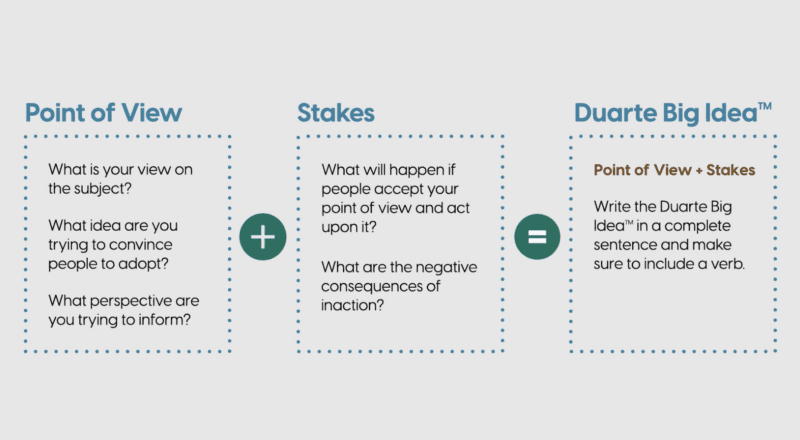
The Duarte Big Idea™ offers a robust framework for distilling complex messaging into a clear, concise, and actionable takeaway. It is the art of articulating a unique point of view on a subject, combined with a clear exposition of what is at stake for the audience, all encapsulated within a single, digestible sentence. This formula—Point of View + Stakes = Big Idea—serves as an unwavering guide. The Point of View defines the specific perspective or idea the organization wants its sales teams to adopt, while the Stakes delineate the positive consequences of embracing this view and acting upon it, or the negative ramifications of inaction.
This principle is a cornerstone of The Duarte Method™ and has been trusted by Fortune 50 companies and global brands for high-stakes communications. Its effectiveness lies in its simplicity and adaptability. The initial aim is to craft the Big Idea into a single, unequivocal sentence. If it exceeds this, the task becomes one of ruthless editing, identifying and excising any extraneous information that does not contribute directly to the core meaning. The guiding question here is: "What is the absolute essence of what I want to communicate, and why should my audience care?"
Once this sharp, unmissable point is forged, it becomes the strategic North Star for all subsequent SKO content development. Every keynote address, breakout session, workshop, and supporting material must align with and reinforce this Big Idea. Anything that does not directly serve this central message should be reconsidered for inclusion, or perhaps communicated through alternative channels. This disciplined approach prevents information overload, ensuring that the audience leaves with a crystal-clear understanding of the year’s primary objective and their role in achieving it. For example, continuing with our AI workflow scenario, a Big Idea might be: "This new AI workflow will liberate sellers from 20% of clerical tasks, freeing 8-10 hours weekly to cultivate high-value client relationships and drive significant revenue growth." This single sentence clearly states the change (POV) and the direct, beneficial outcome for the sales team and the company (Stakes).
The Power of Narrative: Structuring with a 3-Act Arc
With the audience understood and the Big Idea firmly established, the next imperative is to imbue the SKO programming with a compelling structure. Leveraging the universally recognized 3-Act Structure—a beginning, a middle, and an end—provides a familiar and psychologically resonant framework for the audience to follow, transforming information delivery into an engaging narrative. This structure taps into innate human understanding of story, making complex information more digestible and memorable.
The beginning of the SKO story is where the audience is introduced as the protagonist. It sets the current stage, acknowledges existing circumstances, and crucially, validates the feelings, gaps, and needs identified during the audience research phase. This act establishes rapport and relevance. The middle is where the core action unfolds. Here, the protagonist (the sales team) encounters challenges, obstacles, and opportunities that test their capabilities, creating narrative tension. This "messy middle" is where growth occurs, and old paradigms give way to new visions. It’s also where new strategies, tools, and training are introduced as solutions to the acknowledged problems. Finally, the end brings resolution. The protagonist emerges transformed, equipped with new insights and tools. Tension is released as a new, more desirable reality is presented, outlining the path forward and celebrating the potential for collective success.
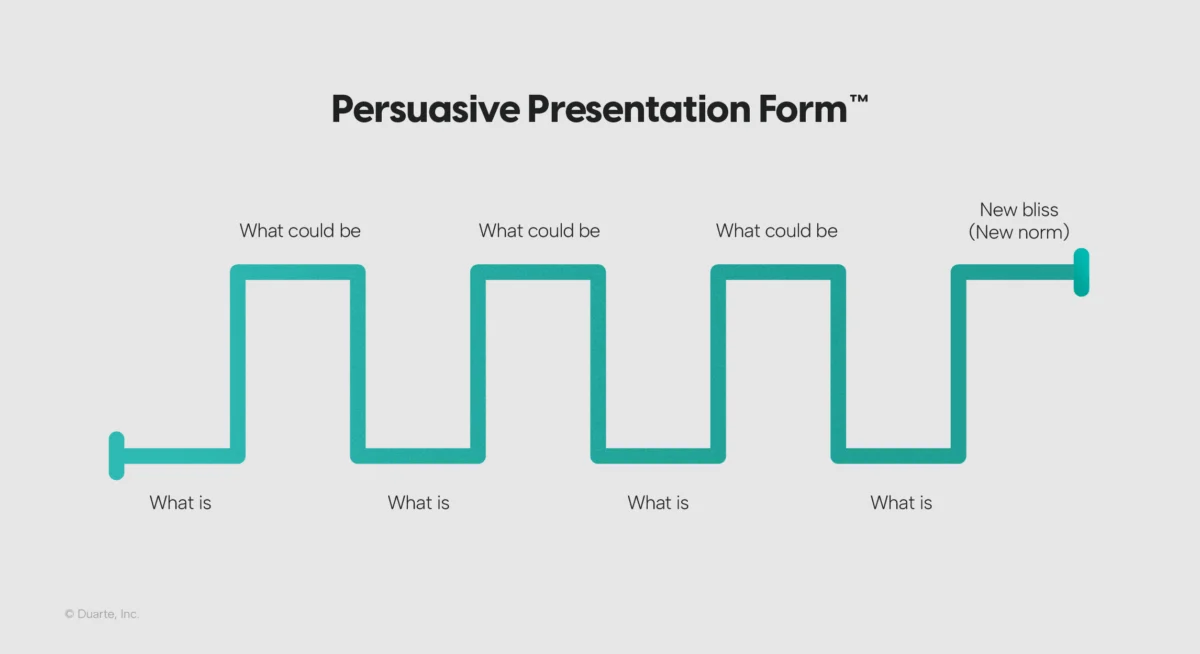
This classic narrative arc underpins countless timeless stories, from epic sagas to everyday anecdotes, making it instantly recognizable and emotionally engaging. Its ubiquity allows audience members to instinctively track the narrative progression and respond emotionally as tension builds and resolves. Within this overarching 3-act structure, The Duarte Method™ often employs the Persuasive Presentation Form™ (or Presentation Sparkline™), particularly within the "messy middle." This form alternates between describing the world "as it is" (the current state, with its challenges and pain points) and "what could be" (the envisioned future, with its solutions and opportunities). This call-and-response dynamic builds conviction, gradually persuading the audience to embrace the "new bliss" offered by the resolution.
For instance, addressing the AI workflow, the "what is" might highlight the current burden of administrative tasks, lost selling time, and potential burnout. The "what could be" would then paint a vivid picture of liberated schedules, deeper client relationships, and enhanced job satisfaction. This oscillation effectively validates current struggles while simultaneously inspiring hope and desire for the proposed solution. To implement this:
- Define "What Is": Articulate the current reality, including challenges, pain points, and current performance metrics that need improvement.
- Envision "What Could Be": Clearly describe the desired future state, highlighting the benefits and opportunities that arise from embracing the Big Idea.
- Map the Journey: Outline the specific actions, strategies, and support systems that will bridge the gap between "what is" and "what could be."
- Reinforce the Resolution: Conclude by reiterating the new reality and the collective success achievable.
Consider this example for our AI workflow: "We know that currently, many of you feel bogged down by administrative tasks, often spending valuable selling hours on data entry and reporting. This ‘what is’ leads to less time with clients and, frankly, less fulfilling work. But imagine ‘what could be’: an AI-powered co-pilot that automates 20% of your current workload, giving you back 8-10 hours a week. This allows you to deepen client relationships, strategize more effectively, and focus on high-impact activities. Yes, there will be an onboarding period, and change is always challenging, but we’ve built comprehensive training and support systems to ensure a smooth transition. The new bliss is not just about hitting numbers, it’s about reclaiming your time and passion for sales." This narrative flow acknowledges potential resistance while clearly articulating the path to a better future.
Weaving in Personal Stories: The Human Connection
The final, yet profoundly impactful, element is the integration of personal stories. After rigorous audience analysis, a precise Big Idea, and a compelling narrative structure, a personal touch provides the emotional resonance that transforms information into inspiration. While storytelling may come naturally to some, it is a skill that can be developed, and audiences often appreciate genuine effort, even if imperfect. The key is authenticity.

A well-placed personal anecdote can cut through corporate jargon, humanize leadership, and forge a deeper connection with the audience. Such stories don’t need to be deeply vulnerable; a happy medium that offers a glimpse into the leader’s humanity outside the workplace often suffices. When skillfully deployed, a personal story can achieve several critical outcomes:
- Builds Empathy and Trust: Sharing a personal experience allows the audience to see the leader as a fellow human, fostering a sense of shared understanding and breaking down hierarchical barriers.
- Increases Message Retention: Stories are inherently more memorable than dry facts or statistics. They create an emotional anchor for the core message.
- Demonstrates Authenticity: It signals that leaders are genuinely invested in the vision and its impact on the team, not just reciting corporate mandates.
- Illustrates Abstract Concepts: A personal narrative can make complex or abstract ideas relatable by grounding them in concrete, personal experience.
If personal storytelling feels unfamiliar, a good starting point is to identify the most challenging aspect of your message—the part that might be hardest for the audience to believe, embrace, or understand. Then, reflect on whether a quick, relevant story from your own life or leadership journey can connect that point to an emotion or make an abstract element tangible.
Revisiting our AI workflow example: "When we first explored this AI integration, I admit I was skeptical. My youngest daughter had just started school, and the demands of both work and home felt overwhelming. I was constantly battling my inbox, feeling like I was always behind. But as I started beta-testing these tools, something shifted. I wasn’t just hitting targets; I was consistently finishing my work earlier. I found myself at the school gates on time, able to truly engage with my family in the evenings. This wasn’t just about productivity for me; it was about reclaiming precious time, becoming a better leader, and frankly, a more present parent. That personal experience made me a true believer in the transformative power of this new workflow, and I believe it can do the same for all of you."
Such an anecdote instantly connects the abstract benefit of "time savings" to a relatable human experience, building trust and making the change feel less like a directive and more like a shared opportunity. Leaders should practice these stories in smaller settings—team meetings or internal presentations—to gauge their reception and refine their delivery before the main event. With thoughtful practice, authentic personal stories can powerfully move hearts and minds, aligning the entire organization around a shared vision.
The Strategic Imperative: A Holistic Approach to SKO Success
By meticulously reflecting on the audience’s needs, committing to a singular, compelling Big Idea, structuring the narrative within a familiar 3-act arc, and infusing the presentation with authentic personal stories, organizations can elevate their Sales Kickoff events from routine gatherings to transformative strategic junctures. The return on investment for such a comprehensive approach is multifaceted: enhanced sales performance, greater team cohesion, improved employee retention, and a robust organizational culture. In an increasingly competitive landscape, a meticulously crafted SKO is not merely an annual event; it is a strategic imperative, driving sustained business growth and fostering a deeply engaged, high-performing sales force ready to conquer the year ahead. The ability to effectively communicate, inspire, and align teams around a unified vision is, ultimately, a hallmark of market leadership.
