

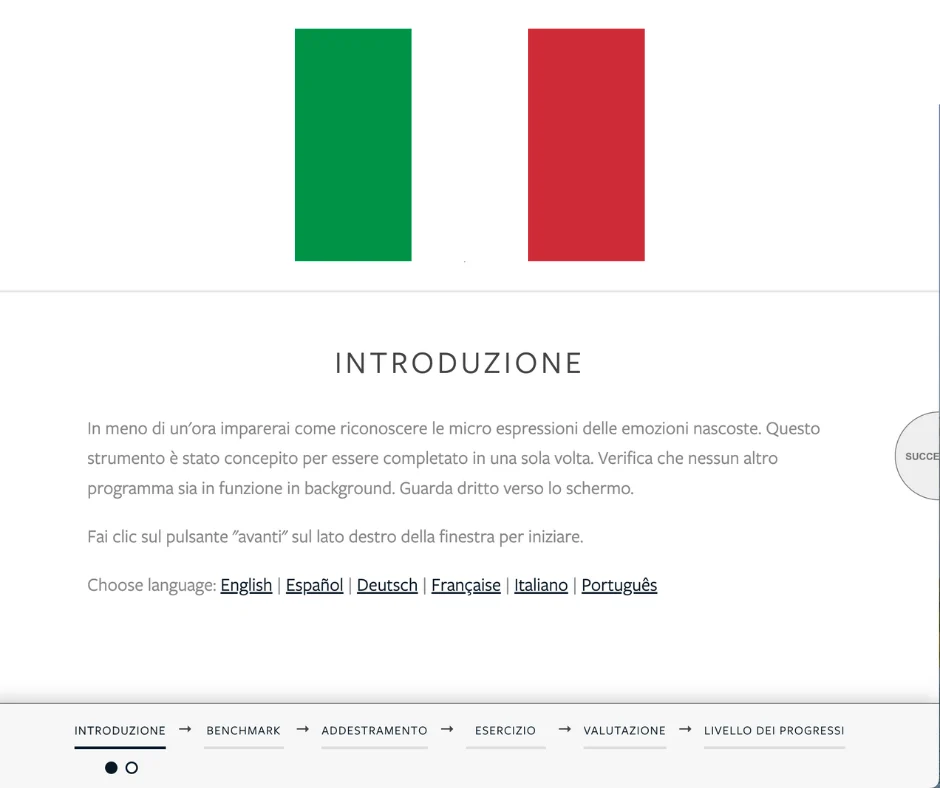
The Paul Ekman Group, a leading authority in the science of emotions and facial expressions, has significantly expanded the accessibility of its renowned online microexpression training tools. In a move designed to democratize emotional intelligence education, the organization has announced the official launch of its comprehensive training programs in Italian, French, and German. This expansion marks a pivotal moment in the group’s ongoing mission to foster greater self-awareness and interpersonal understanding worldwide.
The newly translated modules encompass all seven core online training tools, available across the three distinct training packages offered by the Paul Ekman Group. These additions complement the existing Spanish and Portuguese translations, further solidifying the group’s commitment to serving a diverse international audience. Users will be prompted to select their preferred language at the commencement of each course, ensuring a seamless and intuitive learning experience.
A Mission Rooted in Universal Understanding
The core mission of the Paul Ekman Group, founded by the pioneering psychologist Dr. Paul Ekman, has always been to empower individuals with the ability to understand themselves and others more profoundly. This is achieved by cultivating advanced emotional awareness and the skill to accurately interpret facial cues. The introduction of Italian, French, and German translations is a direct response to the growing global demand for such expertise.
"We are thrilled to announce the availability of our online training tools in Italian, French, and German," stated a spokesperson for the Paul Ekman Group. "Our goal has always been to make the science of emotions, as pioneered by Dr. Ekman, accessible to as many people as possible. These new translations represent a significant stride towards achieving that vision, particularly for our European community."
The implications of this expansion are far-reaching. For educators, professionals in fields such as law enforcement, healthcare, and business, as well as individuals seeking to enhance their personal relationships, the ability to learn about microexpressions in their native tongue removes a significant barrier to entry. The training is designed to equip learners with the crucial skills to recognize subtle, involuntary facial expressions that often betray a person’s true emotional state, even when they are attempting to conceal it.
The Science of Microexpressions: A Brief Overview
Microexpressions are fleeting, involuntary facial expressions that flash across a person’s face for a fraction of a second, typically lasting between 1/25th and 1/2 of a second. They are considered universal, meaning they are the same across all human cultures. Dr. Ekman’s groundbreaking research, conducted over several decades, identified seven universal emotions that are expressed through distinct facial configurations: happiness, sadness, anger, fear, surprise, disgust, and contempt.
These fleeting expressions are significant because they often reveal emotions that a person is trying to hide or is not consciously aware of expressing. Their detection can provide invaluable insights in various contexts:
- Law Enforcement and Security: Identifying deception, assessing threat levels, and understanding the emotional state of individuals during interrogations or in public spaces.
- Healthcare Professionals: Enhancing patient-provider communication, detecting distress or pain that may not be verbally communicated, and building stronger therapeutic alliances.
- Business and Leadership: Improving negotiation skills, understanding customer sentiment, building trust with teams, and fostering more effective communication.
- Personal Relationships: Deepening empathy, resolving conflicts more constructively, and building stronger, more authentic connections.
The Paul Ekman Group’s training programs are meticulously designed to teach individuals how to observe, identify, and interpret these subtle cues. They move beyond theoretical knowledge, offering practical, science-based methodologies that have been validated through extensive research.
A Growing Global Footprint: Timeline and Evolution
The journey of making Dr. Ekman’s work accessible globally has been a gradual but consistent process. The foundation was laid with the initial development of the microexpression training tools, which were primarily available in English. Recognizing the limitations of a single language offering, the group began a strategic expansion into other widely spoken languages.
- Early 2000s: The initial development and release of the first generation of microexpression training tools, largely focused on the English-speaking market.
- Mid-2010s: A significant push towards internationalization began, with the introduction of Spanish and Portuguese language options for key training modules. This period saw increased adoption in Latin America and Spanish-speaking regions of North America.
- Late 2010s – Early 2020s: Further refinement of online training platforms and increased global connectivity led to a surge in demand for multilingual content. The group began exploring more robust translation and localization strategies.
- October 2023 (Announced): The official launch of Italian, French, and German language versions of all seven core microexpression training tools. This announcement marks the most substantial multilingual expansion to date.
This phased approach reflects a commitment to quality and a deep understanding of the nuances involved in translating complex psychological concepts. Each translation undergoes rigorous review to ensure accuracy, cultural appropriateness, and pedagogical effectiveness.
Supporting Data and the Science Behind the Tools
The efficacy of microexpression training is underpinned by decades of scientific research. Dr. Paul Ekman’s work, often cited as foundational in the field of nonverbal communication, has been published in numerous peer-reviewed journals and has been the subject of extensive academic study.
- Cross-Cultural Validation: Dr. Ekman’s research famously demonstrated that the facial expressions of the seven universal emotions are recognized across vastly different cultures, even in isolated communities that had minimal contact with the outside world. This universality is a cornerstone of the training’s effectiveness.
- Accuracy Rates: Studies utilizing Dr. Ekman’s training methodologies have shown significant improvements in individuals’ ability to detect microexpressions. For example, pre-training assessments often show average accuracy rates for novices, which can increase dramatically after completing the comprehensive training. While specific post-training accuracy figures vary depending on the individual and the specific module, improvements of 30-50% or more in detection accuracy are commonly observed.
- Global Adoption: The Paul Ekman Group’s tools are currently utilized in over 230 countries. This widespread adoption, prior to the recent language expansions, speaks to the universal appeal and practical utility of understanding facial expressions. The new translations are expected to further democratize this global reach, making the training accessible to an even broader segment of the world’s population.
Analysis of Implications: Bridging Cultural and Linguistic Divides
The introduction of Italian, French, and German language options carries significant implications for individuals and organizations across Europe and beyond.
- Enhanced Professional Development: Professionals in countries where these languages are spoken can now acquire a critical skill set without the linguistic barrier of English. This is particularly relevant for fields where nuanced communication and accurate emotional assessment are paramount, such as diplomacy, international business, and mental health services.
- Academic Research and Education: Universities and research institutions in Italy, France, and Germany can integrate Dr. Ekman’s training into their curricula, providing students with a robust understanding of emotional science and nonverbal communication. This can foster a new generation of researchers and practitioners well-versed in the field.
- Personal Growth and Interpersonal Skills: For the general public, the ability to learn about microexpressions in their native language offers a profound opportunity for personal growth. It can lead to more empathetic interactions, better conflict resolution, and a deeper understanding of human behavior in everyday life.
- Strengthening European Collaboration: In an increasingly interconnected Europe, the shared understanding of emotional cues facilitated by this training can contribute to smoother cross-cultural communication and collaboration among individuals and organizations.
The strategic decision to focus on these specific languages is likely driven by the significant populations of speakers and the existing demand for emotional intelligence training within these regions. The organization’s proactive approach to linguistic accessibility positions them as a leader in the global emotional intelligence education market.
Looking Ahead: Continued Expansion and Community Engagement
The Paul Ekman Group has indicated that this is not the end of their multilingual expansion efforts. The organization is actively working to introduce additional language options in the future. They have also encouraged their global community to provide feedback and suggest languages they would like to see added.
"We are committed to making the science of emotions accessible to everyone, everywhere," the spokesperson added. "We believe that by breaking down language barriers, we can empower more individuals to develop their emotional intelligence and build a more understanding world. We eagerly await further suggestions from our community regarding new languages."
This open invitation for input underscores the group’s dedication to serving its users and adapting to the evolving needs of a global audience. The emphasis on community engagement suggests a long-term vision focused on continuous improvement and widespread impact.
Individuals interested in exploring the microexpression training tools can visit the Paul Ekman Group website. Upon purchase or access to an existing account, users will be able to select their preferred language directly from the main menu of any Paul Ekman training tool. The organization invites all to "try it in your language" and embark on a journey to unlock a deeper understanding of human emotions.
