

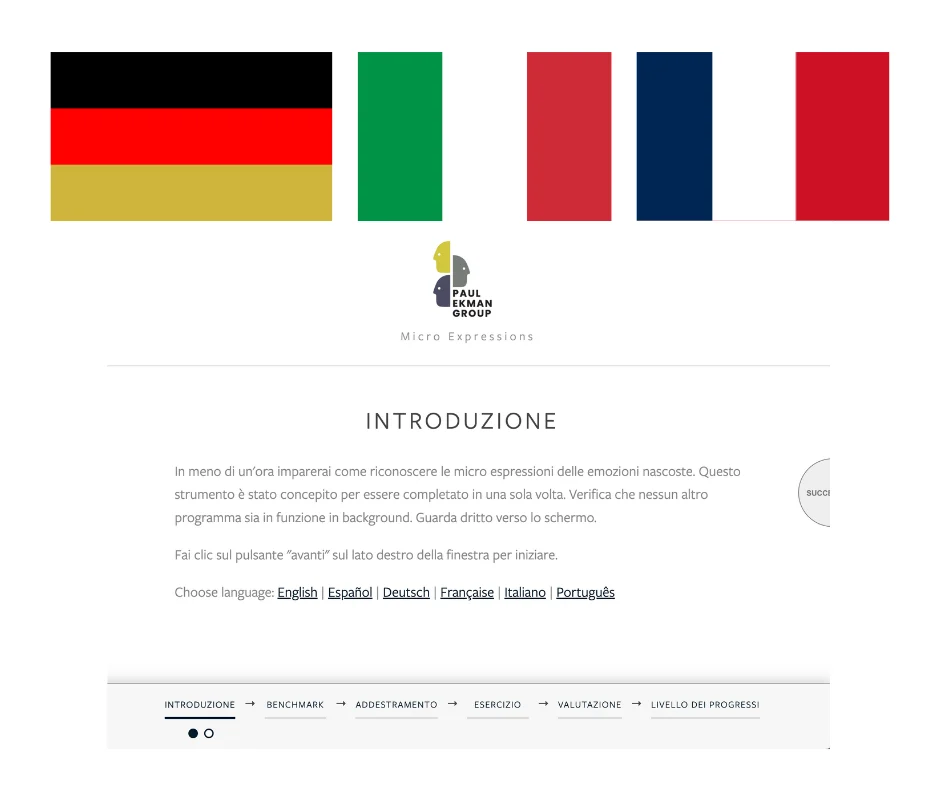
The Paul Ekman Group, a renowned leader in the science of emotion and micro expressions, has significantly expanded the accessibility of its acclaimed online micro expression training tools by introducing full translations in Italian, French, and German. This strategic enhancement marks a pivotal moment in the organization’s mission to foster greater emotional awareness and understanding on a global scale, making its science-based emotional skills training available to a broader European audience and beyond.
The newly introduced language options are now integrated into all seven core online micro expression training tools offered within the Paul Ekman Group’s comprehensive training packages. These packages, previously available in English, Spanish, and Portuguese, now cater to a more diverse linguistic landscape. Users initiating any micro expression course will be prompted to select their preferred language from a user-friendly interface, ensuring a seamless and intuitive learning experience. This initiative directly addresses a growing demand for culturally and linguistically relevant emotional intelligence training, particularly in regions with a strong interest in psychological sciences and interpersonal communication.
A Deep Dive into Micro Expressions and Their Significance
Micro expressions, defined as brief, involuntary facial movements that betray a person’s true emotions, are a cornerstone of Dr. Paul Ekman’s groundbreaking research. These fleeting expressions, often occurring in fractions of a second, bypass conscious control and can provide invaluable insights into an individual’s genuine feelings, even when they are attempting to conceal them. Their significance spans a wide array of professional and personal contexts.
In high-stakes professions, such as law enforcement, intelligence gathering, and legal proceedings, the ability to detect micro expressions can be crucial for assessing credibility, identifying deception, and understanding underlying motivations. For instance, research in forensic psychology has explored the correlation between micro expressions and indicators of deception, suggesting that trained observers may be better equipped to identify subtle emotional cues that others miss. The Paul Ekman Group’s training is designed to equip professionals in these fields with the skills to recognize these subtle, yet powerful, emotional signals.
Beyond these critical applications, understanding micro expressions is equally vital in interpersonal relationships and everyday interactions. Educators can leverage this knowledge to better gauge student engagement and emotional states, fostering a more supportive and effective learning environment. Mental health professionals can utilize this enhanced emotional awareness to deepen their understanding of patients’ underlying emotional experiences, leading to more targeted and effective therapeutic interventions. In the corporate world, leaders and team members who can accurately interpret micro expressions can improve communication, build stronger relationships, and navigate complex organizational dynamics with greater empathy and insight. The benefits of this training are intrinsically linked to the development of emotional intelligence, a critical skill set increasingly recognized for its impact on personal well-being and professional success.
Chronology of Expansion and Global Vision
The introduction of Italian, French, and German translations is the latest phase in the Paul Ekman Group’s sustained effort to disseminate emotion science globally. Dr. Ekman’s foundational work, beginning in the mid-20th century, emphasized the universality of basic emotions and their corresponding facial expressions across diverse cultures. This principle has guided the organization’s expansion strategy.
The initial development of the online micro expression training tools represented a significant technological leap, transforming the delivery of complex psychological training from in-person workshops to accessible digital platforms. The first wave of multilingual offerings included Spanish and Portuguese, catering to vast populations in Latin America and Iberia. The recent addition of Italian, French, and German reflects a strategic focus on increasing reach within Europe, a region with a rich academic tradition and a growing appreciation for psychological sciences.
The decision to prioritize these languages was likely informed by several factors, including market research indicating strong demand, the presence of established academic and professional networks interested in emotional intelligence, and the cultural significance of these languages in global discourse. The Paul Ekman Group has consistently aimed to bridge geographical and linguistic barriers, with its resources and tools having reached individuals in over 230 countries. These new translations represent a tangible commitment to this overarching goal, making the intricate science of micro expressions accessible to those whose primary language is not English, Spanish, or Portuguese.
Supporting Data and the Science Behind the Training
The efficacy of micro expression training is underpinned by decades of scientific research. Dr. Paul Ekman’s seminal work, including studies on facial expressions in diverse cultures and the identification of the seven universal emotions (happiness, sadness, anger, fear, surprise, disgust, and contempt), laid the groundwork for the development of these training tools.
The core of the training involves presenting users with a vast library of video clips showcasing micro expressions. These clips are meticulously curated to represent subtle facial movements associated with various emotions. Users are then tasked with identifying the emotion being expressed, often under timed conditions, mimicking the fleeting nature of real-life micro expressions. The training employs sophisticated algorithms to track user progress, provide immediate feedback, and adapt the difficulty level based on individual performance.
Studies on the impact of micro expression training have consistently demonstrated significant improvements in participants’ ability to accurately identify emotions. For example, research published in journals like Emotion and Psychological Science has indicated that individuals who undergo rigorous micro expression training exhibit enhanced accuracy in recognizing subtle facial cues compared to untrained individuals. While specific data on the user base for the newly translated versions is not yet available, the prior success of the English, Spanish, and Portuguese versions suggests a strong potential for widespread adoption. The Paul Ekman Group’s commitment to a science-based approach ensures that its training tools are not only educational but also empirically validated, offering a reliable pathway to improved emotional intelligence.
Implications for Global Emotional Literacy
The expansion of micro expression training into Italian, French, and German has far-reaching implications for global emotional literacy. By making these advanced tools available in native languages, the Paul Ekman Group is empowering a new cohort of individuals and professionals to develop a deeper understanding of human emotions.
For individuals, this translates to enhanced self-awareness and improved interpersonal skills. The ability to recognize one’s own emotional states and those of others is a fundamental component of emotional intelligence, which in turn is linked to better mental health, stronger relationships, and greater overall life satisfaction.
For professionals across various sectors, the implications are equally significant. In an increasingly interconnected world, effective cross-cultural communication and collaboration are paramount. The ability to accurately interpret emotional nuances, regardless of linguistic barriers, can foster greater trust, reduce misunderstandings, and improve team dynamics. This is particularly relevant in international business, diplomacy, and humanitarian efforts.
Furthermore, the availability of this training in multiple languages contributes to the democratization of psychological knowledge. Complex scientific concepts, once confined to academic circles or specific linguistic communities, are now being made accessible to a broader global audience. This can inspire new research, foster innovation in applied psychology, and ultimately contribute to a more empathetic and understanding world.
Official Statements and Future Outlook
While direct quotes from specific executives regarding this recent expansion were not provided in the initial release, the underlying mission of the Paul Ekman Group, as articulated in their communications, underscores the strategic importance of this multilingual initiative. The organization has consistently emphasized its dedication to "helping people around the world better understand themselves and others by improving emotional awareness skills." The expansion into Italian, French, and German is a direct manifestation of this commitment, reflecting a proactive approach to meeting the diverse needs of its global user base.
Looking ahead, the Paul Ekman Group has indicated that it is actively working on expanding its offerings to additional languages. This suggests a long-term vision for comprehensive global coverage, with a continuous effort to identify and incorporate languages where there is significant demand and potential impact. The organization has also established a feedback mechanism, inviting users to suggest languages they would like to see added to their training suite. This open approach to development fosters a sense of community and ensures that future expansions are aligned with the evolving needs of their international audience.
The ongoing journey of the Paul Ekman Group is characterized by a dedication to both scientific rigor and practical application, aiming to equip individuals with the essential skills to navigate the complexities of human emotion. As they continue to break down linguistic barriers, their impact on fostering a more emotionally intelligent and understanding global community is poised to grow significantly. The availability of these sophisticated training tools in Italian, French, and German represents a substantial step forward in this ambitious and vital endeavor.
