

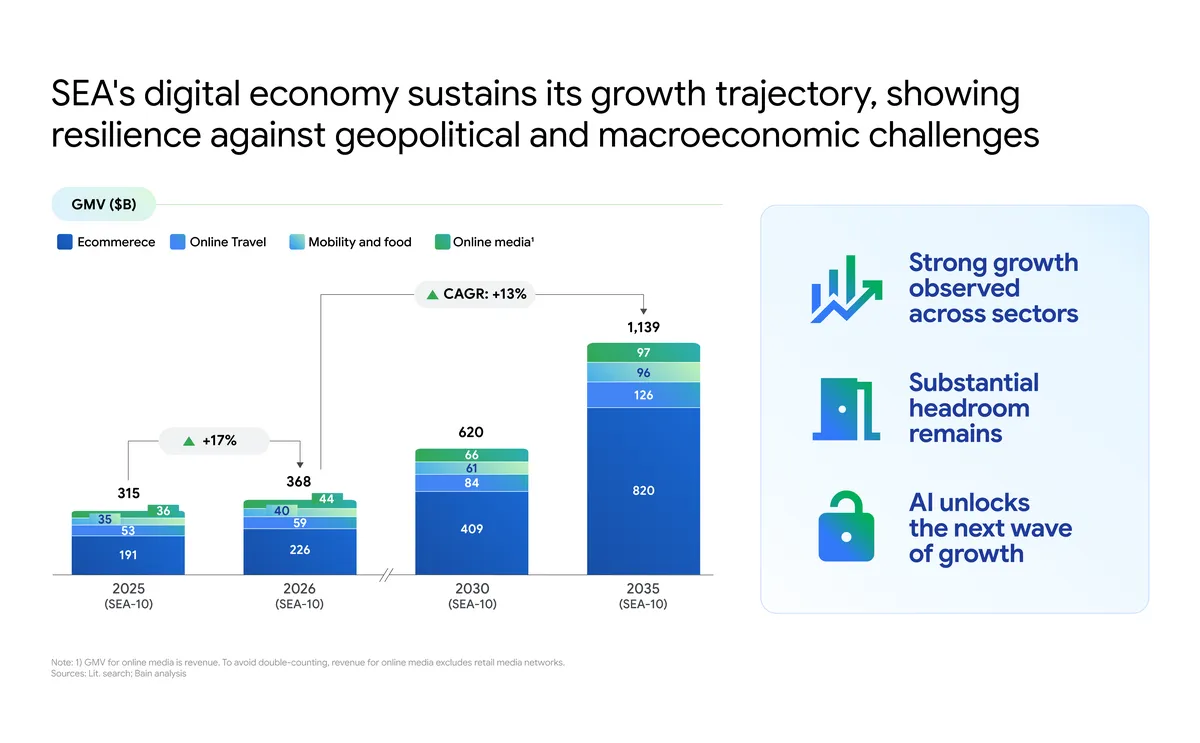
The digital landscape of Southeast Asia is undergoing a profound transformation as generative artificial intelligence (AI) transitions from an experimental novelty to a foundational driver of economic activity. According to the 11th annual e-Conomy SEA report, titled "Building the Intelligent Economy," the region’s digital economy is projected to reach $368 billion in Gross Merchandise Value (GMV) by 2026. This represents a robust 17% year-on-year growth, signaling that the region is firmly on a trajectory to surpass the $1 trillion milestone by 2035. This comprehensive study, a collaborative effort between Google, Temasek, and Bain & Company, underscores a pivotal shift: AI is no longer a peripheral technology but the primary catalyst for the next decade of regional growth.
The Rapid Ascent of Generative AI
The adoption of generative AI in Southeast Asia has outpaced almost every other major technological rollout in recent history. The report reveals that 243 million people, representing approximately 58% of the region’s working-age population, are now active users of generative AI tools. This scaling process is occurring four times faster than the initial rollout of the mobile internet over a decade ago.
This acceleration is not merely a matter of consumer curiosity; it is a fundamental restructuring of how value is created and measured. The report introduces "tokens"—the basic units of data processed by AI models—as a new benchmark for measuring the health and scale of the digital economy. Projections indicate a 60-fold surge in regional AI usage over the next five years, driven largely by the emergence of "agentic commerce," where AI agents perform autonomous tasks, from price comparisons to completing complex transactions.
A Chronology of Digital Evolution in Southeast Asia
To understand the current surge, it is necessary to view it through the lens of the region’s digital evolution over the last decade.
In the mid-2010s, Southeast Asia underwent a "mobile-first" revolution, skipping the desktop era for millions of consumers. By 2019, the digital economy was valued at roughly $100 billion, driven primarily by ride-hailing and e-commerce. The COVID-19 pandemic served as a massive accelerant, forcing a decade’s worth of digital adoption into two years. By 2022, the focus shifted from pure user acquisition to "profitable growth" as global interest rates rose and venture capital became more selective.
In 2024 and 2025, the narrative has shifted again. The "efficiency" era has evolved into the "intelligence" era. Companies are no longer just looking to cut costs; they are leveraging AI to unlock new revenue streams and enhance consumer engagement. This timeline illustrates a region that is highly adaptable, moving from basic connectivity to sophisticated, AI-driven consumption in record time.
Sectoral Impact: How AI Sustains and Accelerates Growth
The e-Conomy SEA 2026 report breaks down the impact of AI across five core pillars of the digital economy, showing that the technology is providing a significant "lift" to already maturing sectors.
E-commerce: The $226 Billion Anchor
E-commerce remains the largest contributor to the regional digital economy, expected to reach $226 billion in GMV with an 18% annual growth rate. AI is revolutionizing the "discovery" phase of shopping. Instead of simple keyword searches, consumers are using multimodal tools—such as searching via images or voice—and interacting with in-app AI assistants. These personalized experiences have led to a 10% increase in conversion rates and, in some cases, order volume uplifts of up to 75%.
Online Travel: Planning the Complex
With a GMV of $59 billion and 10% growth, the travel sector is seeing a shift in consumer behavior. While traditional search engines remain dominant, generative AI has surpassed social media to become the second-most utilized tool for organizing complex travel itineraries. AI’s ability to synthesize vast amounts of data regarding flights, hotels, and local attractions into a cohesive plan is proving invaluable to the region’s burgeoning middle class.
Online Media: The $4 Billion Commerce Media Opportunity
Online media revenue is surging at 22% year-on-year, reaching $44 billion. AI is being used to hyper-personalize content feeds and ad placements. This has resulted in a 10% to 20% improvement in engagement quality. A significant sub-sector is "commerce media"—advertising that happens directly on shopping platforms—which has blossomed into a $4 billion market as brands use AI to target consumers at the exact moment of intent.
Mobility and Food Delivery: Predictive Efficiency
The mobility and food delivery sectors are projected to reach $40 billion in GMV, growing at 15%. Here, AI is used behind the scenes for predictive demand modeling, smarter courier routing, and pooled ride-sharing options. These efficiencies save consumers time and lower costs for providers, sustaining healthy growth even as the market matures.

Digital Financial Services: A $1.65 Trillion Powerhouse
Digital Financial Services (DFS) represent the largest segment by Gross Transaction Value (GTV), hitting $1,650 billion. AI’s role here is critical for risk management, real-time fraud detection, and credit scoring for the "unbanked" or "underbanked" populations. Singapore continues to lead the region as a hub for digital wealth management, using AI to provide personalized financial advice that was previously available only to high-net-worth individuals.
The Era of Agentic Commerce and Consumer Trust
A standout finding of the report is the high level of consumer trust in AI within Southeast Asia. Approximately 62% of users report having more trust in AI tools today than they did just a year ago. This trust is built on three pillars: a proven track record of helpfulness (56%), increasing familiarity (55%), and the perceived accuracy of outputs (53%).
This reservoir of trust is essential for the next phase of the digital economy: agentic commerce. The report finds that 72% of users already rely on basic automation like price tracking, and 75% express a willingness to allow AI agents to autonomously complete transactions on their behalf. However, this transition is contingent on platforms providing robust "guardrails." Consumers are demanding:
- Privacy Safeguards: 44% of users cite data protection as a primary concern.
- Transparency: 36% want clear information on AI limitations.
- Reversibility: 30% insist on the ability to reverse or cancel transactions initiated by an AI agent.
Strategic Implications and Necessary Adaptations
To support the projected 60-fold increase in AI usage by 2030, the report identifies four critical areas where the regional ecosystem must adapt. While the digital economy is robust, its long-term health depends on systematic evolution in the following domains:
1. Digital Infrastructure and Data Centers
The demand for AI processing requires a massive expansion of data center capacity. Southeast Asia is becoming a global hub for data center investment, with significant projects underway in Malaysia, Thailand, and Indonesia. Ensuring a stable, green energy supply to power these facilities is a primary challenge for regional governments.
2. Talent Development
There is a critical shortage of AI-specialized talent. The report suggests that for the region to reach its $1 trillion potential, there must be a concerted effort between the private sector and academia to upskill the workforce. This includes not just high-level data scientists, but a "digitally fluent" workforce capable of using AI tools in daily operations.
3. Regulatory Harmonization
As AI becomes more integrated into daily life, fragmented regulations across the ten ASEAN nations could hinder cross-border digital trade. The report advocates for a harmonized approach to AI governance that balances innovation with consumer protection and ethical standards.
4. Sustained Investment
While venture capital has become more cautious, the "quality" of investment is rising. Investors are moving away from "growth at all costs" toward companies that demonstrate a clear AI-driven path to profitability. Maintaining this investment flow is vital for the region’s startups to scale into global contenders.
Analysis: The Path to $1 Trillion
The findings of the e-Conomy SEA 2026 report suggest that Southeast Asia is uniquely positioned to lead the global "Intelligent Economy." Unlike Western markets, which often face "legacy" hurdles, Southeast Asia’s digital-first population is more receptive to new technologies. Nitin Gajria, Managing Director at Google for Southeast Asia and South Asia Frontier Markets, noted that the speed of AI adoption in the region is a testament to its vibrant digital ecosystem.
The transition from a $368 billion economy in 2026 to a $1 trillion economy by 2035 will not be linear. It will require navigating geopolitical shifts, energy constraints, and the inherent risks of autonomous technology. However, the data indicates that the foundation is solid. With over half the working population already engaged with AI and a clear roadmap for sector-specific integration, Southeast Asia is no longer just "emerging"—it is defining the future of the global digital landscape.
As the region moves toward this trillion-dollar future, the focus will likely shift from how many people are online to how intelligently they are using that connectivity. The 11th e-Conomy SEA report makes it clear: the intelligent economy is not a distant prospect; it is already here, and it is reshaping Southeast Asia in real-time.
