

In today’s hyper-connected and information-saturated business landscape, the ability to merely present facts and figures is no longer sufficient to captivate audiences and drive action. The profound power of business storytelling, a concept frequently discussed and increasingly adopted, has emerged as a critical differentiator for leaders aiming to secure deals, gain budget approvals, and navigate their teams through periods of significant change. Far from requiring a personal anecdote at the start of every meeting, true business storytelling involves framing information as a compelling narrative, leveraging proven techniques to engage audiences deeply and inspire tangible outcomes. This approach transforms a dry recitation of data into an immersive experience, fostering connection and clarity that traditional presentations often fail to achieve.
The evolution of business communication has seen a notable shift from purely logical, data-driven reports to more emotionally resonant, narrative-based delivery. This transformation is not merely a stylistic preference but a strategic imperative. As attention spans dwindle and decision-makers are bombarded with countless proposals and updates, the human brain’s innate wiring for stories becomes a powerful tool. Research in cognitive psychology suggests that information presented in a narrative format is significantly more memorable and persuasive than uncontextualized facts. Leaders who master this craft become not just presenters, but architects of understanding, capable of shaping perceptions and galvanizing collective effort towards shared objectives.
The Foundational Framework: Embracing the Hero’s Journey
At the core of effective storytelling lies a universal structure that resonates deeply with the human psyche: the Hero’s Journey. Originating from ancient myths and epic tales, this archetypal narrative arc, popularized by Joseph Campbell, provides a robust framework for structuring any compelling story, including a business presentation. It typically begins with a hero in their ordinary world, who then encounters a challenge or a "call to adventure." Unable to overcome this challenge alone, the hero seeks or finds a mentor who provides the necessary tools, wisdom, or encouragement. Equipped with this guidance, the hero confronts the challenge, often undergoing a transformation, and ultimately achieves a "new bliss" or a return to a changed, better world.
For a business presentation, understanding and applying this structure is paramount. It necessitates a clear beginning, middle, and end. The presentation must establish the current state, highlight the existing problem or opportunity (the hero’s challenge), introduce the proposed solution (the mentor’s guidance), and paint a vivid picture of the desired future state (the happily ever after). The power of this structure lies in its ability to create dramatic tension and resolution, guiding the audience through a relatable journey of problem-solving. However, the success of this framework hinges on accurately identifying who embodies the hero and who assumes the role of the mentor within the business context.

Shifting Perspectives: The Audience as the True Hero
A common pitfall in business presentations is the presenter inadvertently positioning themselves or their company as the hero. This often manifests in presentations that heavily emphasize a company’s storied history, extensive client lists, or numerous accolades. While establishing credibility is important, an excessive focus on self-glorification can alienate the audience, who may perceive the presentation as self-serving rather than problem-solving. This approach inadvertently places the audience in a passive, secondary role, diminishing their engagement and investment in the proposed solution.
In contrast, the most impactful storytelling presentations consciously position the audience as the hero. This strategic shift is critical because it is the audience who faces the challenges, who experiences the pain points, and who ultimately needs a guide to navigate towards a better future. By making the audience the protagonist, the presenter demonstrates empathy and understanding, creating an immediate and profound connection. The narrative becomes about their journey, their struggles, and their potential for success. This reframing not only enhances engagement but also makes the proposed solution more relevant and compelling, as it directly addresses the hero’s plight.
The Presenter’s Role: The Guiding Mentor
If the audience is the hero, then the presenter naturally assumes the role of the mentor. This role is not about receiving glory but about providing invaluable guidance, insights, and solutions. Experienced presentation storytellers consistently embody this mentor archetype, focusing their efforts on empowering the audience with the tools necessary to overcome their challenges. This approach transforms the presentation from a monologue of self-promotion into a collaborative journey towards a shared goal.
Consider a scenario involving a meal kit delivery service. A "hero" presenter might highlight the company’s superior ingredients, innovative menus, and glowing reviews, essentially stating, "We are the best." While this conveys quality, it fails to connect with the audience’s underlying needs. A "mentor" presenter, however, would begin by acknowledging the audience’s struggles – for example, the dilemma parents face balancing quality family time with preparing healthy meals. The narrative then shifts to how the meal kit service acts as the solution, cutting cooking time in half and empowering parents to achieve both goals. This empathetic framing ("We come alongside you to solve your problem") resonates deeply, demonstrating that the presenter understands and cares about the audience’s journey, thus building trust and paving the way for action.

Engaging Through Contrast: The Presentation Sparkline™ Framework
Beyond character roles, the dynamism of a story is often found in its contrast. Linear narratives, which proceed smoothly from one point to the next using "and," tend to be less engaging. The most captivating stories, conversely, introduce tension and variation through "but then" moments. For instance, "Sarah wakes up and goes to work, but then she gets a flat tire." This contrast creates anticipation and keeps the audience invested in the unfolding events.
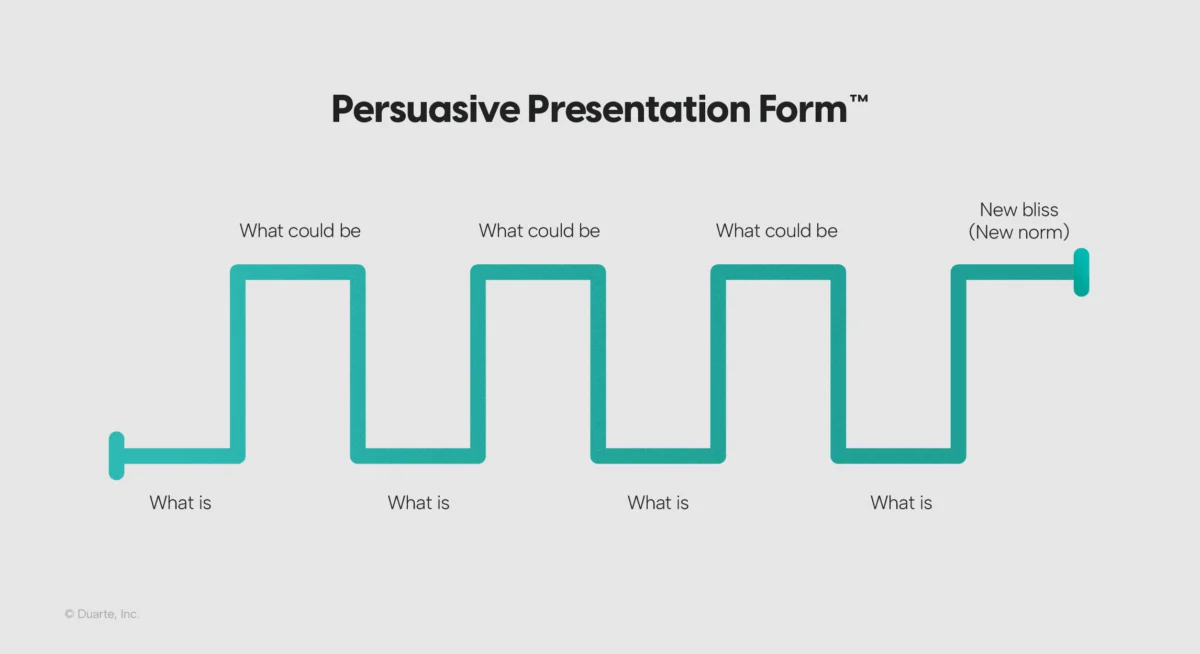
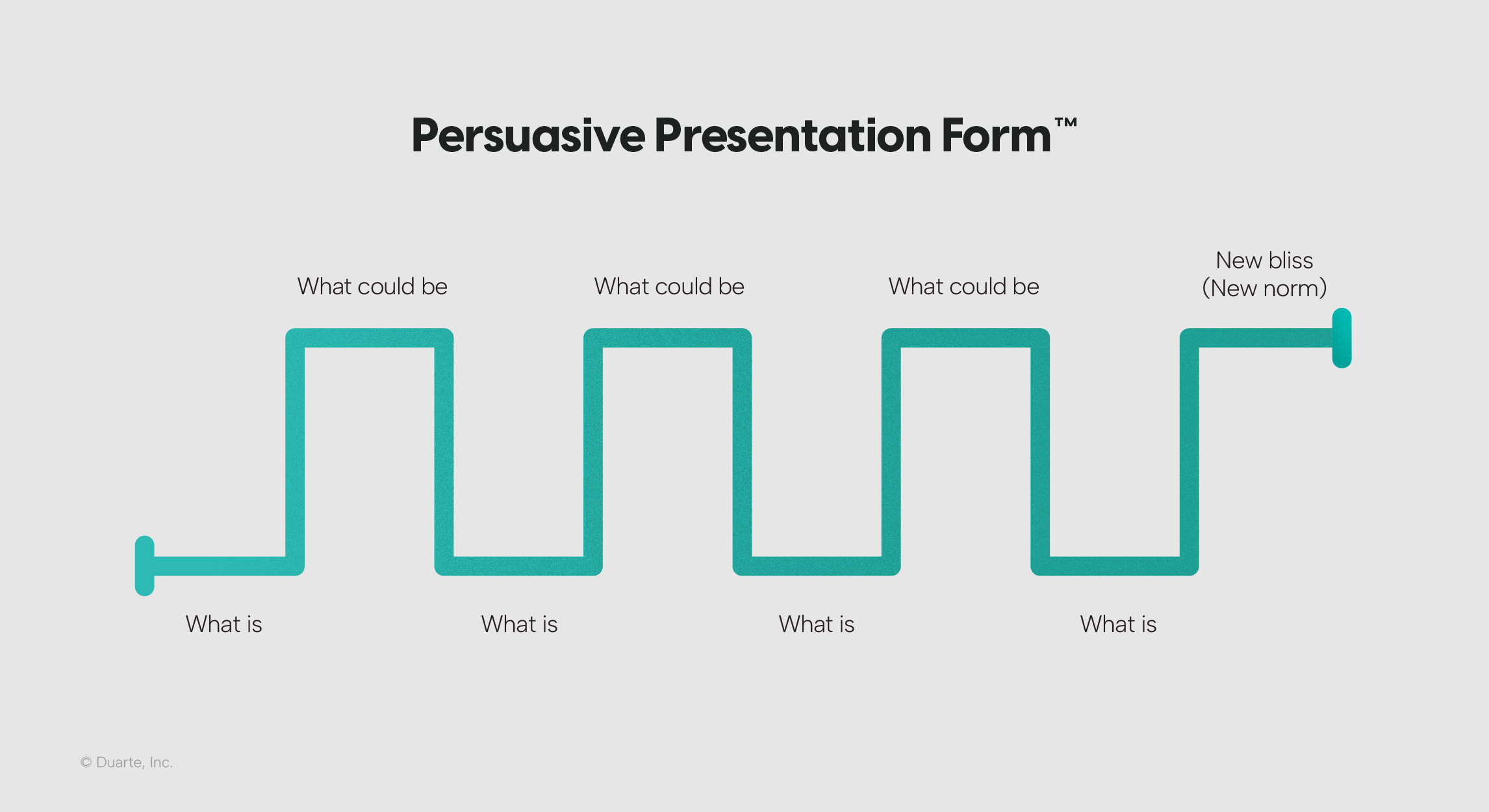
In business presentations, this principle translates into the Duarte Presentation Sparkline™ framework. Traditional reports often maintain a relatively flat line, dwelling on "what is" – the current state, both positive and negative – with a brief suggestion for "what could be" at the end. Conversely, a typical pitch might start with "what is" but quickly ascend to an idealized vision of "what could be," often sounding too good to be true. Both structures lack the dynamic interplay necessary to sustain audience engagement.
The Presentation Sparkline™ framework, however, constantly oscillates between "what is" (the current reality, challenges, and pain points) and "what could be" (the proposed solution, the vision for a better future, and the benefits). This rhythmic alternation creates a compelling narrative tension, mirroring the natural ebb and flow of problem-solving and progress. By repeatedly illustrating the gap between the current state and the desired future, and then offering bridges to cross that gap, the presenter keeps the audience actively involved. Iconic examples like Steve Jobs’ 2007 iPhone launch and Dr. Martin Luther King, Jr.’s "I Have a Dream" speech famously follow this structure, demonstrating its universal power to persuade and inspire.
Crafting Unforgettable Moments: S.T.A.R. Moments™
Even the most well-structured presentation can benefit from specific, unforgettable anchors. These are what Duarte calls S.T.A.R. Moments™ – "Something They’ll Always Remember." In an age of information overload, where detailed facts can quickly blur, a single, powerful moment can etch the core message into the audience’s memory. These moments are designed to be vivid, emotionally resonant, or strikingly illustrative, serving as memorable touchstones for the entire presentation.

A quintessential example comes from Al Gore’s presentation on climate change, which inspired his documentary An Inconvenient Truth. Faced with the challenge of communicating the alarming projected rise in CO2 concentration over the next 50 years, Gore didn’t just display a graph. Instead, he created a S.T.A.R. Moment by stepping onto a mechanical lift that physically ascended alongside the rising CO2 data on a massive chart. This experiential demonstration transformed abstract numbers into a visceral, unforgettable reality, allowing the audience to "feel" the magnitude of the problem in a way that mere statistics could not. Such moments transcend the purely cognitive, tapping into emotional and sensory memory, making the message profoundly sticky.
Humanizing Data: The Art of Data Storytelling
One of the most significant hurdles in business storytelling is integrating complex data without sacrificing narrative flow or audience engagement. Data, in its raw form, is inert; it requires a presenter to imbue it with meaning and context. Effective data storytelling transforms dry statistics into compelling insights, making them accessible and impactful. This can be achieved by marveling at the magnitude of a data point, humanizing the data to show its real-world impact, or surprising the audience with unexpected revelations.
Steve Jobs was a master of data storytelling. In his 2008 MacBook Air reveal, instead of simply stating the laptop’s slimmest dimension (0.76 inches), he performed a memorable feat: he slid the device into a standard manila envelope. This unexpected visual demonstration instantly communicated the product’s revolutionary thinness in a relatable and astonishing way. The manila envelope became a universal, tangible unit of measurement, shocking the audience and making the data point profoundly memorable. This technique bridges the gap between abstract numbers and concrete understanding, ensuring that the data supports, rather than detracts from, the overarching narrative.
The Vision of a New Bliss: Concluding with Impact
Every compelling story requires a satisfying conclusion, and business presentations are no exception. The final act of a storytelling presentation is not merely a summary but a powerful vision of "new bliss." This is the "happily ever after" for the audience-hero, a vivid and attainable future state where their challenges have been overcome thanks to the mentor-presenter’s solutions. It is crucial that this vision is not a fairytale but a realistic and achievable outcome, grounded in the practical solutions presented.
The "new bliss" serves as a call to action, inspiring the audience to embrace the proposed changes or adopt the presented solutions. It provides psychological closure to the narrative arc, reinforcing the benefits and the positive transformation awaiting the hero. By painting a clear, hopeful, and tangible picture of the future, the presenter solidifies the value proposition and empowers the audience to take the necessary steps towards realizing that vision. This powerful ending leaves the audience not just informed, but inspired and motivated to act.
Implications for Modern Business Leadership
The increasing emphasis on storytelling in business presentations underscores a broader shift in leadership and communication paradigms. In an era where authenticity and connection are highly valued, leaders are expected to do more than just manage operations; they must inspire, align, and motivate. Business storytelling is a core competency for achieving these objectives, impacting various facets of an organization:
- Sales and Marketing: Narratives cut through the noise, making products and services more desirable by connecting them to customer needs and aspirations.
- Change Management: Storytelling helps employees understand the "why" behind organizational changes, reducing resistance and fostering a sense of shared purpose during transitions.
- Team Alignment: Leaders can use stories to articulate vision, values, and strategy, uniting teams around a common direction and fostering a strong corporate culture.
- Investor Relations: Compelling narratives can convey market potential and business strategy more effectively than raw financials, securing crucial funding and partnerships.
The ability to craft and deliver powerful storytelling presentations is no longer a niche skill but a fundamental requirement for effective leadership in the 21st century. Organizations that invest in developing these capabilities among their teams often report higher engagement, increased productivity, and more successful outcomes across the board. Whether through agency partnerships to craft bespoke presentations or comprehensive training programs to equip internal teams, mastering business storytelling is an investment in an organization’s persuasive power and future success. As the world continues to grapple with complex challenges and rapid change, the leaders who can tell the most compelling stories will be the ones who ultimately shape the future.
