

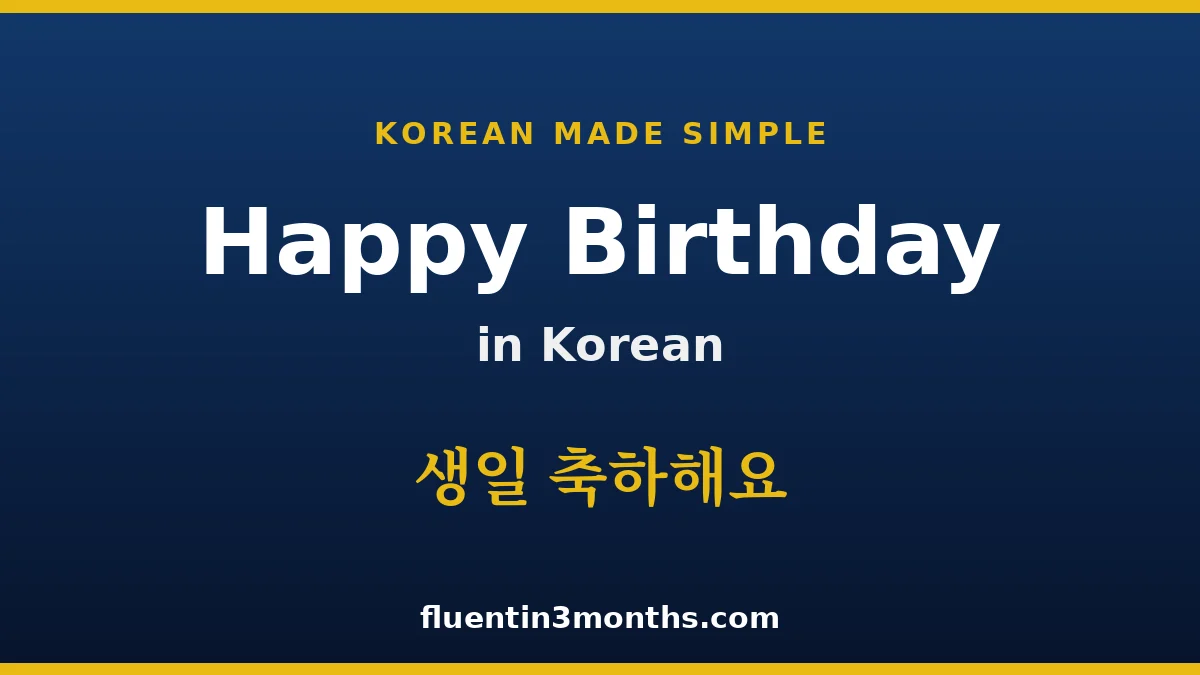
The Korean phrase for happy birthday, saeng-il chuk-ha-hae-yo (생일 축하해요), represents more than a simple well-wish; it serves as a primary gateway into the complex sociolinguistic hierarchy of the Korean language. While English speakers utilize a singular phrase regardless of the recipient’s social standing, the Korean language dictates that the speaker’s choice of words must reflect the age, social status, and level of intimacy shared with the person being celebrated. Failure to navigate these linguistic nuances can lead to social friction, highlighting the deep-seated cultural emphasis on respect and collectivism that remains a cornerstone of modern South Korean life.
Linguistic analysis reveals that the standard Korean greeting does not translate literally to "happy birthday." Instead, the verb chuk-ha-ha-da (축하하다) means "to congratulate." This subtle distinction shifts the focus from the individual’s emotional state—wishing them "happiness"—to a communal recognition of the achievement of surviving and thriving for another year. This perspective is rooted in historical East Asian contexts where reaching subsequent years was a significant milestone in the face of various societal and health-related challenges.
The Hierarchy of Politeness and Social Stratification
In the Korean language, politeness levels, or jondaemal (존댓말), are embedded into the grammar through specific verb endings and vocabulary choices. Understanding when to use each of the four primary birthday greetings is essential for maintaining social harmony.
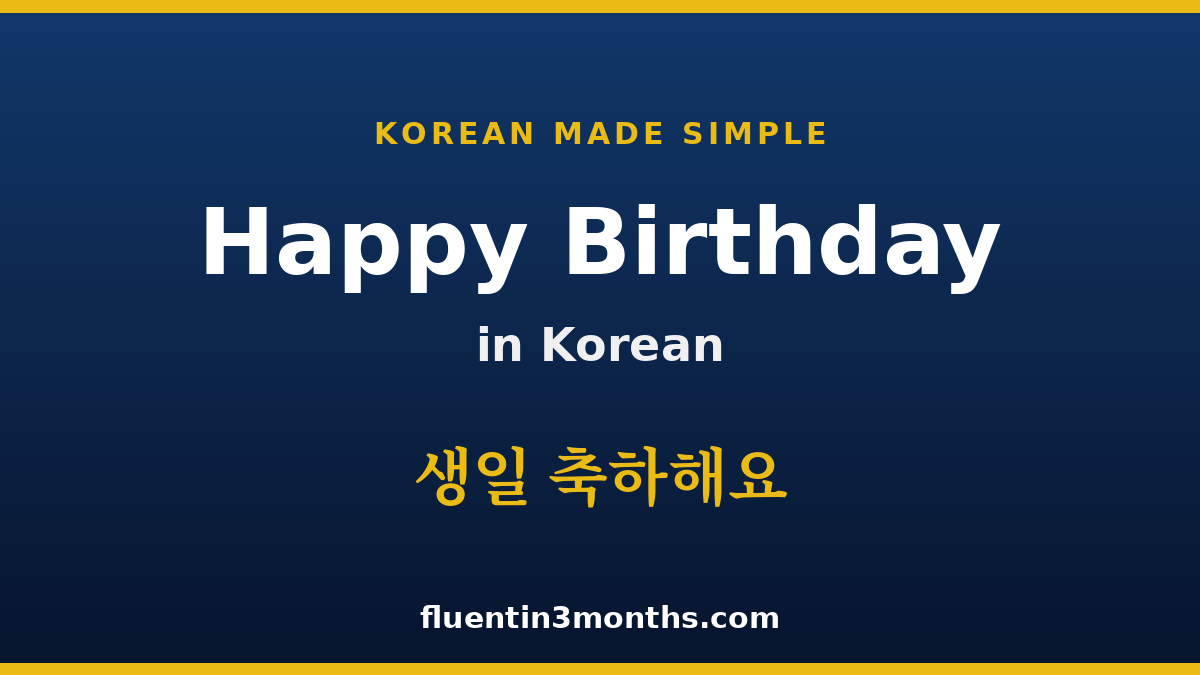
The most informal level, saeng-il chuk-ha-hae (생일 축하해), is categorized as banmal (반말), or "half-speech." This version is strictly reserved for close friends, younger siblings, or children. Using this with a superior or an older acquaintance is considered a significant breach of etiquette. Moving up the social ladder, saeng-il chuk-ha-hae-yo (생일 축하해요) is the standard polite form. It is the most versatile phrase, suitable for use with colleagues, acquaintances, or those slightly older than the speaker.
For formal environments, such as business meetings or public announcements, saeng-il chuk-ha-ham-ni-da (생일 축하합니다) is employed. This formal-polite level is also the standard used in the Korean version of the "Happy Birthday" song, reflecting a cultural tendency to default to formal speech in ceremonial or public settings.
The highest level of deference is found in the phrase saeng-sin chuk-ha-deu-rim-ni-da (생신 축하드립니다). This version utilizes honorific substitutions: saeng-il (birthday) becomes saeng-sin (honorific birthday), and the verb for "to give" is replaced with the humble deurida (드리다). This specific greeting is mandatory when addressing grandparents, elderly relatives, or high-ranking social figures. In South Korean society, the use of saeng-sin acknowledges the wisdom and longevity of the elder, reinforcing the Confucian values of filial piety that continue to influence contemporary behavior.
Legislative Reform: The Transition of the Korean Age System
One of the most significant shifts in South Korean birthday culture occurred in June 2023, when the South Korean government officially standardized the nation’s age-counting system. Prior to this legislative change, South Korea utilized three distinct methods for calculating age: "International Age" (man nai), "Counting Age" (seneun nai), and "Year Age" (yeon nai).
Under the traditional "Counting Age" system, a child was considered one year old at birth, accounting for the time spent in the womb. Furthermore, everyone in the nation gained a year collectively on New Year’s Day, regardless of their actual birth date. This meant that a child born on December 31 would technically turn two years old on January 1, despite having lived for only two days.
The complexity of these overlapping systems led to significant administrative confusion and social costs. In December 2022, the South Korean National Assembly passed a set of bills to standardize the age system to match international norms. Minister of Government Legislation Lee Wan-kyu stated during the transition that the move was intended to "reduce unnecessary social costs" and resolve "legal and social disputes" arising from the different age calculations.
As of June 28, 2023, most administrative and legal documents—including passports, age-restricted contracts, and healthcare records—default to the international system. While older generations may still refer to their "Korean age" in casual conversation, the younger demographic has rapidly adopted the international standard, marking a modernization of how milestones are tracked in the country.
Ritualistic Traditions: Miyeok-guk and the Symbolism of Seaweed
The consumption of miyeok-guk (미역국), or seaweed soup, is the most ubiquitous birthday tradition in South Korea. Unlike Western traditions that prioritize the birthday cake, miyeok-guk is considered a mandatory morning meal for the celebrant. The origins of this tradition are deeply maternal. Seaweed is naturally rich in iodine and calcium, and for centuries, it has been the primary recovery food for Korean women following childbirth.
By consuming miyeok-guk on their birthday, individuals are not merely eating a traditional dish; they are performing a ritual of remembrance for their mother’s sacrifice and the pain of labor. It is a quiet, reflective acknowledgement of one’s origins.
The cultural weight of miyeok-guk extends into other areas of life, specifically education. Because seaweed is physically slippery, a popular superstition suggests that eating the soup before an exam will cause the student to "slip" and fail. Consequently, while it is celebrated on birthdays, it is strictly avoided during the Suneung (the national college entrance exam) season. Data from retail sectors often show a spike in seaweed sales during major birthday months, yet a noticeable dip or specific marketing shifts during national exam periods.
The First Milestone: Doljanchi and the Doljabi Ritual
In South Korean culture, the first birthday, known as doljanchi (돌잔치), is arguably the most significant celebration in a person’s early life. Historically, high infant mortality rates in the pre-industrial era meant that reaching the one-year mark was a major triumph. While medical advancements have rendered the survival concern obsolete, the doljanchi remains a massive social event, often held in large hotel banquet halls with hundreds of guests.
The centerpiece of the doljanchi is the doljabi (돌잡이), a fortune-telling ritual. The infant is placed before a variety of objects, each representing a potential future path:
- Thread or String: Symbolizes a long and healthy life.
- Money: Represents future wealth and prosperity.
- Books or Pencils: Suggest a future as a scholar or intellectual.
- Stethoscope or Gavel: Modern additions representing careers in medicine or law.
The object the child picks first is believed to predict their career or destiny. Families often record this moment with great ceremony, and it serves as a lighthearted but significant communal bonding experience. The economic impact of the doljanchi industry is substantial; in urban centers like Seoul, booking a premier venue for a first birthday party can require reservations up to a year in advance, with costs often rivaling those of small weddings.
The Scientific and Cultural Foundation of Hangul
The ability to write and read these greetings is facilitated by Hangul, the Korean alphabet. Commissioned by King Sejong the Great in 1443 and promulgated in 1446, Hangul was designed to increase literacy among the common people, who struggled with the complexities of Chinese characters (Hanja).
Hangul is unique in its "featural" design. The shapes of the consonants—such as ‘ㄱ’ (g/k), ‘ㄴ’ (n), ‘ㅁ’ (m), ‘ㅅ’ (s), and ‘ㅇ’ (ng)—were intentionally created to mimic the physiological positions of the tongue, mouth, and throat during speech. This scientific approach makes the script one of the most logical and easiest to learn in the world.
For the modern learner or the international observer, the ease of Hangul has contributed to the global spread of Korean culture (the Hallyu wave). As South Korean music, film, and digital content reach global audiences, the specific terminology of birthdays—and the respect levels they command—has become a point of interest for millions of people worldwide.
Sociological Implications and Global Influence
The meticulous nature of Korean birthday greetings reflects a society that prioritizes "nunchi" (눈치), the art of sensing another person’s mood and social position. In a globalized context, as South Korean corporations like Samsung, Hyundai, and SK Group expand their international footprints, understanding these linguistic hierarchies has become a component of corporate diplomacy and intercultural competence.
Furthermore, the South Korean government’s recent efforts to streamline the age system and promote traditional culture through tourism initiatives indicate a nation that is balancing its rapid technological advancement with its historical identity. The birthday, once a simple marker of time, has evolved into a complex intersection of law, nutrition, filial piety, and linguistic precision.
Whether it is through the sharing of miyeok-guk or the careful selection of a politeness level, the act of celebrating a birthday in Korea remains a profound exercise in social cohesion. It serves as a reminder that in Korean society, an individual’s identity is always understood in relation to others, and every year lived is a communal achievement worth congratulating.
