


The roar of the crowd, the tension of a tight leaderboard, and the seemingly simple act of sinking a golf ball into a hole – these elements combine to create the captivating drama of professional golf. This past Sunday, the BMW Championship provided a compelling showcase of this drama, culminating in a hard-fought victory for Wyndham Clark. While Clark’s triumph on the greens of Olympia Fields Country Club was a testament to his skill and resilience, it also served as a powerful reminder of a fundamental psychological principle that shapes human decision-making: loss aversion.
For many, the allure of professional golf extends beyond the athletic prowess on display. It offers a window into the intricate workings of the human mind under pressure. The final round of the BMW Championship, in particular, offered a vivid illustration of how psychological factors can influence performance, even for athletes operating at the pinnacle of their profession.
Wyndham Clark’s Dominant Performance and a Shifting Lead
Wyndham Clark entered the final day of the BMW Championship with a commanding five-shot lead, a position many would deem comfortable. However, the fickle nature of golf, coupled with the immense pressure of a championship event, soon tightened the contest. As the day progressed, and particularly on the back nine, Clark’s substantial lead began to erode. The narrative shifted from a potential procession to a nail-biting showdown.
By the crucial latter stages of the round, the lead had evaporated, setting the stage for a dramatic conclusion. It was here, amidst the intense scrutiny and the palpable pressure, that both Clark and his pursuers faced their ultimate tests. While mistakes from those chasing him played a role, it was Clark’s own exceptional play, including a spectacular three-birdie finish, that ultimately secured him a three-shot victory. This performance, marked by its dramatic shifts and eventual triumph, served as a powerful catalyst for examining the underlying psychological forces at play.
The Enduring Mystery of the Six-Foot Putt: A Scientific Inquiry
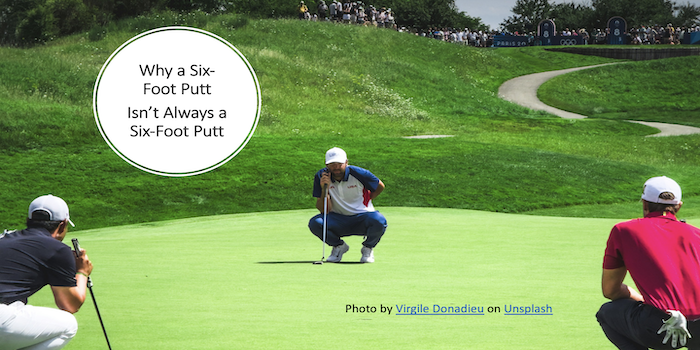
Clark’s victory, and the dramatic swings in his lead, brought to mind significant research conducted by economists and behavioral scientists. A pivotal study, published in 2011 by Devin Pope and Maurice Schweitzer in the prestigious American Economic Review, delved into the subtle yet impactful psychological biases that affect professional golfers. Their paper, titled “Is Tiger Woods Loss Averse? Persistent Bias in the Face of Experience, Competition, and High Stakes,” utilized an unprecedented dataset to explore a fascinating question: is a six-foot putt simply a six-foot putt, or does something more profound influence its outcome?
The researchers meticulously analyzed over 2.5 million PGA Tour putts, meticulously recorded using precise ShotLink measurements, across 421 golfers over a five-year period, from 2004 to 2009. The sheer scale of this dataset provided a robust foundation for drawing statistically significant conclusions.
The Discrepancy: Birdie vs. Par Putts
The findings of Pope and Schweitzer were striking and counterintuitive. Their analysis revealed that professional golfers were approximately 2 to 4 percentage points more likely to make a par putt than a comparable birdie putt. This statistical anomaly held true even when controlling for factors such as the golfer, the distance of the putt, and the general playing conditions. In essence, the same putt, from the same distance, under similar circumstances, yielded a measurably different success rate depending on whether it was to save par or to achieve a birdie.
This observation challenges the purely objective view of golf, where every stroke carries equal weight on the scorecard. Psychologically, however, the implications of sinking or missing a putt can differ dramatically.
Unpacking Loss Aversion: The Fear of Losing
The key to understanding this discrepancy lies in the psychological principle of loss aversion. Pioneered by behavioral scientists Daniel Kahneman and Amos Tversky, loss aversion posits that the psychological impact of a loss is significantly greater than the psychological impact of an equivalent gain. In simpler terms, people tend to feel the pain of losing something more acutely than they enjoy the pleasure of gaining something of equal value. This is closely aligned with Robert Cialdini’s principle of scarcity, where the potential loss of an opportunity can be a more powerful motivator than the prospect of gaining something new.
In the context of golf, this translates directly to the golfer’s mindset when standing over a putt.
-
The Birdie Putt: When a golfer faces a putt for birdie, they are presented with an opportunity for gain. They are aiming to achieve a score one stroke below par. If they miss this putt, and subsequently make their next putt, they still achieve par. The potential gain is a lower score, but the immediate consequence of missing isn’t necessarily a stroke lost relative to their current position on the hole.
-
The Par Putt: Conversely, when standing over a putt to save par, the psychological stakes are different. The golfer is aiming to maintain their current score. If they miss this putt, they will lose a stroke, resulting in a bogey. The emotional weight of avoiding this loss – the negative consequence of a missed putt – often outweighs the positive anticipation of gaining a birdie.
This subtle, yet potent, psychological difference appears to influence the decision-making and execution of even the most skilled golfers in the world. The pressure to avoid a negative outcome can, paradoxically, lead to less consistent performance than the pursuit of a positive one.
The Evolving Bias: Tournament Progression and Field Awareness
Interestingly, Pope and Schweitzer’s research also identified a temporal shift in this loss aversion phenomenon. They observed that the difference in putting success between par and birdie putts decreased as tournaments progressed. The gap narrowed from 3.8 percentage points in the first round to 2.1 percentage points in the final round. However, it is crucial to note that the bias never completely disappeared, even in the high-stakes final rounds.
The researchers attributed this reduction in the bias to a shift in the golfers’ psychological focus. In the earlier rounds, golfers tend to concentrate more on their score relative to par for the course. As the tournament advances to the final round, their focus often shifts to their score relative to the field of other competitors. This increased awareness of the competitive landscape can, to some extent, dilute the singular focus on avoiding a lost stroke for par, as the overarching goal becomes outperforming rivals.
This nuance is particularly significant when considering the caliber of professional golfers. These individuals possess an extraordinary level of experience, dedicate countless hours to relentless practice, compete under immense pressure, and often have millions of dollars riding on their performance. Yet, despite this exceptional training and experience, they remain susceptible to fundamental human psychological tendencies.
Broader Implications: Loss Aversion Beyond the Fairway
The lessons learned from the golf course extend far beyond the realm of sports. The research by Pope and Schweitzer offers a profound insight into how loss aversion shapes decision-making in everyday life and in various professional contexts. It highlights that the principle of scarcity, often associated with overt sales tactics, can manifest in more subtle ways.
Consider common sales and marketing strategies:
- "Limited Time Offer": This tactic plays on the fear of losing out on a deal if the purchase is delayed. The scarcity is the dwindling time window.
- "Only X Left in Stock": This creates a sense of urgency by highlighting the limited availability, preying on the fear of missing out on a desired item.
- "Don’t Miss Out on This Opportunity": This phrase directly appeals to the fear of loss, framing the decision as a choice between gaining a benefit and losing it entirely.
However, as the golf example demonstrates, scarcity can also be the inherent possibility of losing something one already possesses or has a right to. For a golfer, the putt for par represents the potential loss of a stroke they currently have the opportunity to preserve. This fear of a negative outcome can be a more potent motivator than the prospect of a positive gain.
Ethical Influence and Decision-Making Awareness
Understanding these psychological drivers is not about manipulating others’ fears. Instead, it is about fostering ethical influence through awareness. The goal is to comprehend how people naturally make decisions and then to communicate relevant information truthfully and transparently.
For individuals facing important decisions, whether personal or professional, a crucial self-reflection is warranted:
- Are you genuinely pursuing something you desire, or are you primarily reacting to the fear of losing something?
- Is the perceived scarcity a true limitation, or is it an amplified fear of a negative outcome?
Recognizing the powerful influence of loss aversion can lead to more rational and informed choices. It allows individuals to distinguish between genuine opportunity and the compelling urge to avoid a perceived loss. The difference, as illustrated by the subtle yet significant impact on professional golfers, can be far more profound than initially realized.
A Question for the Enthusiasts
For those who navigate the greens themselves, the question remains: does the psychological weight of a six-foot putt for birdie feel distinct from a six-foot putt for par? The research suggests it does, and the implications ripple through every aspect of decision-making, from the professional fairway to the everyday choices that shape our lives. The mastery of golf, like the mastery of one’s own decisions, often lies not just in the execution of skill, but in the nuanced understanding of the human mind.
