

Storytelling has transcended its traditional role in entertainment to become a critical strategic asset in the contemporary business landscape. Far from being a mere buzzword, the ability to articulate information through narrative is increasingly recognized as a foundational skill for leaders aiming to secure deals, garner budget approvals, and navigate their teams through complex periods of change. This approach shifts business communication from a linear presentation of facts to an engaging narrative that captivates audiences and compels them towards desired actions. It’s not about theatrical performance in every meeting, but rather about framing data, proposals, and visions within a story arc, employing proven techniques that foster connection and drive tangible outcomes.
The Psychological Foundation of Narrative
At its core, the effectiveness of storytelling in business is rooted in human psychology and neurobiology. For millennia, stories have been the primary vehicle for transmitting knowledge, culture, and values across generations. Our brains are inherently wired to process and retain information presented in narrative form more effectively than discrete facts or bullet points. Research from various fields, including cognitive psychology and neuroscience, consistently demonstrates that stories activate multiple brain regions, including those associated with emotion, memory, and even sensory experiences. This holistic engagement creates a deeper, more lasting impression.
When presented with a compelling story, listeners don’t just passively receive information; they actively participate in constructing meaning. This creates empathy, builds trust, and makes complex ideas more accessible and persuasive. Neuroscientist Uri Hasson’s research at Princeton University, for instance, has shown that when people listen to stories, their brain activity can synchronize with that of the storyteller, leading to a phenomenon called "neural coupling." This deep level of connection is invaluable in business contexts where buy-in and alignment are paramount.
Shifting Paradigms: From Data Dumps to Dynamic Narratives
For decades, business presentations often defaulted to dense slide decks filled with charts, graphs, and extensive text. The underlying assumption was that more data equated to more credibility and persuasiveness. However, in an era of information overload, this approach often leads to disengagement, cognitive fatigue, and ultimately, missed opportunities. A 2018 study by Prezi and Harris Poll found that 70% of employed Americans say presentation skills are critical to their career success, yet 46% admit to tuning out during presentations due to overwhelming data or a lack of engagement.
The shift towards dynamic narratives acknowledges that data, while essential, cannot provide meaning in isolation. It requires a presenter to contextualize, interpret, and imbue it with significance. This evolution marks a departure from purely analytical communication to a more holistic, human-centered approach. Leading consultancies like McKinsey and Gartner increasingly emphasize the need for "data storytelling" – transforming raw data into actionable insights through narrative. This involves not just presenting what the data says, but why it matters, who it impacts, and what the implications are.
Crafting Compelling Narratives: Core Principles and Structures
Integrating storytelling into business presentations is a structured discipline, not merely an artistic embellishment. It involves adopting specific frameworks that resonate deeply with human experience.
1. The Universal Arc: Embracing the Hero’s Journey
One of the most enduring narrative structures, the Hero’s Journey, popularized by mythologist Joseph Campbell, provides a powerful template for business storytelling. This archetypal narrative typically involves:
- An ordinary world and a call to adventure.
- The hero encountering challenges and trials.
- The intervention of a mentor who provides tools or guidance.
- The hero overcoming obstacles and achieving a transformation.
- A return to a "new normal" or "new bliss."
In a business presentation, establishing this structure is crucial for clarity and impact. There must be a clear beginning (the current state or problem), a middle (the journey through challenges and solutions), and an end (the desired future state). The audience needs to recognize the problem, witness the proposed solution, and envision the "happily ever after" – the positive outcome. A common pitfall for presenters is failing to define the hero and mentor clearly, which dilutes the narrative’s power. By consciously mapping business challenges and solutions onto this framework, presenters can create a compelling and familiar narrative trajectory that guides the audience from problem to resolution.

2. Audience at the Core: Positioning the Stakeholder as the Hero
A fundamental principle of effective business storytelling is shifting the focus from the presenter or company to the audience. Many presenters mistakenly position themselves as the hero, recounting their company’s impressive history, client roster, or accolades. While building credibility is important, an excessive self-focus alienates the audience, who are primarily interested in how a solution addresses their problems.
The most impactful storytelling presentations position the audience as the hero. This is because the audience is the one facing the challenges, the one seeking a solution, and the one who will ultimately benefit from the "happily ever after." By making the audience the protagonist, the presenter demonstrates empathy and relevance. This approach aligns with modern marketing and sales philosophies that prioritize customer needs and pain points over product features. A 2021 Salesforce report highlighted that 84% of customers say the experience a company provides is as important as its products and services, underscoring the need for audience-centric communication. When the audience feels understood and central to the narrative, they are far more likely to engage and act.
3. The Guide on the Side: The Presenter’s Role as Mentor
If the audience is the hero, then the presenter naturally assumes the role of the mentor. Experienced presentation storytellers consistently embody this role, eschewing the limelight for the more powerful position of guiding and empowering their audience. They are less concerned with personal glory and more focused on providing the necessary tools, insights, and solutions for their audience to overcome their challenges.
Consider the example of a meal kit delivery service pitch. A "hero" presenter might boast about the company’s superior ingredients and five-star reviews, focusing solely on the company’s merits. In contrast, a "mentor" presenter would address the audience’s pain points directly: "One of the most difficult things about being a parent is feeling torn between spending time with your children and cooking them a fresh, healthy meal. But what if someone could come alongside you and cut the time it takes you to cook for your family in half? That’s what our meal kit delivery service does. By sending fresh, pre-prepared ingredients straight to your door, we save the average family 5 hours per week. No more choosing between time in the kitchen or time with your children. We allow you to do both." This narrative immediately resonates, demonstrating an understanding of the audience’s struggle and positioning the service as the solution, not just a product. This consultative approach fosters trust and builds a stronger case for adoption.
Mastering Engagement: Techniques for Impactful Presentations
Beyond structural elements, specific techniques can elevate a business story from good to unforgettable, ensuring sustained audience engagement.
1. The Power of Contrast: The Sparkline Framework
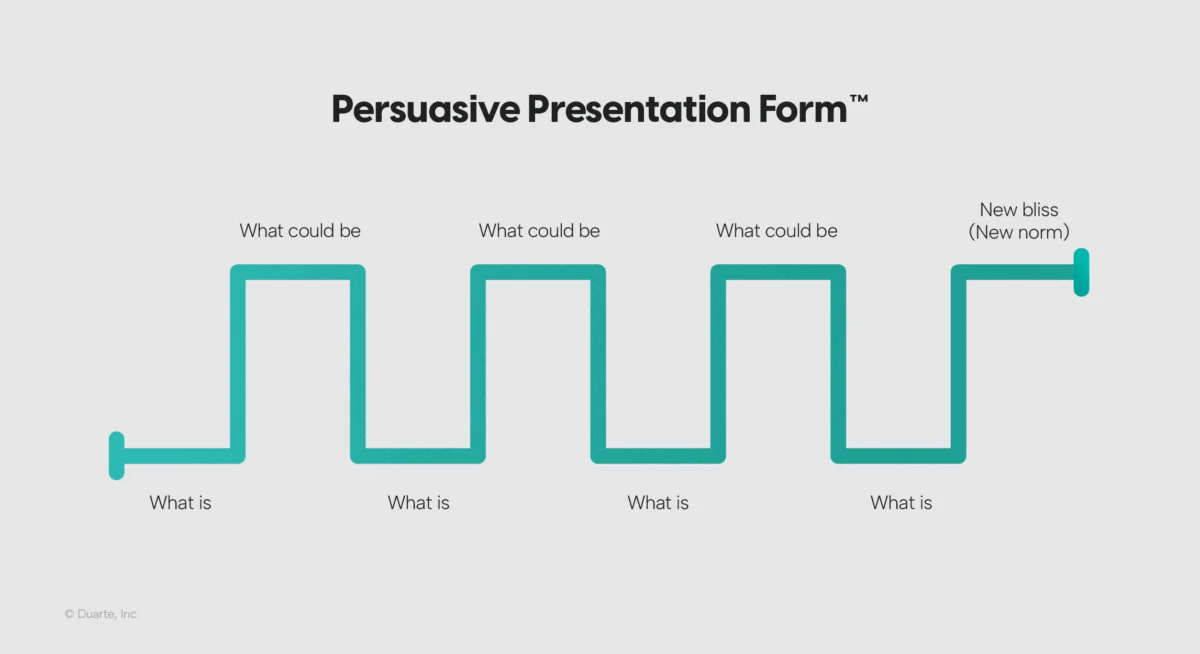
Monotonous, linear presentations ("and then this happened, and then that happened…") quickly lose audience attention. Great stories, and by extension great business presentations, thrive on contrast. This is effectively captured by Duarte’s "Presentation Sparkline" framework, which graphically illustrates the dynamic interplay between "what is" (the current reality, often problematic) and "what could be" (the desirable future state).
Unlike a typical report (which largely stays in "what is") or a standard pitch (which often jumps directly to "what could be"), the Sparkline framework constantly oscillates between these two poles. It highlights the problem, then offers a glimpse of the solution, returning to the current challenges before presenting more of the idealized future. This rhythmic back-and-forth mirrors natural human thought processes and keeps the audience actively engaged by building tension and releasing it. Iconic speeches, such as Steve Jobs’ 2007 iPhone launch and Dr. Martin Luther King, Jr.’s "I Have a Dream" speech, famously follow this pattern, demonstrating its universal power to persuade and inspire. This technique prevents presentations from being perceived as either boring reports or overly optimistic pitches, grounding them in reality while offering a compelling vision.
2. Creating Unforgettable Moments: The S.T.A.R. Method
Human memory is notoriously unreliable for retaining large volumes of factual information. However, people are far more likely to remember specific, impactful moments that evoke emotion or surprise. This is where S.T.A.R. Moments™ (Something They’ll Always Remember) become invaluable. These are carefully crafted segments designed to be highly memorable, often involving a vivid demonstration, a striking statistic, a powerful anecdote, or a visual metaphor.

A classic example is Al Gore’s presentation on climate change, which formed the basis for An Inconvenient Truth. To convey the drastic projected rise in CO2 concentration over 50 years, Gore didn’t just show a chart; he used a lift to ascend alongside the data line, physically demonstrating the alarming scale of the increase. This immersive experience transformed abstract data into a visceral, unforgettable moment. Similarly, Steve Jobs’ 2008 MacBook Air reveal, where he slid the ultra-thin laptop into a standard manila envelope, created a S.T.A.R. Moment that instantly communicated the device’s revolutionary slimness far more effectively than any numerical specification. These moments cut through the noise, anchor key messages, and leave a lasting impression long after the presentation concludes.
3. Beyond Numbers: The Art of Data Storytelling
One of the greatest challenges in business communication is making data compelling and actionable. Raw data, by itself, is inert. It requires a presenter to infuse it with meaning and context. Effective data storytelling involves several key strategies:
- Marveling at Magnitude: Presenting data in a way that highlights its sheer scale or impact. Instead of just stating a large number, relate it to something tangible or relatable.
- Humanizing the Data: Connecting statistics to individual experiences or real-world implications. For instance, rather than saying "20% of the population is affected," share an anecdote about one person impacted by that statistic. This triggers empathy and makes the data more personal.
- Surprising with the Unexpected: Revealing data points that defy common assumptions or present a counter-intuitive insight. This creates curiosity and forces the audience to rethink their understanding.
When data is integrated into a narrative, it ceases to be a dry statistic and becomes evidence that supports the story’s progression, demonstrating the hero’s challenge or the mentor’s solution. Data visualization plays a crucial role here, transforming complex datasets into clear, impactful visual stories that enhance comprehension and retention.
The Vision Forward: Concluding with "New Bliss"
Every powerful story culminates in a resolution. In business storytelling, this is the "new bliss" – a clear, inspiring vision of the future state that is attainable through the proposed solutions. This is not a fairytale ending, but a realistic and compelling picture of "what could be" when the audience (the hero) embraces the solutions provided by the presenter (the mentor).
The conclusion of a storytelling presentation must go beyond a simple summary or a call to action. It must paint a vivid picture of the positive transformation awaiting the audience. This "new bliss" should appeal to both logic and emotion, reinforcing the benefits, mitigating perceived risks, and inspiring confidence. It should clearly articulate how the proposed solution alleviates the hero’s initial problem and leads to a significantly improved reality. This aspirational close provides motivation and a clear direction for the audience to move forward.
Broader Implications for Organizational Success
The impact of skilled business storytelling extends far beyond individual presentations. It fundamentally shapes how organizations operate, innovate, and compete.
- Internal Communication and Alignment: Within an organization, storytelling fosters a shared vision, clarifies strategic objectives, and builds a cohesive culture. Leaders who can articulate the company’s mission and values through compelling narratives inspire employee engagement and loyalty.
- Corporate Culture and Change Management: Storytelling is an invaluable tool for navigating organizational change. By framing changes within a narrative of growth, adaptation, and future success, leaders can mitigate resistance, manage uncertainty, and mobilize teams towards new directions.
- Brand Identity and Market Leadership: A strong corporate story defines a brand’s purpose, differentiates it from competitors, and resonates with customers. Companies like Apple and Nike have mastered the art of brand storytelling, creating emotional connections that transcend product features and foster deep customer loyalty.
- Sales and Marketing Effectiveness: In sales, storytelling transforms transactions into relationships. By weaving customer challenges, product solutions, and success stories into a compelling narrative, sales professionals can build rapport, address objections, and close deals more effectively. Marketing campaigns that tell a story are proven to generate higher engagement and conversion rates.
Investing in Narrative Competence
Recognizing the strategic value of business storytelling, organizations are increasingly investing in training and development programs to cultivate this critical competence across all levels. From executive leadership to sales teams and project managers, equipping employees with narrative skills enhances their ability to communicate complex ideas, influence stakeholders, and drive outcomes. This investment yields significant returns in improved decision-making, accelerated innovation, and stronger organizational performance.
In an increasingly competitive and information-saturated world, the ability to transform data and ideas into engaging, persuasive stories is no longer a soft skill but a hard business imperative. The leaders who master this art will be the ones who not only close deals and secure budgets but also inspire their teams, shape organizational culture, and ultimately, steer their enterprises towards sustained success. The enduring power of narrative ensures that the most compelling story will always win the day.
