

In today’s dynamic corporate landscape, the ability to weave compelling narratives is no longer a peripheral skill but a fundamental requirement for effective leadership and organizational success. Business storytelling, far from being a mere buzzword, is the strategic tool that empowers leaders to convert complex information into memorable, persuasive messages, crucial for securing deals, garnering budget approvals, and navigating teams through periods of significant change. A storytelling presentation transcends a simple recitation of facts; it transforms data and ideas into an engaging journey that captivates audiences and inspires decisive action. This approach leverages proven psychological and communication techniques to elevate engagement, foster understanding, and ultimately, drive desired outcomes.
The Evolution of Business Communication: From Data Dumps to Narrative Arcs
Historically, business presentations often prioritized the sheer volume and accuracy of information. The prevailing belief was that exhaustive data and logical arguments alone would sway decisions. However, as the volume of information proliferated and attention spans dwindled, this approach proved increasingly ineffective. Modern psychological research consistently demonstrates that human brains are hardwired for stories. Narratives activate more brain regions than factual lists, leading to better comprehension, retention, and emotional resonance. This shift in understanding has propelled storytelling from an artistic discipline into a critical business competency.
The transition began subtly, with early adopters recognizing the power of anecdote in sales pitches. Over the last two decades, particularly with the rise of digital media and the demand for authentic communication, the practice has matured into a structured methodology. Communication strategists and consulting firms have codified storytelling frameworks, drawing inspiration from ancient narrative structures and applying them to contemporary corporate challenges. This evolution reflects a broader recognition that effective communication is not just about what is said, but how it is said, and the emotional connection it forges. Industry leaders and communication experts widely agree that presentations failing to engage on an emotional level risk being quickly forgotten, or worse, completely ignored. A 2018 study by the National Center for Biotechnology Information (NCBI) highlighted that stories are remembered up to 22 times more than facts alone when presented in isolation, underscoring the profound cognitive advantage of narrative structures.
Seven Pillars of Effective Storytelling in Business Presentations
Incorporating storytelling into business presentations involves adopting specific techniques that reframe information and reposition the audience within the narrative. Here are seven fundamental examples and strategies proven to enhance engagement and drive action:
1. Embracing the Universal Structure: The Hero’s Journey
At the core of all compelling narratives lies a structured arc, universally recognized as the Hero’s Journey. This framework, popularized by mythologist Joseph Campbell, involves a protagonist embarking on an adventure, facing a crisis, and ultimately overcoming it with the aid of a mentor, returning transformed. In a business context, establishing this structure is paramount. Every effective storytelling presentation must possess a clear beginning, a discernible middle, and a definitive end. The narrative commences with the identification of a problem or challenge, progresses through the introduction of a solution or guidance, and culminates in a vision of a positive future state.
Crucially, for this structure to resonate in a business presentation, a clear delineation of roles is required: who embodies the hero, and who assumes the role of the mentor? This clarity prevents misdirection and ensures the audience feels personally invested in the unfolding narrative. Without a defined problem, solution, and outcome, a presentation risks becoming a disjointed collection of data points, failing to leverage the inherent power of the narrative arc.
2. Positioning the Audience as the Central Hero
A common pitfall in business presentations is for the presenter to inadvertently cast themselves or their company as the hero. This often manifests as lengthy recitations of company history, impressive client lists, or a tally of awards. While these details can build credibility, when presented as the central focus, they detract from the audience’s primary concern: their own challenges and how they can be overcome.

The most impactful storytelling presentations strategically position the audience as the hero. This is a critical distinction. The audience is the entity grappling with a problem, seeking a solution, and ultimately striving for a better future. By framing the presentation around their struggles and aspirations, the presenter establishes immediate relevance and empathy. This shift in perspective transforms the presentation from a self-aggrandizing monologue into a shared journey toward resolution, making the audience feel understood and empowered. Data consistently shows that audience-centric communication leads to higher engagement rates and greater receptivity to proposed solutions.
3. Defining the Presenter’s Role: The Enabling Mentor
If the audience is the hero, then the presenter naturally assumes the role of the mentor. This role is not about seeking glory or spotlighting personal achievements; it is about providing the essential tools, insights, and guidance necessary for the audience to conquer their challenges. An experienced presentation storyteller understands that their value lies in enablement, not self-promotion.
Consider a scenario involving a meal kit delivery service. A "hero" presenter might focus on the company’s superior ingredients, innovative menus, and glowing reviews. While factual, this approach overlooks the customer’s perspective. In contrast, a "mentor" presenter would articulate the customer’s dilemma: "One of the most challenging aspects of modern parenthood is balancing quality time with children against the desire to prepare fresh, healthy meals." They then introduce the service as the solution: "Our meal kit delivery service steps in as your ally, halving the time spent cooking by providing pre-prepared, fresh ingredients directly to your door. This saves the average family five hours weekly, allowing you to reclaim precious moments without compromising nutrition." This mentor-driven narrative directly addresses the hero’s pain points and offers a tangible path to a "new bliss," fostering trust and connection.
4. Employing Contrast for Engagement: The Presentation Sparkline™ Framework
Monotonous, linear communication struggles to hold attention. The most engaging stories, whether literary or business-oriented, thrive on contrast. Instead of a series of "and then this happened" statements, effective narratives introduce "but then" moments, creating tension, raising questions, and prompting anticipation.
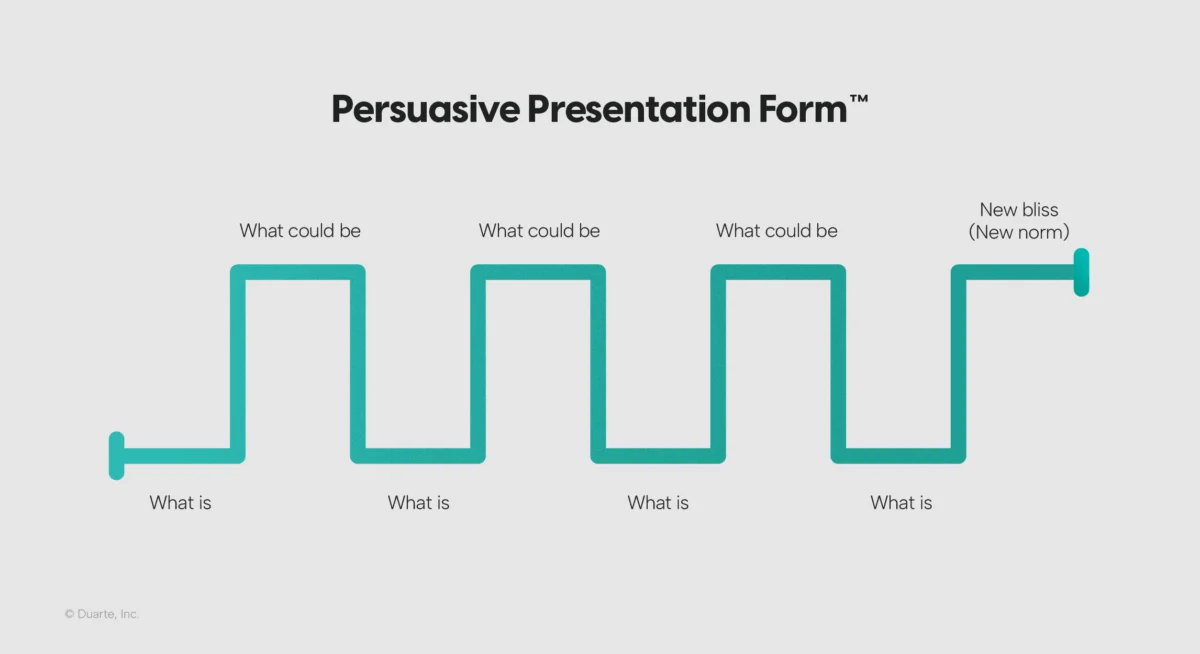
In presentations, this translates into the "Presentation Sparkline™" framework. Traditional reports often present a flat line, focusing predominantly on "what is" – the current state, facts, and figures – with a brief uplift at the end for recommendations. Conversely, a typical pitch might start with "what is" and then immediately ascend to an idealized "what could be," often sounding too optimistic or lacking grounding. Neither sustains audience engagement effectively.
The Sparkline, developed by communication experts, proposes a dynamic oscillation between "what is" (the current reality, challenges, or problems) and "what could be" (the proposed solution, vision, or desired future). This constant interplay creates a rhythmic tension that mirrors the natural ebb and flow of a compelling narrative, keeping the audience intellectually and emotionally invested. Notable examples, such as Steve Jobs’ 2007 iPhone launch and Dr. Martin Luther King, Jr.’s "I Have a Dream" speech, masterfully employed this back-and-forth structure, moving audiences to both understand the current state and envision a transformative future. Research indicates that presentations utilizing such contrasting structures are significantly more memorable and persuasive than purely linear approaches.
5. Crafting Unforgettable Moments: S.T.A.R. Moments™
Given the human brain’s limited capacity for retaining vast amounts of information, the inclusion of "Something They’ll Always Remember" – or a S.T.A.R. Moment™ – is crucial. These are specific, vivid instances designed to anchor key messages in the audience’s memory. They transcend mere data points, transforming abstract concepts into tangible, emotional experiences.
A prime example is Al Gore’s presentation on climate change, which formed the basis for An Inconvenient Truth. Faced with the challenge of conveying the alarming projected rise in CO2 concentration over 50 years, Gore didn’t just display a chart. Instead, he used a hydraulic lift to physically ascend alongside the rising data line, creating a dramatic, immersive experience that visually and viscerally communicated the scale of the impending crisis. This S.T.A.R. Moment was not just informative; it was an unforgettable demonstration that amplified the urgency and impact of his findings, driving home the message far more effectively than any static graph could. Such moments leverage sensory engagement and novelty to bypass cognitive overload and create lasting impressions.
6. Integrating Data Storytelling for Impact

While storytelling can seem antithetical to data-heavy business presentations, the two are not mutually exclusive; they are synergistic. Data, in its raw form, lacks inherent meaning. It requires a presenter to contextualize it, imbue it with significance, and weave it into a narrative. Effective data storytelling involves three key strategies: marveling at magnitude, humanizing the data, and surprising the audience with the unexpected.
Marveling at magnitude involves presenting data in a way that highlights its sheer scale or significance, often through comparison or metaphor. Humanizing data connects abstract numbers to real-world impacts on individuals or communities, fostering empathy. Surprising the audience involves presenting data or demonstrations that defy expectations, creating a memorable "aha!" moment.
Steve Jobs’ 2008 MacBook Air reveal perfectly illustrates the power of surprising the audience. Instead of simply stating the laptop’s thickness (0.76 inches), he dramatically slid the device into a standard manila envelope. This unexpected visual demonstration instantly conveyed the MacBook Air’s revolutionary slimness in a universally relatable and unforgettable manner, transforming a technical specification into a compelling narrative point. This technique capitalizes on cognitive biases, where unexpected information is processed more deeply and retained longer.
7. Concluding with a Vision of "New Bliss"
Every powerful story culminates in a resolution, and business presentations are no exception. The ending, far from being a mere summary, should offer a compelling vision of "new bliss" – the "happily ever after" for the audience-hero. This is not a fantastical fairytale, but a realistic, attainable future made possible by the solutions the presenter, as mentor, has provided.
The "new bliss" must be concrete, aspirational, and directly address the initial challenges identified at the presentation’s outset. It should paint a vivid picture of the improved state, the benefits reaped, and the problems resolved. This final segment serves as a powerful call to action, inspiring the audience to embrace the proposed solutions because they can clearly visualize the positive transformation awaiting them. It reinforces the presenter’s credibility as a problem-solver and leaves the audience with a sense of hope and purpose, primed to take the next step.
Broader Impact and Implications of Storytelling Proficiency
Mastering business storytelling extends beyond individual presentations; it profoundly impacts organizational dynamics, leadership efficacy, and corporate culture. Organizations where storytelling is embedded in communication practices exhibit greater internal alignment, more successful change management initiatives, and enhanced external stakeholder engagement.
Leaders who effectively wield narrative power are better equipped to articulate vision, inspire teams, and negotiate complex agreements. They foster a culture of understanding and collaboration, reducing miscommunication and increasing buy-in. Conversely, organizations that neglect storytelling risk presenting information in a sterile, unengaging manner, leading to missed opportunities, employee disengagement, and a perception of detachment from their audience’s needs. The competitive advantage in an increasingly crowded marketplace often hinges on the ability to differentiate through compelling narratives that resonate emotionally and intellectually.
In essence, business storytelling is an organizational muscle that, when developed and consistently applied, moves work forward with greater efficiency and impact. Every successfully closed deal, every aligned team, and every change initiative that truly takes root owes its success to a story told effectively, at the right moment, by the right person.
Cultivating these storytelling presentation skills, whether individually or across an entire team, is an investment with significant returns. Specialized training programs offer structured approaches to developing this crucial competency, providing frameworks and practical exercises to transform presenters into persuasive storytellers. From bespoke presentation crafting to comprehensive team training, resources are available to guide organizations in integrating this powerful communication strategy, ensuring that their messages not only inform but also inspire and activate their audiences.
