

In the dynamic landscape of contemporary commerce, the ability to weave information into a compelling narrative has emerged as a critical differentiator for leaders. Far from being a mere buzzword, storytelling in business circles is a proven methodology for achieving core objectives: securing deals, gaining budget approvals, fostering team cohesion, and navigating periods of organizational change. It transforms flat data points and abstract concepts into relatable experiences, driving audience engagement and, crucially, inspiring action. Business storytelling does not mandate the opening of every meeting with a personal anecdote; rather, it involves framing information as a narrative, employing established techniques to communicate ideas in a manner that resonates deeply with an audience. This strategic shift from presenting facts to telling a story is fundamental to effective communication in the 21st century.
The Foundational Principles of Narrative Structure
Effective business presentations, much like any compelling narrative, adhere to fundamental structural principles. The archetypal "Hero’s Journey," a concept popularized by mythologist Joseph Campbell, provides a robust framework. This structure typically introduces a protagonist, who encounters a significant challenge they cannot overcome alone. A mentor then emerges, providing the necessary tools, wisdom, or solution, enabling the hero to conquer the obstacle and achieve a state of "happily ever after." In a business context, adapting this structure means establishing a clear beginning, a challenging middle, and a triumphant end. The audience must perceive the problem, understand the proposed solution, and envision the positive future state it promises.
Crucially, implementing this structure requires a precise understanding of who embodies the "hero" and who plays the "mentor." Misidentifying these roles can undermine the entire persuasive effort, transforming an opportunity for connection into a self-serving monologue.
Audience as the Protagonist: Shifting the Focus from "Us" to "You"
A common pitfall in business communication is the tendency for presenters to inadvertently cast themselves or their organization as the hero. This often manifests as lengthy recitations of company history, impressive client lists, or a litany of accolades. While such details might establish credibility, an excessive focus on the presenter’s achievements often alienates the audience, who are primarily concerned with their own challenges and aspirations.
The most effective storytelling presentations strategically position the audience as the hero. This approach is rooted in the psychological principle that individuals are inherently more engaged when they see themselves reflected in the narrative. The audience, after all, is the entity facing the challenge, seeking a solution, and ultimately striving for a "happily ever after." By making the audience the central figure, presenters tap into their innate desire for resolution and improvement. Research in consumer psychology consistently demonstrates that customer-centric communication leads to higher levels of engagement, trust, and conversion rates. When a presentation begins by acknowledging the audience’s pain points and aspirations, it immediately establishes empathy and relevance, setting the stage for a more impactful message.
The Presenter’s True Role: Guiding the Hero Through Challenges
If the audience is the hero, then the presenter’s role naturally becomes that of the mentor. This shift is profound. Experienced presentation storytellers consistently adopt this persona, eschewing self-aggrandizement in favor of equipping their audience with the necessary tools to overcome their challenges. Their focus is not on receiving glory but on facilitating the audience’s success.

Consider the example of a presentation aimed at selling a meal kit delivery service. A "hero" presenter might highlight the company’s superior ingredients, innovative menu, and extensive five-star reviews. While factual, this approach centers entirely on the company’s prowess, neglecting the customer’s perspective. In contrast, a "mentor" presenter would frame the offering around the customer’s struggle: "One of the most difficult things about being a parent is feeling torn between spending time with your children and cooking them a fresh, healthy meal. But what if someone could come alongside you and cut the time it takes you to cook for your family in half? That’s what our meal kit delivery service does. By sending fresh, pre-prepared ingredients straight to your door, we save the average family 5 hours per week. No more choosing between time in the kitchen or time with your children. We allow you to do both."
This mentor-driven approach immediately establishes a connection by articulating a relatable problem and then positioning the service as the empowering solution. It frees the presenter to focus on the value proposition and the problems they solve, rather than merely listing features. This fosters trust and positions the presenter as a valuable ally in the audience’s journey toward resolution.
Leveraging Contrast for Sustained Engagement: The Presentation Sparkline Framework
One of the most potent techniques for maintaining audience engagement in storytelling is the strategic use of contrast. Linear narratives, which simply follow a sequence of events ("and then… and then…"), often fail to capture attention. The human mind is wired to respond to tension and resolution, to the unexpected "but then…" moments that introduce conflict and drive the plot forward.
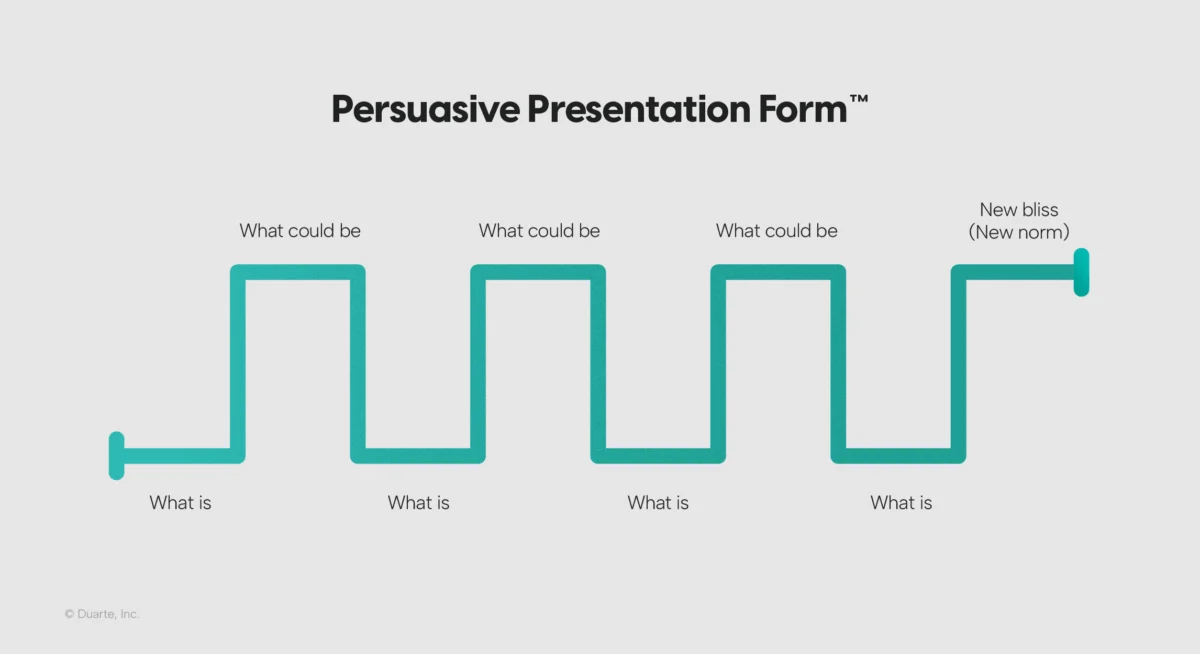
In business presentations, this principle is embodied by the "Presentation Sparkline" or "Persuasive Presentation Form." Traditional presentation structures, such as a typical report, often dwell extensively on "what is"—the current state of affairs, detailing problems and facts—before briefly touching on "what could be" at the very end. Conversely, a standard pitch often begins with "what is" and then dedicates the bulk of its time to an idealized "what could be," sometimes sounding overly optimistic. Both approaches lack the dynamic contrast necessary to sustain engagement. A purely linear report can be boring, while an overly optimistic pitch might lack credibility.
The Sparkline framework, developed by communication experts like Nancy Duarte, proposes a rhythmic oscillation between "what is" and "what could be." This constant interplay of current reality and future potential creates a dynamic tension that keeps the audience actively involved. By repeatedly highlighting the gap between the current undesirable state and the desirable future state, the presenter builds a compelling case for change. This technique was famously identified in powerful speeches such as Steve Jobs’ 2007 iPhone launch and Dr. Martin Luther King, Jr.’s "I Have a Dream" speech, both of which masterfully employed this back-and-forth narrative to inspire and persuade. This constant switching between problem and solution, challenge and opportunity, mirrors the natural rhythm of storytelling and helps solidify the need for the proposed action.
Crafting Unforgettable Moments: The S.T.A.R. Moment™
In an era of information overload, recall and retention are paramount. People struggle to remember vast quantities of data, but they vividly recall specific, impactful moments. This insight is central to the concept of a "S.T.A.R. Moment™" (Something They’ll Always Remember). Integrating these memorable instances into a presentation elevates it from a mere information transfer to an experience.
A classic example comes from Al Gore’s presentation on climate change, which inspired his Academy Award-winning documentary, An Inconvenient Truth. Faced with the challenge of communicating the dramatic, projected rise in CO2 concentration over 50 years, Gore and his team at Duarte devised a S.T.A.R. Moment. Instead of simply displaying a graph, Gore stood on a hydraulic lift that rose alongside the alarming data points, physically demonstrating the scale of the impending environmental crisis. This created a powerful, visceral experience that transcended a simple visual aid, imprinting the data’s gravity onto the audience’s minds. Neuroscience research supports the efficacy of such moments, showing that emotional engagement significantly enhances memory formation and recall. By creating these sensory-rich, emotionally resonant moments, presenters can ensure their key messages endure long after the presentation concludes.
The Art of Data Storytelling: Making Numbers Resonate

One of the most significant hurdles for business storytellers is transforming raw data into a compelling narrative. Data, in its raw form, is inert; it requires a presenter to imbue it with meaning and context. Effective data storytelling involves three primary strategies: marveling at the magnitude, humanizing the data, and surprising the audience with the unexpected.
Marveling at magnitude involves presenting large numbers in a way that truly conveys their scale. Instead of stating "millions," illustrate what "millions" looks like in a relatable context. Humanizing data means connecting statistics to individual experiences. For example, rather than stating a percentage increase in healthcare costs, describe the impact on a typical family’s budget.
Perhaps the most potent strategy is surprising the audience with the unexpected. Steve Jobs’ 2008 reveal of the MacBook Air offers a quintessential illustration. Instead of merely stating the laptop’s incredibly thin .76-inch profile, Jobs famously slid the device out of a standard manila envelope. This unexpected visual demonstration instantly conveyed the product’s revolutionary thinness in a way that no mere statistic could. The shock and delight of the audience were palpable, transforming a technical specification into a captivating narrative moment. Such data storytelling techniques move beyond cognitive understanding to emotional impact, making complex information accessible and memorable, and significantly aiding in data-driven decision-making and stakeholder buy-in.
The "New Bliss": Envisioning the Attainable Future
Every effective story, and indeed every impactful business presentation, requires a resolution—an end that provides a clear vision of what could be. This is the "new bliss": the "happily ever after" that the audience, as the hero, can attain through the mentor’s guidance. This is not a fairytale; it is a concrete, attainable vision for a future state that addresses the problems the audience is currently facing.
The "new bliss" must be credible and grounded in the real solutions that the presenter, in their mentor role, offers. It synthesizes the journey, demonstrating how the proposed actions or solutions lead to tangible improvements, greater efficiency, increased profitability, or enhanced well-being. A powerful ending inspires action by painting a vivid picture of the positive outcomes, motivating the audience to embrace the change or adopt the solution. It provides a sense of closure and a clear path forward, reinforcing the value proposition and solidifying the presenter’s role as a trusted guide.
Broader Implications for Organizational Success and Leadership
Mastering business storytelling transcends individual presentation skills; it is a fundamental organizational competency. It is the engine that drives progress across various facets of a business. Every successful deal, every aligned team, and every change initiative that genuinely takes root rather than dissipating, can be traced back to a story told effectively, at the opportune moment, to the right audience.
For leadership, storytelling is an indispensable tool for vision casting, motivating teams, and instilling a shared purpose. Leaders who can articulate their vision through compelling narratives inspire commitment and foster a sense of collective identity. In marketing and sales, storytelling builds brand loyalty and creates emotional connections with customers, moving beyond transactional relationships. For internal communications, it facilitates cultural integration, clarifies strategic objectives, and helps employees understand their role within the larger organizational narrative.
Communication experts and organizational psychologists emphasize that human beings are fundamentally narrative creatures. We process information, make sense of the world, and form decisions through stories. Consequently, organizations that embed storytelling into their communication strategies tend to exhibit higher levels of employee engagement, stronger external brand perception, and a more agile response to market changes. The investment in developing storytelling capabilities, whether through dedicated training programs or the strategic crafting of key messages, yields significant returns by enhancing clarity, fostering connection, and ultimately, driving action and tangible business results. In a world saturated with information, the ability to tell a memorable and persuasive story is no longer a soft skill, but a hard competitive advantage.
