


The roar of the crowd, the tension in the air, the agonizing wait as the ball rolls towards the cup – these are the hallmarks of professional golf, a sport where fractions of an inch and moments of intense focus can dictate victory or defeat. This past Sunday, the BMW Championship provided a dramatic spectacle, culminating in Wyndham Clark’s hard-fought triumph. While the on-course drama was compelling, it also illuminated a fascinating, long-standing psychological phenomenon that affects even the world’s most elite golfers: the subtle yet significant difference in performance between a putt for birdie and a putt for par.
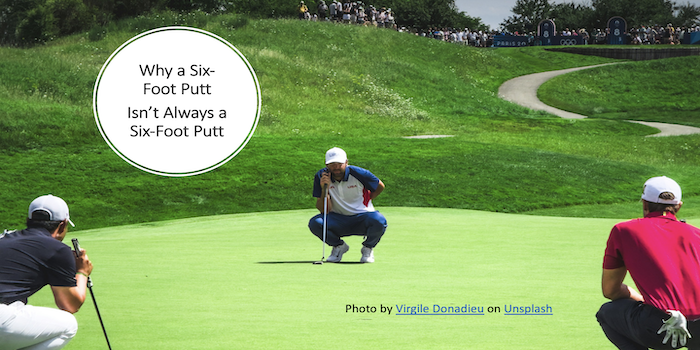
Clark, who began the final round with a commanding five-shot lead, saw his advantage erode on the back nine. However, a combination of strategic play, capitalizing on errors from his competitors, and a stellar three-birdie finish secured him a three-shot victory. This intense display of competitive spirit, played out on a championship stage, serves as a potent reminder of the psychological intricacies that underpin athletic achievement. It echoes the findings of groundbreaking research that suggests a six-foot putt, while physically identical, is not always psychologically the same depending on what it is for.
The Research Unveiling a Putting Paradox
In 2011, economists Devin Pope and Maurice Schweitzer published a seminal study titled "Is Tiger Woods Loss Averse? Persistent Bias in the Face of Experience, Competition, and High Stakes" in the prestigious American Economic Review. Their analysis, leveraging the granular data provided by the PGA Tour’s ShotLink system, delved into the performance of over 421 professional golfers across more than 2.5 million putts recorded between 2004 and 2009. The scope of this dataset is immense, offering a statistically robust snapshot of professional putting habits under real-world tournament conditions.
The findings were striking. Pope and Schweitzer discovered that professional golfers were, on average, 2 to 4 percentage points more likely to make a putt intended for par than a putt of the exact same length intended for birdie. This margin, though seemingly small, represents a statistically significant difference in success rates, impacting hundreds of thousands of crucial putts over the studied period. The implication is profound: the same golfer, facing the same physical challenge from the same distance, under broadly similar circumstances, exhibits a differential success rate based on the potential outcome of the putt.
The Psychological Driver: Loss Aversion
The researchers attributed this disparity to the psychological principle of "loss aversion." This concept, famously articulated by Nobel laureate Daniel Kahneman and his long-time collaborator Amos Tversky, posits that the psychological impact of a loss is significantly greater than the psychological pleasure derived from an equivalent gain. In simpler terms, people tend to feel the pain of losing something more intensely than they enjoy the pleasure of gaining something of equal value.
In the context of golf, this plays out in a subtle yet powerful way. When a golfer stands over a putt intended to secure a birdie, they are looking at an opportunity to gain a stroke relative to the course’s par. If they miss this putt, but subsequently make the ensuing putt for par, they have still achieved par for the hole. The immediate prospect is one of potential gain, with the possibility of maintaining par as a fallback.
Conversely, when faced with a putt for par, the psychological landscape shifts. Missing this putt results in a loss of a stroke relative to par, leading to a bogey. The primary motivation becomes the avoidance of this negative outcome. The golfer is no longer striving for an additional gain; they are actively trying to prevent a setback. This fundamental difference in psychological framing, the move from seeking a gain to avoiding a loss, appears to exert a discernible influence on performance, even among athletes who have dedicated their lives to mastering their craft and who are accustomed to performing under immense pressure.
Nuances in the Data: Tournament Progression and Competitive Focus
The Pope and Schweitzer study also uncovered important nuances regarding how this phenomenon evolved throughout a tournament. The difference in success rates between par and birdie putts was more pronounced in the earlier rounds, with a gap of approximately 3.8 percentage points. As the tournament progressed into the final round, this difference narrowed to around 2.1 percentage points. Crucially, however, the effect never entirely disappeared, indicating its persistent nature.
The researchers suggested that this reduction in the putt-making disparity in later rounds could be attributed to a shift in the golfers’ psychological orientation. In the initial rounds, golfers tend to focus more intently on their score relative to the course’s par. As the tournament enters its final stages, and particularly in the final round, their primary concern often shifts to their position relative to the other competitors in the field. This change in focus, from a personal score against the course to a competitive score against rivals, appears to mitigate the sting of potential loss on a par putt.
This finding is particularly significant when considering the caliber of the athletes involved. These are professionals who possess extraordinary experience, dedicate countless hours to practice, compete under the most intense scrutiny, and have millions of dollars riding on their performance. The fact that such a subtle psychological bias can still manifest, even in this elite group, underscores the pervasive nature of loss aversion.
Broader Implications: Scarcity Beyond the Sales Pitch
The insights gleaned from this golf research extend far beyond the greens. The study provides a powerful illustration of how the principle of scarcity, often associated with marketing tactics, can manifest in more profound and subtle ways. While a salesperson might invoke scarcity with phrases like "Only two left!" or a website might flash "Sale ends at midnight!", the psychological impact of scarcity can also stem from the mere possibility of losing something that is already possessed.
For a golfer, the perceived scarcity of a good score, or the potential loss of a hard-earned stroke, can influence their actions more powerfully than the abstract prospect of gaining an additional stroke for a birdie. This is a crucial lesson in understanding human decision-making. The possibility of loss can often exert a stronger gravitational pull on our choices than an equivalent opportunity for gain.
Ethical Influence and Self-Awareness
The broader implication for ethical influence, as highlighted by experts like Brian Ahearn, Chief Influence Officer at Influence PEOPLE and faculty at the Cialdini Institute, is the paramount importance of awareness. The goal of understanding these psychological principles is not to manipulate individuals by exploiting their fear of loss. Instead, it is to recognize how people naturally make decisions and to communicate relevant information truthfully and transparently.
By understanding the inherent human tendency towards loss aversion, individuals can approach important decisions with greater clarity. The next time you find yourself making a significant choice, whether it’s a personal decision or a business negotiation, it is beneficial to pause and ask: Am I genuinely pursuing something I desire, or am I reacting more strongly due to an underlying fear of losing something I already have? Recognizing this distinction can lead to more rational and beneficial outcomes.
The Golfer’s Perspective: An Enduring Question
The research by Pope and Schweitzer, while providing robust data, also leaves room for individual experience and perception. For golfers themselves, the question of whether a six-foot putt for birdie feels psychologically different from a six-foot putt for par remains a subject of personal reflection. While the data suggests a tangible impact on performance, the subjective experience can vary.
This enduring question invites further exploration, not just within the realm of professional sports but also in everyday decision-making. The golf course, with its precise measurements and observable outcomes, serves as a compelling microcosm for understanding the complex interplay between objective reality and subjective psychological perception, demonstrating that even in the most controlled environments, human behavior is subject to fascinating and often predictable biases. The ability to recognize and account for these biases is a hallmark of astute decision-making, both on the fairway and in life.
