

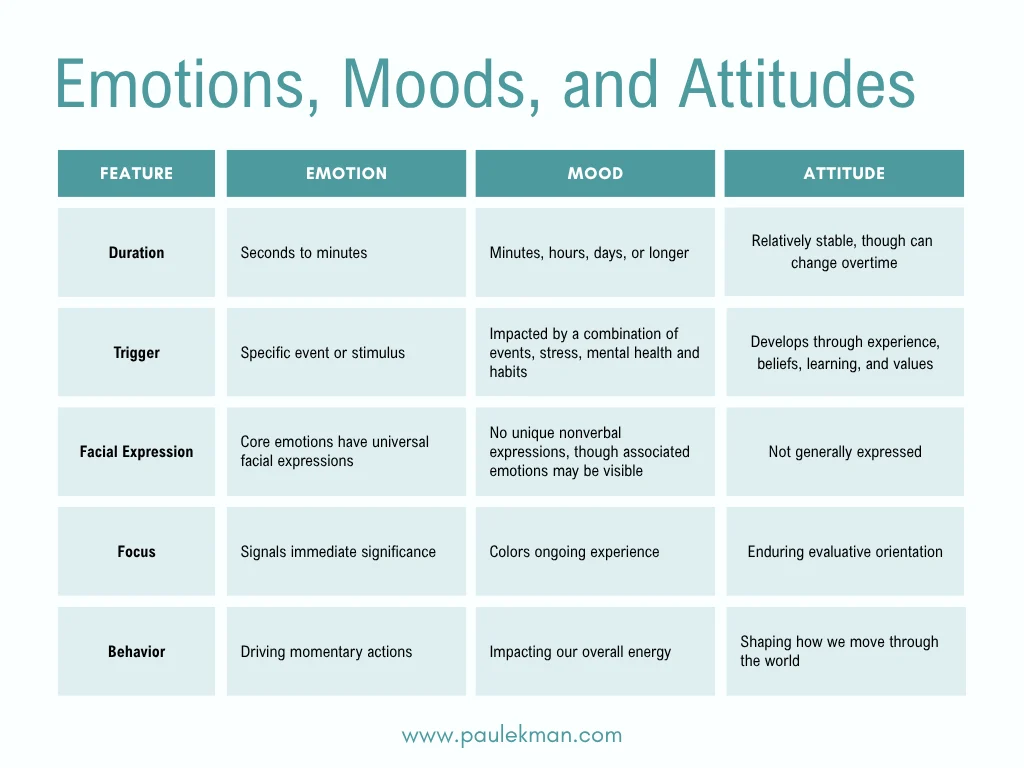
Emotions, moods, and attitudes are fundamental aspects of the human experience, shaping our perceptions, decisions, and interactions with the world. While often used interchangeably in casual conversation, these psychological constructs operate on distinct timescales and serve unique functions. A deeper understanding of their differences and their intricate interplay is crucial for cultivating enhanced emotional awareness, fostering more effective emotional regulation, and gaining profound insights into our ingrained patterns of thought and behavior. This exploration builds upon previous discussions differentiating moods and emotions, now incorporating the vital concept of attitudes to provide a comprehensive framework for understanding our inner landscape.
The Nature of Emotions: Brief, Intense, and Action-Oriented
Emotions are defined as automatic appraisal processes, deeply influenced by both our evolutionary heritage and accumulated personal experiences. They are triggered by events or stimuli that hold significance in relation to our goals, needs, or overall well-being. Upon activation, emotions initiate a cascade of coordinated psychological and physiological changes, preparing us for immediate action or response. By their very nature, emotions are transient, typically lasting from mere fractions of a second to a few minutes. These intense, short-lived states involve widespread bodily alterations, including changes in autonomic nervous system activity, which can manifest as distinct physiological responses such as increased heart rate, sweating, and muscle tension. Furthermore, emotions are often accompanied by characteristic facial expressions, which serve as vital social signals, communicating our internal state to others. For instance, the universal recognition of facial expressions for happiness, sadness, anger, fear, surprise, and disgust, as extensively researched by pioneers like Paul Ekman, underscores the innate and adaptive nature of these emotional responses. These expressions are not merely decorative; they are integral to our survival and social bonding, facilitating rapid communication and coordinated action in response to perceived threats or opportunities.
Moods: The Pervasive Emotional Backdrop
In contrast to the sharp, focused nature of emotions, moods are characterized by their diffuse and enduring quality. Moods represent more generalized affective states that can persist for hours, days, or even longer. A key distinction lies in their origin: while emotions typically have a readily identifiable trigger, moods often lack a clear, specific antecedent. One might wake up already in a particular mood, or find themselves gradually slipping into one without any discernible external cause. Unlike the pronounced facial expressions associated with many emotions, moods tend to manifest in more subtle ways. While distinct facial cues may be absent, observers might notice alterations in posture, muscle tension, energy levels, or overall demeanor. Moods do not necessarily direct us to respond to a specific event; rather, they create an overarching emotional atmosphere or "backdrop" that colors our entire experience. This pervasive influence means that moods can lower or raise our threshold for experiencing certain emotions. For example, a person in an irritable mood might find minor inconveniences disproportionately frustrating, leading to a more intense emotional reaction than if they were in a more neutral or positive mood. Conversely, a cheerful mood can make it easier to shrug off small setbacks and maintain a positive outlook. This dynamic suggests that moods act as a lens, subtly but significantly shaping how we interpret events, navigate social interactions, and even engage with our own thoughts. Research into the neurobiology of mood disorders, such as depression and anxiety, highlights the complex interplay of neurotransmitters and brain regions that contribute to these prolonged affective states, underscoring their profound impact on daily functioning.
Attitudes: Enduring Evaluations and Behavioral Tendencies
Moving beyond the transient nature of emotions and moods, attitudes represent more stable and enduring evaluations of people, ideas, objects, behaviors, or experiences. Unlike emotions or moods, which are affective states themselves, attitudes are not primarily about feeling in the moment. Instead, they are conceptualized as complex structures that typically comprise three interconnected components, often referred to as the ABC model:
- Affective Component: This refers to the emotional associations linked to the attitude object. For example, a positive attitude towards environmentalism might be accompanied by feelings of hope and inspiration when thinking about conservation efforts.
- Behavioral Component: This encompasses the predispositions to act in certain ways toward the attitude object. Someone with a positive attitude towards exercise is likely to engage in regular physical activity.
- Cognitive Component: This involves the beliefs, knowledge, and thoughts we hold about the attitude object. A person with a negative attitude towards a particular political policy might believe it is economically unsound and harmful to society.
Attitudes can also be categorized as explicit or implicit. Explicit attitudes are those we are consciously aware of and can readily report, such as our stated preference for a certain brand of coffee. Implicit attitudes, on the other hand, are unconscious biases or associations that influence our behavior without our direct awareness. These can be particularly powerful in shaping our perceptions and actions, even when they contradict our explicit beliefs. For instance, studies on implicit bias have shown that individuals may hold unconscious negative associations towards certain demographic groups, leading to differential treatment despite their conscious commitment to equality.
The formation of attitudes is a dynamic process. While generally more stable than emotions or moods, they are not immutable. Attitudes develop over time through a variety of influences, including repeated emotional experiences, observational learning, direct instruction, social and cultural norms, and personal reflection. Classical and operant conditioning play significant roles; positive reinforcement associated with an object or behavior can foster a positive attitude, while negative experiences can lead to aversion. Social learning theory, as proposed by Albert Bandura, emphasizes the role of observing others and their attitudes in shaping our own. Furthermore, our interactions within families, peer groups, and broader societal contexts significantly contribute to the attitudes we adopt. New experiences, particularly those that are emotionally charged or involve significant learning, can gradually reshape or reinforce existing attitudes. The stability of attitudes is what allows for a degree of predictability in human behavior, enabling us to navigate the complexities of social life with a degree of coherence.
Crucially, attitudes are always directed toward a specific object or target. We can hold attitudes towards individuals, specific products, political ideologies, societal issues, or even our own emotional responses. Because attitudes act as evaluative lenses, they profoundly influence how we interpret new information, the attributions we make about events, and the way we tend to respond to stimuli. This makes them powerful predictors of future behavior and critical determinants of our overall experience of the world.
The Dynamic Interplay: A Symphony of Influence
While distinct in their characteristics, emotions, moods, and attitudes are not isolated phenomena. Instead, they exist in a constant state of dynamic interaction, each influencing and being influenced by the others.
Moods as a Catalyst for Emotions
Our prevailing mood significantly impacts the likelihood and intensity of experiencing specific emotions. When in an upbeat or positive mood, individuals may find themselves bouncing back more quickly from minor frustrations or disappointments. The emotional impact of a setback might be lessened, and recovery swifter. Conversely, an irritable or negative mood can act as a highly sensitive trigger, amplifying reactions to even minor annoyances. A series of brief, intense negative emotions, such as experiencing worry or frustration, can coalesce over time to create a prolonged state of anxiety or irritability, demonstrating how short-lived emotional episodes can contribute to the development of a persistent mood. This suggests a feedback loop where transient emotional states can aggregate into more stable affective backgrounds, which in turn influence subsequent emotional experiences.
Attitudes as Architects of Emotional Response
Attitudes play a pivotal role in shaping how we emotionally engage with situations. Consider two individuals encountering the same constructive feedback. One person, holding an attitude that views feedback as a valuable opportunity for growth and learning, might experience feelings of motivation and even excitement. Their underlying belief system frames the feedback positively, leading to a congruent emotional response. In contrast, another individual, whose attitude frames feedback as a personal threat or criticism, might experience anxiety, defensiveness, or annoyance. The objective nature of the feedback remains the same, but their pre-existing attitudes dictate their interpretation and, consequently, the emotional experience they undergo. This highlights how our ingrained evaluations act as filters, predisposing us to certain emotional reactions. Research in cognitive psychology consistently demonstrates that the appraisal of a situation, which is heavily influenced by our attitudes, is a primary determinant of the emotional response.
Attitudes Toward Emotions: The Meta-Layer of Influence
A particularly significant aspect of attitudes is our attitude toward emotions themselves. These meta-attitudes, often formed early in life through family dynamics, cultural norms, and personal experiences, dictate how we perceive and manage our own emotional lives. For example, an individual might develop an attitude that anger is inherently dangerous and must always be suppressed, or that sadness signifies weakness and should be hidden. Conversely, joy might be viewed as something that should always be openly expressed. These deeply ingrained beliefs about emotions directly influence our willingness to acknowledge, accept, express, and learn from our feelings. This concept is closely related to "display rules," the culturally learned norms that govern when, where, and how it is appropriate to express emotions. While certain facial expressions of emotion are considered universal, the rules dictating their outward display vary significantly across cultures. These display rules, themselves a form of attitude, can lead to marked differences in how emotions are expressed and perceived globally, impacting interpersonal communication and social harmony. Understanding these "display rules" is crucial for cross-cultural competence and for navigating diverse social environments effectively.
Cultivating Emotional Intelligence Through Awareness
At the core of developing robust emotional intelligence lies the ability to observe our internal experiences with clarity and curiosity. By consciously recognizing our emotions as they arise, understanding the pervasive influence of our moods, and becoming aware of the attitudes that shape our interpretations, we can move beyond automatic reactions. This enhanced self-awareness empowers us to respond to ourselves and others with greater wisdom, empathy, and compassion.
The development of these skills is an ongoing practice, akin to strengthening any other capacity. Through consistent effort and intentionality, our ability to navigate our emotional landscape can be significantly enhanced. Resources and training programs focused on emotional intelligence, often drawing from decades of psychological research, can provide structured pathways for individuals seeking to deepen their understanding and mastery of these vital human capacities. By integrating knowledge of emotions, moods, and attitudes, individuals can foster more resilient psychological well-being and cultivate more meaningful and effective relationships. This comprehensive understanding provides a robust foundation for personal growth and for contributing positively to the social fabric.
