

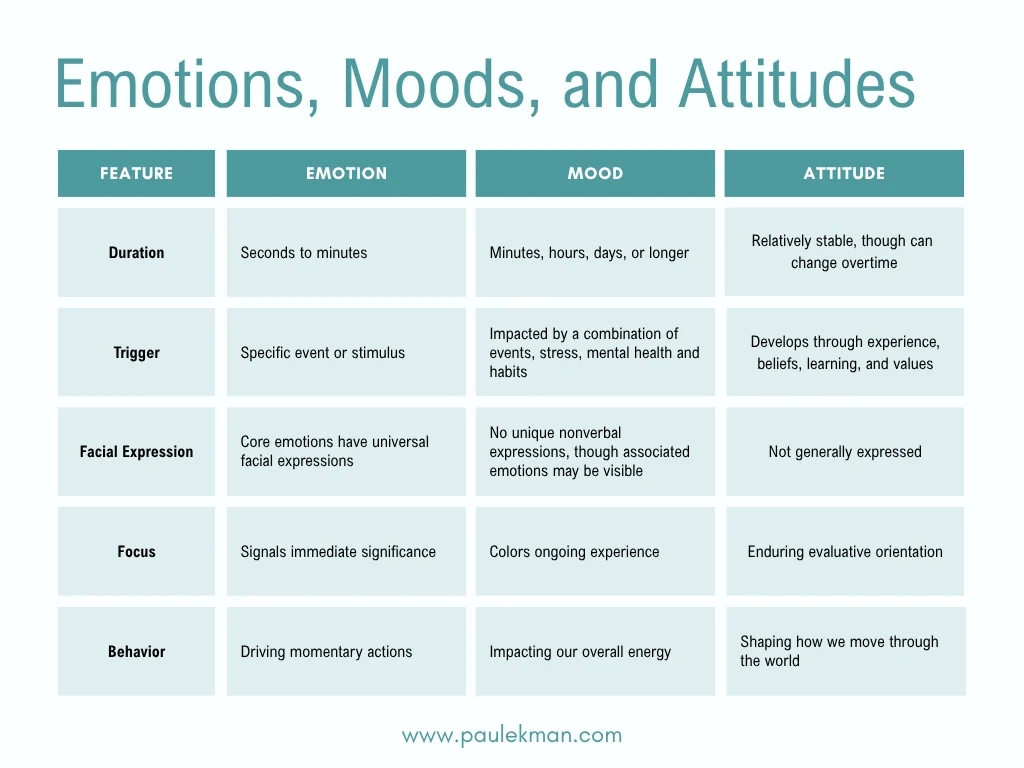
The intricate landscape of human psychology is shaped by a dynamic interplay of emotions, moods, and attitudes, each contributing uniquely to our perception of self and the world. While often used interchangeably in casual conversation, these distinct psychological constructs operate on different temporal scales and serve varied functions, profoundly influencing our decision-making, relationships, and overall well-being. Building upon prior explorations of the nuances between moods and emotions, this comprehensive examination delves into the broader spectrum of human affective experience, incorporating the crucial element of attitudes and elucidating their interconnectedness. A deeper comprehension of these relationships is paramount for fostering enhanced emotional awareness, refining emotional regulation strategies, and gaining a more profound insight into our cognitive and behavioral patterns.
The Ephemeral Nature of Emotions: Rapid Responses to Significance
Emotions, at their core, represent an automatic appraisal process deeply rooted in both our evolutionary heritage and the accumulation of personal experiences. They are triggered by events that hold significant implications for our goals, needs, or overall well-being, initiating a cascade of coordinated psychological and physiological changes. Scientifically, emotions are characterized by their relative brevity, typically lasting from fractions of a second to mere minutes. This swift activation is crucial for survival, enabling rapid responses to immediate stimuli.
Research has consistently demonstrated the physiological underpinnings of emotions. Studies employing neuroimaging techniques, such as fMRI, have shown distinct patterns of brain activity associated with different emotional states. For instance, the amygdala, a key structure in the limbic system, plays a pivotal role in processing fear and other threat-related emotions. Simultaneously, physiological changes, including alterations in heart rate, respiration, and perspiration, prepare the body for action. Furthermore, emotions are often accompanied by universally recognizable facial expressions, a phenomenon extensively studied by pioneers in the field like Paul Ekman, whose work has identified a set of basic emotions with distinct facial configurations that transcend cultural boundaries. These expressions, such as joy, sadness, anger, fear, surprise, and disgust, serve as vital communication signals, conveying our internal states to others and facilitating social interaction.
The intensity and duration of an emotion are often influenced by the perceived magnitude of the triggering event and individual differences in emotional reactivity. For example, a near-miss in traffic might elicit a fleeting surge of fear and adrenaline, while a significant personal loss could trigger a more prolonged and intense emotional response. Understanding the triggers and the typical duration of our emotions is a fundamental step in developing self-awareness.
The Enduring Influence of Moods: The Emotional Backdrop of Daily Life
In contrast to the fleeting nature of emotions, moods represent more diffuse and sustained affective states that can persist for hours, days, or even longer. Unlike emotions, moods often lack a clearly identifiable, singular trigger and are not typically directed towards a specific object or event. We might wake up feeling inexplicably cheerful or find ourselves gradually slipping into a state of irritability without a readily apparent cause. This pervasive quality makes moods akin to an emotional backdrop against which daily experiences unfold.
While distinct facial expressions are less characteristic of moods, subtle indicators such as changes in muscle tension, posture, vocal tone, or overall energy levels can often betray a person’s underlying mood. For instance, someone in a negative mood might exhibit slumped shoulders and speak in a monotone, whereas an individual in a positive mood might display more animated gestures and a brighter vocal quality.
Moods exert a significant influence on how we interpret events and interact with our environment. A pervasive negative mood can heighten our sensitivity to criticism, amplify feelings of frustration, and lead to a generally more pessimistic outlook. Conversely, a positive mood can foster optimism, enhance creativity, and make us more resilient to minor setbacks. This influence is not merely subjective; research in cognitive psychology has demonstrated that moods can bias attention and memory recall, leading us to selectively attend to and remember information that aligns with our current affective state. This phenomenon, known as mood congruence, can create self-reinforcing cycles, where a negative mood leads to the recall of negative memories, further entrenching the negative mood.
Attitudes: Enduring Evaluations Shaping Our Worldview
Unlike emotions and moods, which are transient affective states, attitudes represent relatively stable and enduring evaluations of people, ideas, objects, behaviors, or experiences. They are not direct emotional experiences themselves but rather a complex synthesis of beliefs, emotional associations, and behavioral tendencies. A widely accepted framework for understanding the multifaceted nature of attitudes is the ABC model, which posits that attitudes comprise three components:
- Affective Component: This refers to the feelings or emotions associated with the attitude object. For example, a positive attitude toward a particular brand of coffee might be linked to feelings of pleasure and comfort derived from its taste and aroma.
- Behavioral Component: This encompasses the predisposition to act in a certain way toward the attitude object. If someone has a positive attitude toward exercise, they are more likely to engage in regular physical activity.
- Cognitive Component: This involves the beliefs and thoughts one holds about the attitude object. A person might believe that a particular political policy is beneficial for society, which contributes to their positive attitude towards it.
Attitudes can be further categorized as either explicit or implicit. Explicit attitudes are those we are consciously aware of and can readily articulate, such as our stated preference for a certain type of music. Implicit attitudes, on the other hand, are unconscious biases or predispositions that, while not consciously recognized, can still significantly influence our behavior and judgments. For instance, implicit biases related to race or gender can affect hiring decisions or social interactions, even when individuals consciously believe they are being fair.
The development of attitudes is a continuous process, shaped by a multitude of factors over time. Repeated emotional experiences, learning through various conditioning processes (classical and operant), the influence of social and cultural norms, and personal reflection all contribute to the formation and modification of our attitudes. While generally more stable than emotions or moods, attitudes are not immutable. New experiences, significant life events, and deliberate efforts at self-reflection and learning can gradually reshape them. A compelling example is an attitude toward public speaking. It might initially be shaped by a negative experience of embarrassment, leading to beliefs that it’s a daunting task and a tendency to avoid it. However, through consistent practice, positive reinforcement, and a shift in beliefs to view it as a valuable skill, this attitude can evolve towards one of confidence and even enjoyment.
Crucially, attitudes are always directed towards something specific. We hold attitudes toward individuals, abstract concepts like democracy, tangible objects like automobiles, and even towards our own internal experiences, such as our emotions. Because attitudes serve as an evaluative lens, they profoundly influence how we interpret new information, how we anticipate future events, and how we are predisposed to respond to various situations. This evaluative function makes attitudes powerful predictors of behavior.
The Dynamic Interplay: How Emotions, Moods, and Attitudes Intersect
While distinct, emotions, moods, and attitudes are not isolated phenomena; they are in constant, dynamic interaction, weaving a complex tapestry that defines our psychological experience.
Mood as a Catalyst and Amplifier for Emotions
Our underlying mood significantly influences the likelihood and intensity with which specific emotions arise. An individual in an upbeat and cheerful mood may find themselves more resilient to minor frustrations, recovering quickly from setbacks. In contrast, someone experiencing an irritable or somber mood might find minor inconveniences disproportionately upsetting, leading to more intense and prolonged emotional reactions. For instance, a series of minor annoyances throughout a day—a missed bus, a spilled coffee, a curt email—can, when experienced within an already negative mood state, coalesce into a more pervasive feeling of anxiety or irritability that lingers long after the individual events have passed. Conversely, a positive mood can buffer against the impact of negative events, making us less susceptible to experiencing intense negative emotions.
Attitudes as Architects of Emotional Experience
Attitudes play a pivotal role in shaping how we perceive and subsequently react emotionally to events. Consider two individuals receiving identical constructive criticism on a project. One person, holding a positive attitude towards feedback as a valuable opportunity for growth, might experience excitement and a proactive desire to improve. The other, harboring an attitude that views feedback as a personal threat or an indictment of their capabilities, might experience anxiety, defensiveness, and annoyance. The external stimulus is the same, but their pre-existing attitudes dictate the emotional interpretation and subsequent emotional response. This highlights how our evaluative frameworks actively construct our emotional realities.
Furthermore, our attitudes are not only shaped by our emotional experiences but also actively contribute to their formation. Repeated negative emotional experiences in a particular context can solidify negative attitudes towards that context. Conversely, positive emotional experiences can reinforce positive attitudes. This reciprocal relationship underscores the interconnectedness of these psychological constructs.
Attitudes Towards Emotions: A Meta-Level Influence
A particularly significant form of attitude is our attitude towards emotions themselves. We develop beliefs and evaluations about the appropriateness, desirability, or danger of experiencing and expressing certain emotions. For example, cultural norms or family upbringing might instill the belief that anger is inherently destructive, sadness is a sign of weakness, or fear should always be suppressed. These deeply ingrained attitudes influence our willingness to acknowledge, accept, express, and learn from our emotions.
These "attitudes toward emotions" are closely linked to the concept of "display rules," which are culturally learned norms that dictate how, when, and to whom emotional expressions are appropriate. While basic facial expressions of emotion are considered universal, the rules governing their expression vary significantly across cultures. For instance, in some cultures, overt displays of sadness are accepted and even encouraged, while in others, emotional restraint is valued. These display rules, learned and internalized as attitudes, profoundly shape how emotions are outwardly communicated and perceived globally. Understanding these display rules is crucial for effective cross-cultural communication and for appreciating the diversity of human emotional expression.
Cultivating Emotional Intelligence: A Path to Deeper Self-Understanding
The Paul Ekman Group advocates for the development of emotional intelligence, emphasizing that a foundational step is the cultivation of observational skills regarding our internal experiences. By developing the capacity to clearly and curiously observe our emotions, understand the moods that color our perceptions, and recognize the attitudes that shape our interpretations, we equip ourselves to respond to ourselves and others with greater wisdom and compassion.
The development of these skills is not an instantaneous achievement but rather a practice that strengthens over time. Through consistent effort and engagement with evidence-based resources, individuals can significantly enhance their emotional awareness and regulation capabilities. The exploration of the science of emotion and emotional awareness offers a pathway to a more nuanced understanding of human behavior, leading to improved interpersonal relationships and a more fulfilling personal life.
The ongoing research in affective science continues to illuminate the intricate connections between our immediate emotional reactions, the prevailing emotional climate of our moods, and the deeply held evaluative frameworks of our attitudes. By integrating this knowledge, individuals can embark on a transformative journey toward greater self-mastery and a more profound connection with the world around them.
