

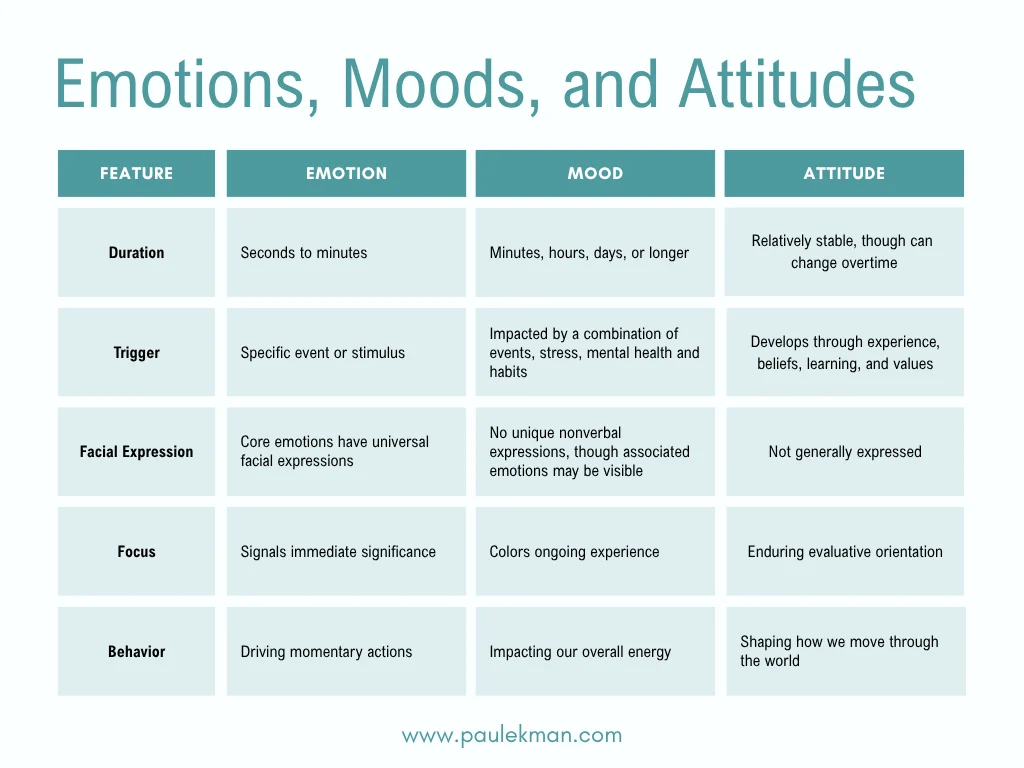
Building on foundational research that has previously distinguished between fleeting emotions and more enduring moods, this comprehensive exploration delves into the intricate interplay of these affective states with a third critical component of human psychology: attitudes. The confluence of emotions, moods, and attitudes profoundly shapes our subjective experience of ourselves and the world, yet they operate across distinct temporal scales and fulfill unique psychological functions. A nuanced understanding of their dynamic interactions is paramount for cultivating heightened emotional awareness, fostering robust emotional regulation, and gaining deeper insights into our ingrained patterns of thought and behavior. This article aims to elucidate these distinctions and their interconnectedness, drawing upon established psychological frameworks.
The Architecture of Human Affect: Emotions, Moods, and Attitudes
Emotions represent the most immediate and reactive facet of our affective landscape. They are fundamentally an automatic appraisal process, deeply influenced by both our evolutionary heritage—the ingrained biological predispositions that have shaped human survival—and our unique personal experiences. Emotions are triggered when an event, internal or external, is perceived as significant in relation to our goals, needs, or overall well-being. This perception initiates a cascade of coordinated psychological and physiological changes.
Crucially, emotions are characterized by their brevity. Scientific research, including studies on physiological responses, indicates that emotions typically last from mere fractions of a second to a few minutes. This rapid activation involves widespread bodily changes, encompassing alterations in autonomic nervous system activity, which governs involuntary functions like heart rate and respiration, and distinct facial expressions, as meticulously cataloged by researchers like Paul Ekman. These immediate physical and psychological shifts are adaptive, preparing the individual to respond effectively to the salient stimulus in the present moment. For instance, the emotion of fear, often triggered by perceived danger, elicits physiological responses like increased heart rate and adrenaline release, alongside a facial expression that signals alarm to others, facilitating either confrontation or flight.
In stark contrast to the transient nature of emotions, moods represent more diffuse and sustained affective states. They can permeate our experience for hours, days, or even extended periods. A defining characteristic of moods is their often elusive or non-specific trigger. Unlike emotions, which are typically directed toward a particular event or object, moods can arise without a clear, identifiable cause. Individuals may report waking up in a particular mood or gradually slipping into one without a discernible external stimulus.
While moods may not elicit the pronounced facial expressions associated with many emotions, they often manifest through subtler somatic cues. These can include changes in muscle tension, posture, energy levels, and general demeanor. Rather than serving as a direct response to a singular situation, moods function more like an ambient emotional backdrop. They can significantly influence the ease with which specific emotions are subsequently triggered. For example, a person in a generally irritable mood may find minor inconveniences far more likely to escalate into anger, whereas someone in a pleasant mood might brush them off with little emotional residue. Moods also exert a pervasive influence on our interpretation of daily events, social interactions, and even our internal thought processes.
Attitudes, however, occupy a distinct conceptual space, diverging significantly from emotions and moods. Attitudes are not considered emotional states in themselves. Instead, they are defined as relatively enduring evaluations or predispositions toward particular entities. These entities can range from people, ideas, and objects to specific behaviors or abstract experiences. Psychologists commonly conceptualize attitudes as comprising a tripartite structure, often referred to as the ABC model:
- Affective Component: This refers to the emotional associations and feelings one has towards the attitude object. For example, a positive attitude toward a particular brand of coffee might be accompanied by feelings of comfort and pleasure.
- Behavioral Component: This component relates to the tendency to act in a certain way toward the attitude object. A positive attitude toward environmental conservation might manifest as a behavioral tendency to recycle and reduce waste.
- Cognitive Component: This aspect involves the beliefs, thoughts, and knowledge one holds about the attitude object. Believing that exercise is beneficial for health is a cognitive component of a positive attitude toward physical activity.
Furthermore, attitudes are frequently categorized as either explicit or implicit. Explicit attitudes are those that individuals are consciously aware of and can readily articulate. Implicit attitudes, conversely, operate at an unconscious level, influencing behavior and perceptions without conscious awareness.
Consider the example of an attitude toward public speaking. This attitude might encompass a set of beliefs, such as the conviction that public speaking is a vital professional skill. It could also involve emotional memories, such as a past experience of feeling embarrassed while giving a presentation. These beliefs and memories, in turn, can shape behavioral tendencies, leading to either an inclination to seek out public speaking opportunities or a strong desire to avoid them altogether.
While attitudes are generally more stable and resistant to change than emotions or moods, they are not immutable. They evolve over time through a complex process that includes repeated emotional experiences, various forms of learning (including classical and operant conditioning), the pervasive influence of social and cultural norms, interpersonal relationships, and introspective reflection. Novel experiences possess the capacity to either reinforce existing attitudes, diminish their intensity, or gradually reshape them.
A crucial distinction between attitudes and moods is that attitudes are invariably directed toward a specific object or target. We can hold attitudes towards individuals, tangible objects, public policies, particular events, or even toward our own emotional states. Because attitudes serve as a filter through which we process new information and predispositions for response, they act as an evaluative lens, profoundly influencing how we perceive and interact with the world around us.
The Dynamic Interplay: How Affective States and Evaluations Converge
Despite their distinct theoretical definitions, emotions, moods, and attitudes are not isolated phenomena. Instead, they are in constant and dynamic interaction, shaping and being shaped by one another in a continuous feedback loop.
The Symbiotic Relationship Between Mood and Emotion
Our prevailing mood significantly influences the likelihood and intensity of emotional responses. For instance, an individual in an upbeat or positive mood may find it easier to recover from momentary frustrations or setbacks. Their emotional resilience is enhanced, allowing them to return to a baseline state more rapidly. Conversely, someone experiencing an irritable or negative mood is more susceptible to reacting with heightened intensity to minor provocations. A series of short-lived, intense emotions, such as periods of worry or frustration, can coalesce and contribute to the development of a more prolonged affective state, such as an overall feeling of anxiety or pervasive irritability. This illustrates how acute emotional experiences can contribute to the formation and maintenance of chronic moods.
Attitudes as Mediators and Influencers of Emotional Experience
Attitudes play a pivotal role in both shaping and being shaped by our emotional lives. To illustrate this, consider two individuals receiving identical constructive feedback on their work. One individual may hold a positive attitude towards feedback, viewing it as an invaluable opportunity for personal and professional growth. This attitude might lead them to experience feelings of excitement and motivation upon receiving the feedback. In contrast, another individual might harbor a negative attitude toward feedback, perceiving it as a personal threat or an indication of inadequacy. This defensive attitude could trigger emotions of anxiety, defensiveness, and annoyance in response to the same feedback. The objective situation remains constant, but their pre-existing attitudes profoundly alter their subjective evaluation of the event and, consequently, the emotions they experience.
The Influence of Attitudes Toward Emotions
A particularly significant and often overlooked aspect of attitudes is their application to our emotional experiences themselves. We can develop attitudes about specific emotions, such as believing that anger is inherently destructive, that sadness signifies weakness, that fear is something to be suppressed, or that joy should always be openly expressed. These deeply ingrained attitudes are frequently cultivated over many years, influenced by family dynamics, cultural conditioning, educational experiences, and personal life histories.
Our attitudes toward emotions directly impact our willingness to acknowledge, accept, express, or learn from them. For example, someone who holds a negative attitude toward sadness might actively avoid experiencing or expressing it, potentially leading to emotional suppression. Conversely, an individual who views sadness as a natural and even cathartic human experience might be more open to processing it. These attitudes also intersect with the concept of "display rules," which are culturally learned norms dictating how, when, and to whom emotional expressions are deemed appropriate. While certain universal facial expressions of emotion are recognized across diverse human populations, the specific display rules governing their outward manifestation can vary considerably across cultures. These cultural variations in display rules contribute to observable differences in emotional expression worldwide, highlighting the complex interplay between universal emotional predispositions and culturally shaped attitudes.
Cultivating Emotional Intelligence: A Pathway to Deeper Self-Understanding
At the forefront of psychological research and application, organizations like the Paul Ekman Group emphasize that the journey toward enhanced emotional awareness begins with the cultivation of a clear and curious observational stance toward our internal experiences. By diligently learning to identify our emotions, comprehend the underlying moods that influence our affective state, and recognize the attitudes that shape our interpretations of events, individuals can develop the capacity to respond to themselves and others with greater wisdom, empathy, and measured compassion.
The development of these sophisticated psychological skills is not an instantaneous process but rather a continuous endeavor that requires consistent practice and deliberate effort. These capabilities can be systematically strengthened over time through targeted training and mindful application. For individuals seeking to deepen their understanding of the science of emotion and enhance their emotional intelligence, a wealth of research-based resources is available. These resources often provide structured frameworks and practical exercises designed to foster greater self-awareness and emotional regulation.
The implications of a more profound understanding of emotions, moods, and attitudes extend far beyond individual well-being. In professional settings, enhanced emotional intelligence can lead to improved leadership, more effective team dynamics, and superior conflict resolution. In interpersonal relationships, it fosters deeper connection, greater empathy, and more constructive communication. On a societal level, a populace with a greater capacity for emotional awareness and regulation is better equipped to navigate complex social challenges and contribute to a more harmonious and understanding world. The ongoing exploration and application of these psychological principles represent a vital pathway toward individual fulfillment and collective progress.
