

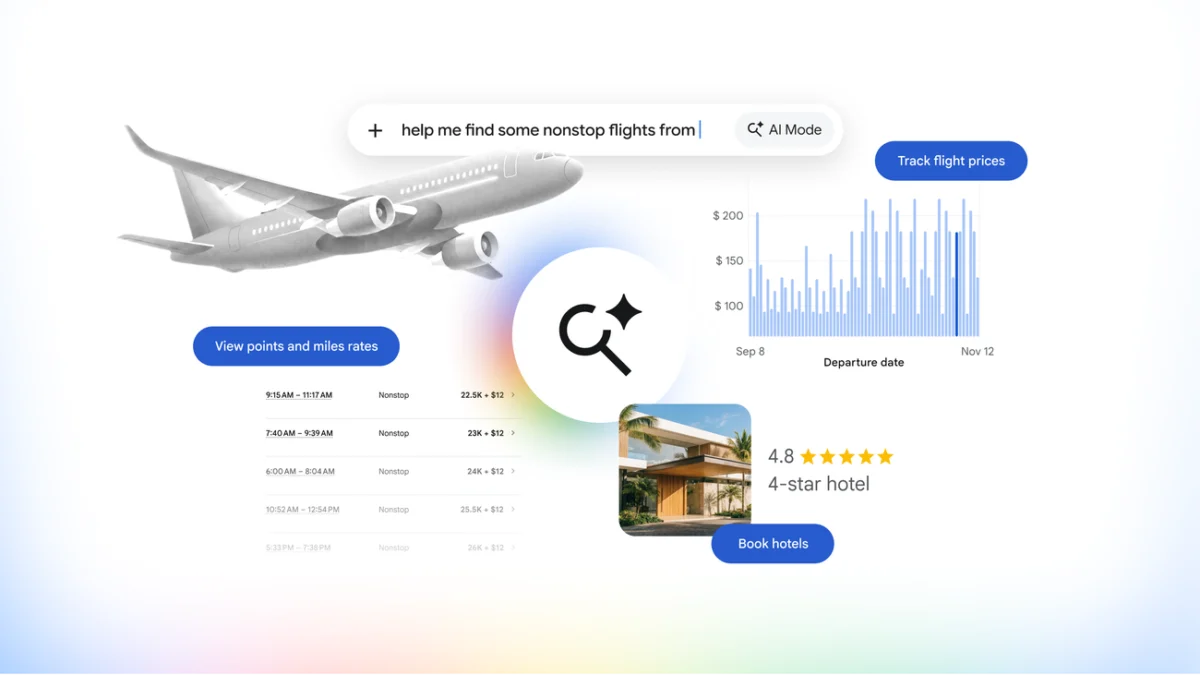
Google has announced a significant expansion of its artificial intelligence capabilities within Search, introducing three major features designed to streamline the travel planning and booking process. The tech giant is integrating advanced flight price tracking, loyalty reward calculations, and direct hotel booking functionality into its AI-driven search experience. This move marks a pivot from traditional search results toward a more "agentic" model, where the AI not only provides information but also executes tasks on behalf of the user. According to James Byers, Group Product Manager for Search, these upgrades aim to reduce the friction inherent in coordinating complex itineraries, allowing users to transition from discovery to transaction within a single conversational interface.
The update focuses on three core pillars: real-time price monitoring for airfare, the ability to view costs in airline miles or hotel points, and a simplified checkout process for accommodations. By leveraging Google Flights’ extensive data network and establishing new partnerships with major hospitality brands, the company is positioning its AI Mode as a comprehensive travel concierge. These features are being rolled out globally, with specific functionalities like direct booking starting in the United States before broader international deployment.
Conversational Flight Price Tracking and Monitoring
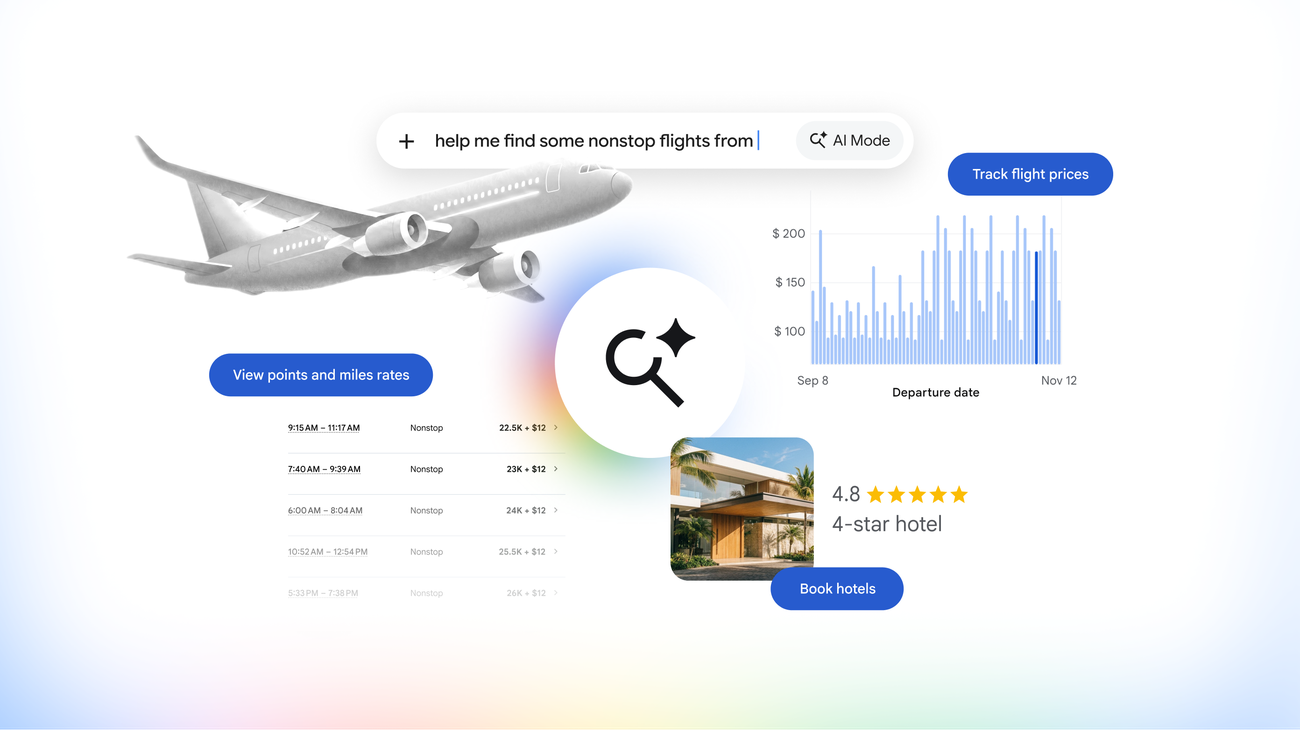
One of the most notable additions to the AI Mode is the integration of Google Flights’ price tracking technology. Traditionally, users had to navigate to the dedicated Google Flights portal to set up alerts for specific routes. Under the new update, this capability is now native to the AI Search interface. Users can describe their desired destination and travel dates in natural language, and the AI will present the best current options from more than 300 partner airlines and travel sites.
The innovation lies in the persistence of the search. If a user is not ready to purchase immediately, they can simply instruct the AI to "track these flight prices." The system then monitors fluctuations in real-time and sends email notifications when prices drop significantly. This feature is currently available in more than 180 countries and territories, representing one of Google’s widest geographical rollouts for an AI-enhanced search feature to date. For the consumer, this eliminates the need to manually refresh searches or maintain multiple tabs for different carriers, consolidating the "waiting game" of travel booking into an automated background process.
Integration of Loyalty Programs and Reward Redemptions
In a move that addresses the needs of "travel hackers" and frequent flyers, Google has introduced the ability to view travel costs in points or miles. Loyalty programs are a cornerstone of the travel industry, yet comparing the value of points across different platforms has historically been a manual and often confusing task. AI Mode now allows users to query specific reward balances, such as asking for nonstop flights from Atlanta to Miami using American Airlines miles.
The AI calculates the required points based on live data from partners. At launch, the system supports Alaska Airlines, Hawaiian Airlines, American Airlines, Choice Hotels International, Hilton, and Wyndham Hotels & Resorts. Google has confirmed that support for additional major players, including Accor, Flying Blue, Hyatt, LATAM Airlines, and the Lufthansa Group, will be added in the coming weeks. By surfacing these values directly in the search flow, Google is bridging the gap between cash-based searches and the multibillion-dollar loyalty economy, making it easier for users to maximize the value of their earned rewards without leaving the Google ecosystem.
Direct Hotel Booking and the "Continue on Google" Workflow
Perhaps the most disruptive of the three features is the introduction of direct hotel booking within AI Mode. When a user identifies a hotel they wish to book, they no longer need to navigate through multiple third-party redirects. By selecting the "Continue on Google" option, users can view room types, review cancellation policies, and finalize the transaction securely using Google Pay.
This feature is being launched in the United States in English, with an initial roster of partners that includes major Online Travel Agencies (OTAs) and hotel chains such as Booking.com, Expedia, Marriott International, IHG Hotels & Resorts, and Priceline. Crucially, Google has clarified that while the booking happens within its interface, the hotel or the respective booking platform remains the "merchant of record." This means that the partner handles all customer service, modifications, and cancellations, while Google acts as the secure facilitator. This model attempts to balance user convenience with the existing infrastructure of the hospitality industry, ensuring that hotels maintain their direct relationship with the guest.
Historical Context and the Evolution of Google Travel
To understand the significance of these updates, one must look at the trajectory of Google’s involvement in the travel sector. The foundation of these features was laid in 2010 when Google acquired ITA Software for $700 million. This acquisition gave Google access to the QPX software, which powered the flight search engines of many major airlines. Over the subsequent decade, Google Flights and Google Hotels evolved from simple search tools into dominant market forces.
The transition to AI-driven travel planning is the latest phase in this evolution. In early 2023, Google began testing "Search Generative Experience" (SGE), which used large language models to synthesize information from across the web. The current "AI Mode" is the refinement of those experiments. By moving from "providing links" to "providing solutions," Google is responding to a broader shift in consumer behavior where users expect digital assistants to handle logistics rather than just provide a list of websites to visit.
Industry Implications and Competitive Landscape
The integration of booking and loyalty data into Google Search has profound implications for the travel industry. For years, OTAs like Expedia and Booking Holdings have spent billions of dollars on Google Ads to capture traffic. By offering direct booking and price tracking within the search results, Google risks "disintermediating" these partners—effectively keeping the user on its own platform rather than sending them to the partner’s site.
However, the inclusion of Expedia and Booking.com as launch partners for the "Continue on Google" feature suggests a symbiotic, if tense, relationship. These platforms benefit from the high-intent traffic Google generates, even if they lose some control over the user interface. For hotel chains, the ability to show points and miles rates is a significant win, as it encourages direct loyalty bookings which are generally more profitable for hotels than bookings made through third-party agencies.
Market analysts suggest that this move is also a defensive strategy against the rise of specialized AI agents. Startups and competitors like OpenAI (with ChatGPT) and Perplexity have been developing their own travel planning tools. By embedding these features directly into the world’s most-used search engine, Google is leveraging its massive data advantage to retain its dominance in the travel planning phase.
Technical Infrastructure and Security Measures
The backend of these new features relies on a complex web of APIs (Application Programming Interfaces) that allow Google’s AI to communicate in real-time with airline and hotel reservation systems. This ensures that the prices and point values shown are accurate at the moment of the query.
Security is a primary concern in any transaction-based AI system. Google is utilizing its existing Google Pay infrastructure to handle the financial aspects of the hotel bookings. This provides a layer of encryption and biometric authentication that many users already trust. Furthermore, the "merchant of record" distinction is a vital legal and operational safeguard. By ensuring that the travel provider handles the actual booking record, Google avoids the liabilities associated with being a travel agency while still providing a streamlined user experience.
Supporting Data: The Growth of AI in Travel
The push for AI integration is supported by current travel trends. According to industry reports from 2023 and 2024, nearly 40% of travelers expressed interest in using AI to plan their trips, citing time savings as the primary motivator. Furthermore, the mobile travel booking market is expected to reach over $600 billion by 2030, making the "few taps" approach of AI Mode a strategic necessity for tech companies.
Google’s data indicates that price remains the single most important factor for 70% of travelers when booking flights. By automating the tracking process, Google is addressing the most significant pain point in the consumer journey. Similarly, the "unclaimed" value of loyalty points globally is estimated to be in the billions; by making these points easier to spend through search, Google is unlocking latent value for both consumers and travel brands.
Future Outlook and Global Expansion
As AI Mode continues to roll out, the next phase will likely involve deeper personalization. Future iterations could potentially integrate with a user’s Google Calendar to suggest travel dates or use past search history to recommend hotels that align with specific aesthetic or budgetary preferences.
The current announcement is a clear signal that Google views the future of search not as a page of blue links, but as a proactive assistant. As the service expands to more languages and more partners—particularly the upcoming additions of Hyatt and the Lufthansa Group—the barrier between "searching for a trip" and "having a trip booked" will continue to blur. For the global travel industry, the message is clear: the era of conversational, AI-mediated commerce has arrived, and it is centered squarely within the search bar.
