

In an era increasingly focused on early childhood development, a growing emphasis is being placed on the intentional selection of playthings that foster critical speech and language skills. Pediatric speech-language pathologists (SLPs) are stepping forward to provide expert-curated recommendations, transforming holiday shopping and everyday toy acquisition into opportunities for developmental enrichment. These initiatives aim to equip parents and caregivers with actionable insights, moving beyond mere entertainment to leverage play as a powerful therapeutic and educational tool.
The Foundational Role of Play in Early Development
Speech and language acquisition are cornerstone elements of a child’s overall development, impacting cognitive abilities, social interactions, academic success, and emotional well-being. From the earliest babbling to complex sentence structures, a child’s communication journey is intrinsically linked to their environment and experiences. Play, often perceived as a simple pastime, is in fact a child’s primary mode of learning and exploring the world. Through play, children naturally engage in communication, problem-solving, social negotiation, and imaginative thinking—all crucial precursors and accelerators for language development.
Research consistently highlights the profound impact of play-based learning. Studies published in journals like Pediatrics and the Journal of Speech, Language, and Hearing Research underscore that unstructured, imaginative play significantly contributes to a child’s ability to articulate thoughts, understand complex instructions, develop vocabulary, and master pragmatic language skills (the social rules of language). The American Academy of Pediatrics, in its clinical report "The Power of Play: A Pediatric Role in Enhancing Development in Young Children," emphasizes that play is "essential to development because it contributes to the cognitive, physical, social, and emotional well-being of children and youth."
However, not all toys are created equal in their developmental efficacy. While flashy electronics might capture attention, SLPs advocate for open-ended toys that encourage interaction, creativity, and sustained engagement, thereby maximizing opportunities for verbal and non-verbal communication.

Understanding Speech and Language Development and Potential Challenges
Normal speech and language development follows a predictable, albeit varied, timeline. Infants coo and babble, toddlers begin to use single words and short phrases, and preschoolers rapidly expand their vocabulary and sentence complexity. By school age, children are typically proficient in conversational skills and narrative storytelling. However, developmental delays and disorders can emerge, affecting a significant portion of the pediatric population.
According to the National Institute on Deafness and Other Communication Disorders (NIDCD), approximately 8-9% of young children (ages 3-17) have a speech, voice, or language disorder. Conditions such as Childhood Apraxia of Speech (CAS), a neurological speech sound disorder that makes it difficult for children to make accurate movements for speech, require targeted therapeutic interventions. Other common challenges include expressive language delays (difficulty communicating thoughts and ideas), receptive language delays (difficulty understanding spoken language), and articulation disorders (difficulty producing specific speech sounds). Early identification and intervention are paramount for optimizing outcomes for children facing these challenges. An SLP like Jenna Kirk, who is both a professional and a parent of a child with CAS, brings a unique and invaluable perspective to the selection of toys that can specifically support these therapeutic goals.

The SLP’s Approach to Toy Selection: Beyond Entertainment
When a speech-language pathologist evaluates a toy, the criteria extend far beyond a child’s immediate enjoyment. The focus shifts to how a toy facilitates specific developmental objectives. Key considerations often include:
- Open-Endedness: Toys that can be used in multiple ways, rather than having a single prescribed function, encourage imaginative play and provide endless opportunities for diverse vocabulary and narrative development. Blocks, dolls, art supplies, and animal figures are prime examples.
- Interaction and Joint Attention: The best toys promote interaction between the child and a caregiver or peers. They foster "joint attention," where two people focus on the same object or activity, which is crucial for early language learning. Board games, puzzles, and pretend play sets naturally encourage turn-taking, asking questions, and responding.
- Encouraging Communication: Does the toy inherently prompt verbalization? For instance, a toy that requires asking for pieces, describing actions, or narrating a story provides more language opportunities than one that can be silently manipulated. Puppets, doctor’s kits, and kitchen sets are excellent for this.
- Promoting Problem-Solving and Sequencing: Toys that involve assembly, sorting, or following instructions help develop cognitive skills that underpin language organization and understanding. Puzzles, shape sorters, and building sets fall into this category.
- Versatility and Adaptability: Toys that can grow with a child, offering different levels of engagement as their skills evolve, provide sustained developmental benefit. A simple ball, for example, can be used for rolling (early interaction), throwing (following instructions), or imaginative games (developing narratives).
- Sensory Engagement: For younger children, toys that engage multiple senses can stimulate neural pathways important for development. Textured objects, musical instruments, and light-up toys can be beneficial.
These principles guide SLPs in creating curated lists, ensuring that each recommendation serves a tangible developmental purpose.

A Chronology of Play: Age-Specific Recommendations for Speech and Language
Understanding developmental stages is critical for effective toy selection. SLPs often categorize recommendations by age groups, aligning toy features with emerging cognitive and linguistic abilities.
- Infancy (0-12 months): At this stage, play focuses on sensory exploration, cause-and-effect, and early social interaction. Toys that promote joint attention and encourage vocalizations are ideal.
- Examples: Soft rattles, textured balls, unbreakable mirrors, pop-up toys, simple musical instruments.
- Speech/Language Benefits: Encourages babbling, imitation of sounds, tracking objects with eyes (pre-linguistic skill), understanding "in" and "out," and turn-taking in vocal exchanges.
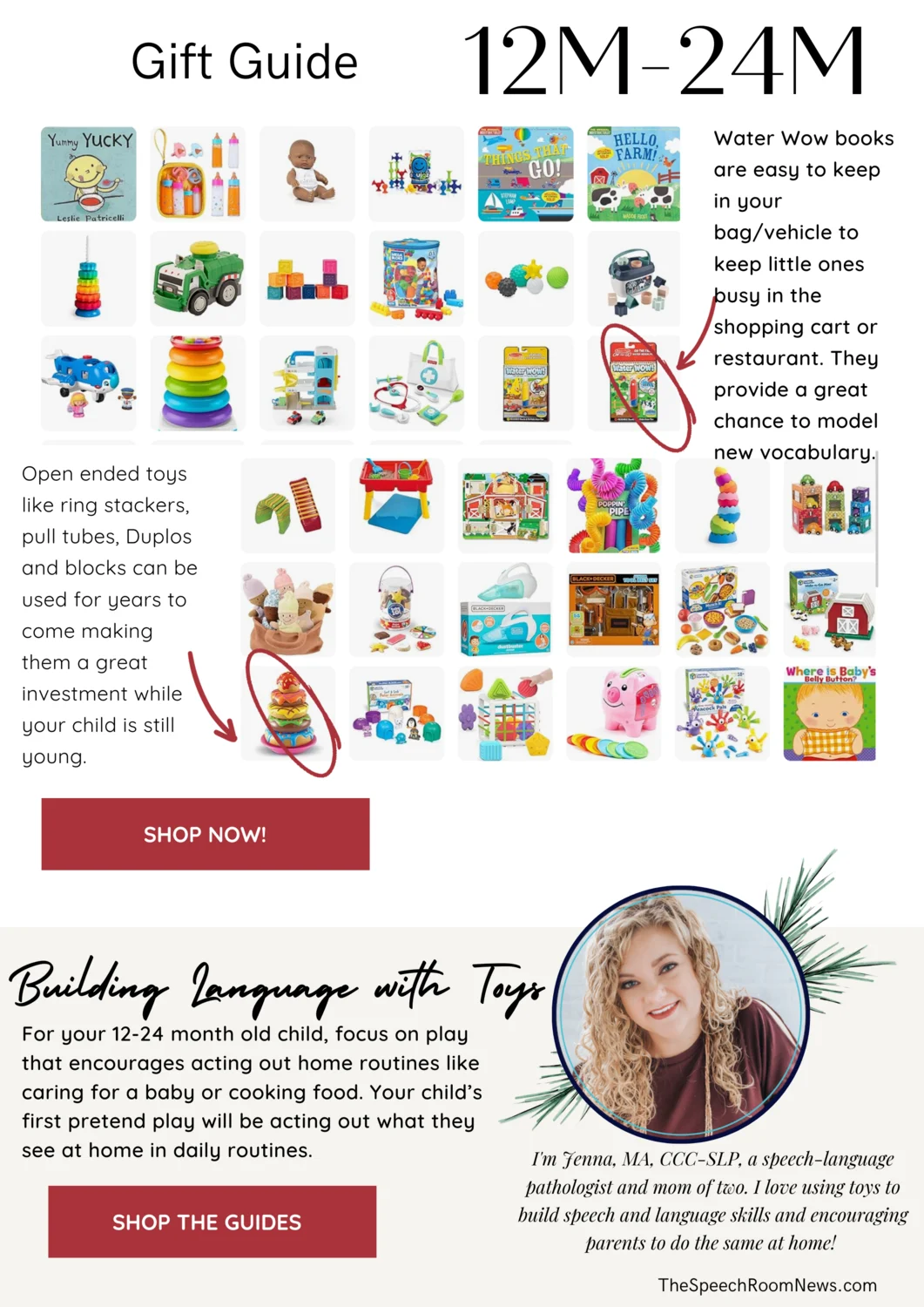
- Toddlerhood (1-3 years): This period sees an explosion in vocabulary and the emergence of two- and three-word phrases. Toys should encourage imitation, simple problem-solving, and early pretend play.
- Examples: Stacking rings, shape sorters, chunky puzzles, dollhouses, play food, toy vehicles, picture books with simple narratives.
- Speech/Language Benefits: Promotes naming objects, following one- and two-step directions, using early verbs and nouns, developing imaginative scenarios, expanding vocabulary, and understanding spatial concepts (e.g., "on," "under").
- Preschool (3-5 years): Language becomes more complex, with children constructing longer sentences and engaging in more elaborate pretend play. Toys that facilitate storytelling, social interaction, and conceptual understanding are highly beneficial.
- Examples: Dress-up clothes, elaborate building blocks, craft supplies, board games (simple rules), playdough, puppets, story-telling cards.
- Speech/Language Benefits: Encourages narrative skills, asking and answering "wh-" questions (who, what, where, why), using descriptive adjectives, developing social communication skills (turn-taking, topic maintenance), problem-solving through dialogue, and expanding sentence structure.
- Early School Age (5-8 years): Children refine their communication skills, engage in more complex social interactions, and develop literacy foundations. Toys can support strategic thinking, verbal reasoning, and more nuanced social communication.
- Examples: More complex board games (e.g., Candyland, Chutes and Ladders, Guess Who?), LEGOs, science kits, chapter books, card games, role-playing games.
- Speech/Language Benefits: Enhances deductive reasoning, vocabulary expansion, understanding complex rules, practicing negotiation and persuasion, developing conversational fluency, and strengthening literacy skills through story engagement.
Stocking Stuffers: Small Gifts, Big Impact

Even smaller items can be strategically chosen to support speech and language. These often provide quick, engaging opportunities for interaction.
- Examples: Bubbles (encourages blowing, requesting "more," "open"), small sensory items (stress balls, fidget toys for self-regulation and focus), mini puzzles, playdough tools, small art supplies (crayons, stickers for naming and describing), card games (Uno, Go Fish for turn-taking, number/color identification).
- Speech/Language Benefits: Encourages requesting, describing, turn-taking, fine motor skills (linked to speech articulation), and brief conversational exchanges.
The Broader Impact and Implications for Families
The provision of expert-curated gift guides by SLPs like Jenna Kirk offers significant implications for families, educators, and the broader approach to early intervention.

- Empowering Parents: These guides demystify the process of toy selection, moving parents beyond marketing hype to make informed choices that directly benefit their child’s development. This proactive approach can reduce anxiety about developmental milestones.
- Promoting Early Intervention: By highlighting toys that target specific skills, parents can inadvertently provide "pre-therapy" or supplementary therapy at home, reinforcing concepts learned in formal therapy sessions or addressing minor delays before they become significant.
- Bridging the Gap Between Play and Therapy: These resources underscore that therapy doesn’t always have to happen in a clinical setting. Everyday play, when structured with purpose, can be incredibly therapeutic and enjoyable for children.
- Fostering a Language-Rich Environment: When parents understand why certain toys are beneficial, they are more likely to engage with their children in ways that promote language—asking open-ended questions, narrating play, and modeling new vocabulary. This creates a consistently language-rich home environment.
- Cost-Effectiveness and Sustainability: Investing in high-quality, open-ended toys that have lasting developmental benefits can be more sustainable and cost-effective in the long run than accumulating numerous single-purpose or quickly discarded items.
While these guides provide invaluable direction, experts consistently advise that toys are tools, not substitutes for professional assessment and intervention when significant concerns arise. If a child exhibits consistent delays in speech or language development, consulting with a certified speech-language pathologist remains the most crucial step. The goal of these curated lists is to complement, not replace, professional guidance.
In conclusion, the movement towards expert-backed toy recommendations for speech and language development represents a significant step forward in proactive childhood support. By integrating the insights of pediatric speech-language pathologists into purchasing decisions, parents and caregivers can transform play into a powerful and joyful pathway to robust communication skills, laying a strong foundation for lifelong learning and connection.
