

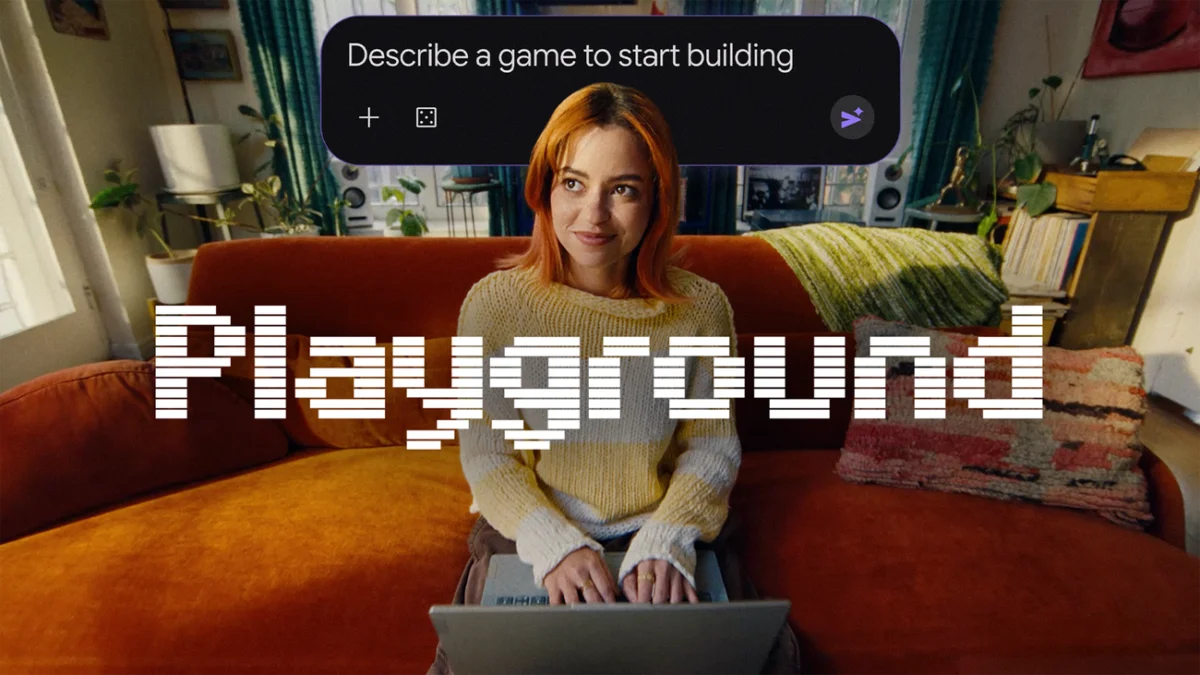
Google has officially unveiled Playground, a pioneering experimental platform designed to democratize the multi-billion dollar game development industry by allowing users to create, play, and share custom digital experiences using natural language prompts. Developed by the AI Innovation and Research division, the platform represents a significant shift in how interactive media is produced, moving away from traditional, code-heavy development environments toward a conversational, AI-driven interface. Led by software engineer Maryam Karimzadehgan, the initiative aims to bridge the gap between creative conceptualization and technical execution, effectively removing the barrier of entry for millions of potential creators who lack formal programming education.
The core functionality of Playground centers on a text-to-game paradigm. Users can initiate the creation process from a blank canvas or choose to "remix" existing starter prompts. Through a chat-based interface, creators can dictate every aspect of their game, from physics and rule sets to character aesthetics and environmental design. The platform’s underlying generative AI interprets these instructions in real-time, allowing for an iterative design process where the creator can test, tweak, and overhaul concepts instantly. This "no-code" approach is intended to transform game development from a specialized technical skill into a form of everyday creative expression, similar to how social media platforms simplified digital publishing and video sharing.
The Evolution of User-Generated Content and the AI Shift
The launch of Playground arrives at a critical juncture for the gaming industry. Historically, game development has been the province of large studios or highly skilled independent developers utilizing complex engines such as Unreal Engine or Unity. While platforms like Roblox and Minecraft’s Creative Mode paved the way for user-generated content (UGC), they still require a degree of familiarity with specific platform mechanics or scripting languages like Lua. Playground’s integration of Large Language Models (LLMs) represents the next evolutionary step, where the interface itself understands human intent without the need for intermediary syntax.
According to industry data, the global gaming market is projected to exceed $200 billion by the end of 2024, with UGC platforms accounting for an increasingly large share of player engagement. By leveraging its proprietary AI research, Google is positioning Playground as a competitor in the creator economy space, targeting the estimated 3.4 billion gamers worldwide. The project reflects years of research into generative models that can handle not just text and images, but complex logic and spatial reasoning required for interactive software.
Technical Integration and the Unity Spark Partnership
A pivotal component of the Playground ecosystem is the announced partnership with Unity, a dominant force in the professional game development world. While Playground serves as an entry-point for casual creators, Google has revealed an upcoming integration with "Unity Spark." This feature is designed to provide a professional-grade "graduation path" for creators whose ideas outgrow the initial experimental platform.
Unity Spark will unlock high-fidelity 3D capabilities, robust physics engines, and the flexibility of the Unity runtime, which currently powers over 70% of the world’s top mobile games. This integration suggests a strategic move to create a seamless pipeline from a simple text prompt to a commercially viable product. Currently in a closed beta testing phase, Unity Spark is expected to offer a bridge between the accessibility of Google’s AI and the industrial-strength tools used by professional developers. This "low floor, high ceiling" approach ensures that while the platform remains approachable for beginners, it does not artificially limit the creative potential of more ambitious users.
Chronology of Development and Strategic Rollout
The development of Playground follows a series of internal Google initiatives aimed at exploring the intersection of AI and creativity. The timeline of this release can be traced back to the expansion of Google’s "AI Test Kitchen" and the broader deployment of the Gemini model.
- Early 2023: Google Research began exploring "generative world-building" models capable of maintaining consistency in 2D and 3D environments.
- Late 2023: Internal testing of conversational game design interfaces began within the AI Innovation + Research team.
- Mid-2024: The partnership with Unity was formalized to ensure the platform could scale beyond simple 2D mechanics.
- October 2024: Official launch of Playground for U.S. users aged 18 and older, marking the transition from a laboratory experiment to a public-facing service.
The rollout is being handled with a tiered access model. While the "Explore" gallery is open to the public, creation capabilities are being distributed based on Google AI subscription tiers. This suggests that the computational cost of generating real-time game logic is substantial, necessitating a managed release to ensure server stability and quality control.
Community Features and the Social Ecosystem
Playground is not merely a creation tool; it is designed as a social hub. The platform is entirely browser-based, ensuring cross-platform compatibility across smartphones, tablets, and laptops without the need for heavy downloads. This accessibility is central to Google’s strategy of capturing "snackable" gaming moments—games that are easy to build, easy to share via a link, and easy to play in a matter of seconds.
The platform includes several features designed to foster a competitive and collaborative community:
- Play Games Profiles: Users can claim custom handles, track their progress, and follow specific creators.
- Global Leaderboards: Select genres support real-time competitive scoring, encouraging replayability.
- The Explore Gallery: An algorithmic feed that highlights "fresh, creative, and fun" games based on player ratings and engagement metrics.
- Multiplayer Functionality: Select templates allow for synchronous multiplayer gameplay, a technical feat for a browser-based generative platform.
To maintain a safe environment, Google has implemented a multi-layered screening process. Every game published to the public gallery undergoes automated safety screenings aligned with Google’s Community Guidelines. Furthermore, a user reporting system is in place to flag content that bypasses automated filters, addressing the inherent risks associated with AI-generated content.
Industry Implications and Market Analysis
The introduction of Playground has significant implications for the broader tech and gaming landscapes. By lowering the barrier to entry, Google is effectively challenging the "gatekeeper" model of digital entertainment. For educational institutions, Playground offers a potential tool for teaching logic and narrative design without the steep learning curve of syntax-heavy coding.
However, the move also raises questions regarding the future of entry-level game design roles. If AI can generate a functional 2D platformer or a complex puzzle game from a paragraph of text, the value of manual "grey-boxing" and basic scripting may shift. Professional analysts suggest that platforms like Playground will likely augment rather than replace professional developers, acting as a "rapid prototyping" tool that allows studios to test concepts in hours rather than weeks.
Furthermore, the data gathered from Playground will likely feed back into Google’s AI development cycle. By observing how users describe game mechanics and how the AI translates those descriptions into playable code, Google can refine its models’ understanding of spatial logic and cause-and-effect—two areas where generative AI has historically struggled.
Access and Availability
As of its launch, Playground is available exclusively in the United States to users over the age of 18. The age restriction is a standard cautionary measure for Google’s experimental AI products, reflecting the unpredictable nature of generative outputs. Interested users can access the platform at playground.google.
The tiered rollout of creation access is expected to expand globally as Google scales its infrastructure. With the integration of Unity Spark on the horizon, the platform is poised to move from a "playground" for experiments into a robust ecosystem for the next generation of digital creators. Google has encouraged early adopters to provide feedback, signaling that the platform will evolve rapidly based on community interaction and the types of games that gain the most traction in the Explore gallery.
In summary, Playground represents a bold bet on the future of interactive media. By synthesizing natural language processing with game engine logic, Google is attempting to turn every gamer into a developer, fundamentally altering the creative economy of the digital age. Success will depend on the platform’s ability to move beyond "novelty" experiences and provide creators with the depth and reliability needed to build truly engaging, high-fidelity games.
