

The revitalization of the Greek tourism sector, which accounts for approximately 20 percent of the nation’s Gross Domestic Product (GDP), has placed a renewed emphasis on the importance of linguistic accessibility for international visitors. While English is widely spoken in urban centers like Athens and Thessaloniki, as well as on popular islands like Mykonos and Santorini, the ability to communicate in the native tongue remains a vital asset for travelers seeking authentic cultural immersion. Language experts and tourism officials suggest that even a rudimentary command of Modern Greek can significantly alter the social dynamics of a trip, fostering goodwill and facilitating smoother interactions in hospitality and emergency situations. This comprehensive guide outlines the essential vocabulary required for modern navigation, social integration, and cultural appreciation within the Hellenic Republic.
The Foundation of Greek Social Interaction
In the hierarchy of Greek communication, the distinction between formal and informal address is paramount. This linguistic nuance reflects a cultural emphasis on respect for elders and strangers, contrasted with the warmth and familiarity shared among peers. The basic greeting "Yassas" (γεια Ϩας) serves as the professional standard, utilized when addressing a group or an individual in a formal setting. Conversely, "Ya sou" (γεια Ϩου) is the informal variant, appropriate for friends or children.
Beyond greetings, the fundamental building blocks of conversation include "Ne" (ναι) for yes and "Ochi" (Ïî¨Î¹) for no. To the uninitiated English speaker, "Ne" can be phonetically confusing as it sounds similar to the English "nay," yet it signifies affirmation. Courtesy is deeply embedded in Greek transactions; "Parakalo" (παϱακαλψ) is the multi-purpose word for "please" and "you’re welcome," while "Efcharisto" (ευÏî±Ï±Î¹ÏƒÏ„ψ) is the standard expression of gratitude. When an error occurs or a passage is blocked, "Signomi" (συγγνψμη) serves as an effective apology or "excuse me."
Chronological Greetings and Daily Life
The Greek day is structured around specific temporal greetings that dictate the rhythm of social life. "Kalimera" (καλημÎϱα), or good morning, is typically used until midday. As the afternoon progresses, "Kalo apogevma" (καλÏÓ Î±Ï€ÏÓγευμα) transitionally covers the post-lunch hours, leading into "Kalispera" (καλησπÎϱα) for the evening. The day concludes with "Kalinihta" (καληνψτα), a phrase reserved specifically for saying goodnight before retiring to sleep.
For the traveler, these phrases are often the first point of contact with local service providers. Understanding the formal "Ti kanete?" (τι κάνετε;)—meaning "How are you?"—versus the informal "Ti kanis?" (τι κάνεισ;) is essential for navigating social boundaries. Furthermore, the departure phrase "Adio" (αντίο) or the more casual "Ta leme" (τα λÎμε)—meaning "we’ll talk later"—provides a natural end to interactions.
Supporting Data: The Impact of Language on Tourism
Recent data from the Hellenic Statistical Authority (ELSTAT) and the Bank of Greece indicate that tourism remains the primary engine of the Greek economy. In 2023, Greece welcomed over 32 million international visitors, a record-breaking figure that surpassed pre-pandemic levels. Analysis suggests that travelers who engage with the local language, even minimally, report higher satisfaction scores in post-travel surveys.
Furthermore, the "Experience Economy" trend has led to a 15 percent increase in bookings for rural agrotourism and cultural tours in regions like Epirus and the Peloponnese. In these less-traversed areas, English proficiency among locals is lower than in the capital, making the "Survival Greek" phrases listed below statistically significant for the safety and success of the excursion.
Survival Phrases for Travelers and Emergency Situations
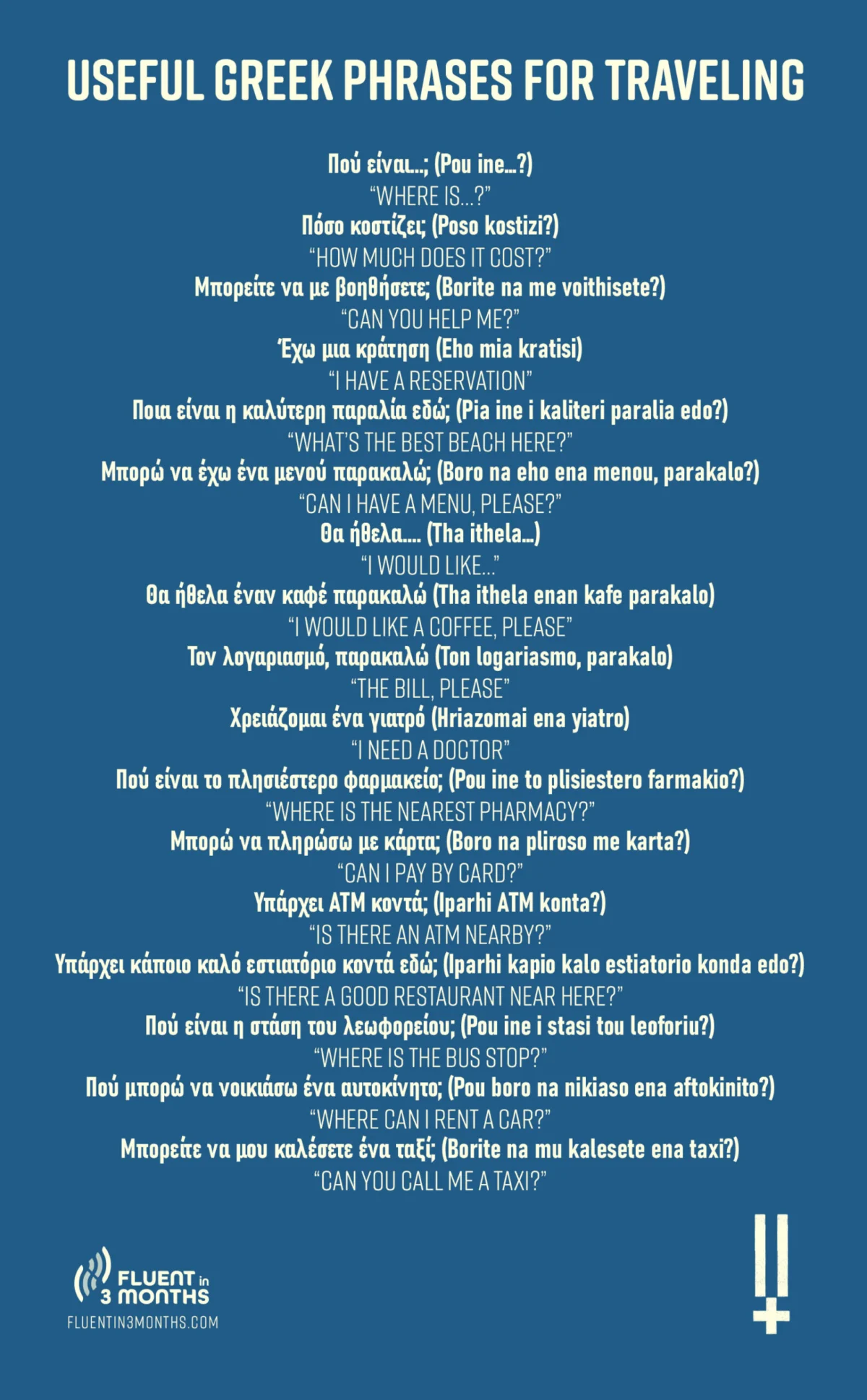
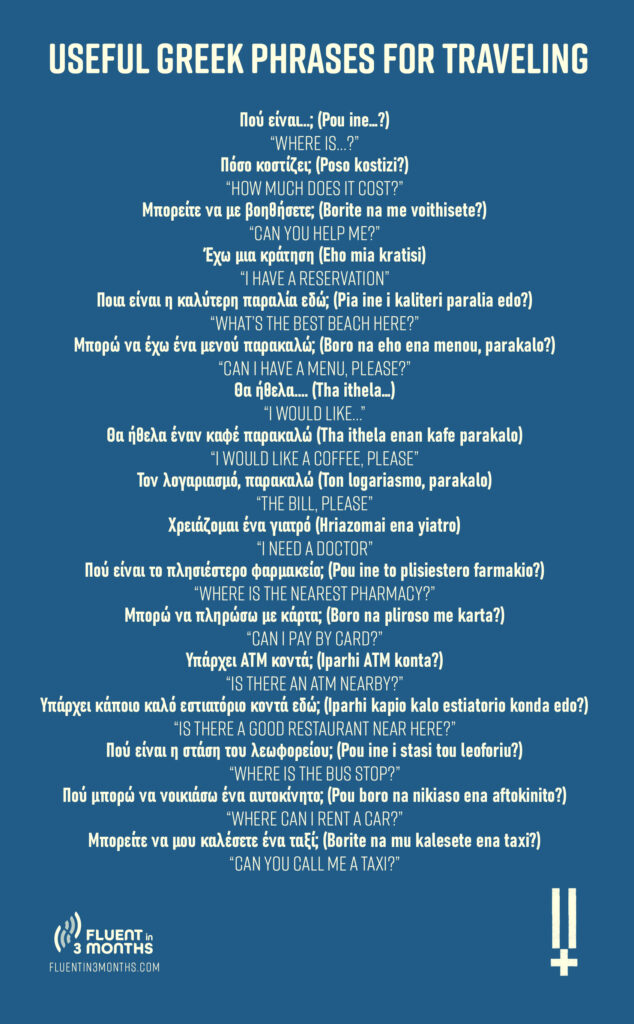
Navigating a foreign country requires a specific set of linguistic tools to handle logistics and unforeseen challenges. The following table outlines the most critical phrases for transit, commerce, and health:
| English | Greek (Transliteration) | Context of Use |
|---|---|---|
| Where is…? | Pou ine…? | Directions to landmarks or hotels |
| How much does it cost? | Poso kostizi? | Retail and market transactions |
| Can you help me? | Borite na me voithisete? | General assistance |
| I have a reservation | Eho mia kratisi | Hotel check-in or dining |
| The bill, please | Ton logariasmo, parakalo | Concluding a meal |
| I need a doctor | Hriazomai ena yiatro | Medical emergencies |
| Where is the pharmacy? | Pou ine to farmakio? | Minor health issues |
| Can I pay by card? | Boro na pliroso me karta? | Modern payment logistics |
| Where is the bus stop? | Pou ine i stasi? | Public transportation |
The phrase "Milate anglika?" (μιλάτε αγγλικά;), meaning "Do you speak English?", remains perhaps the most important question for a traveler. However, preface this with "Signomi" (Excuse me) to maintain a polite and professional tone.
Social Integration: Introducing Yourself
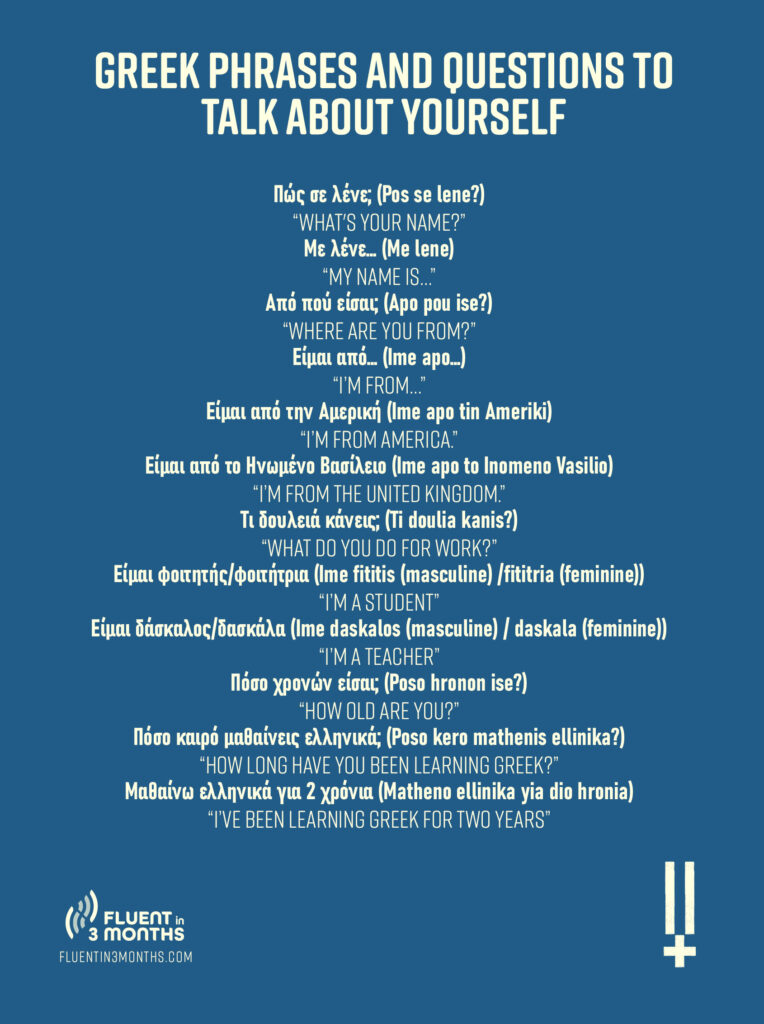
For those staying in Greece for extended periods, such as digital nomads or students, the ability to share personal details is the next step in linguistic progression. The phrase "Me lene…" (με λÎνε) followed by your name is the standard introduction. To ask someone’s name, one uses "Pos se lene?" (πψσ σε λÎνε;).
Geographic origins are another common topic of conversation. "Ime apo tin Ameriki" (είμαι απÏÓ Ï„Î·Î½ αμεϱική) identifies one as being from America, while "Ime apo to Inomeno Vasilio" (είμαι απÏÓ Ï„Î¿ ηνψμÎνο αβασίλειο) indicates the United Kingdom. Professional identities also play a role in Greek social networking: "Ime fititis" (I am a student) or "Ime daskalos" (I am a teacher) are common descriptors.
The Role of Slang and Informal Language
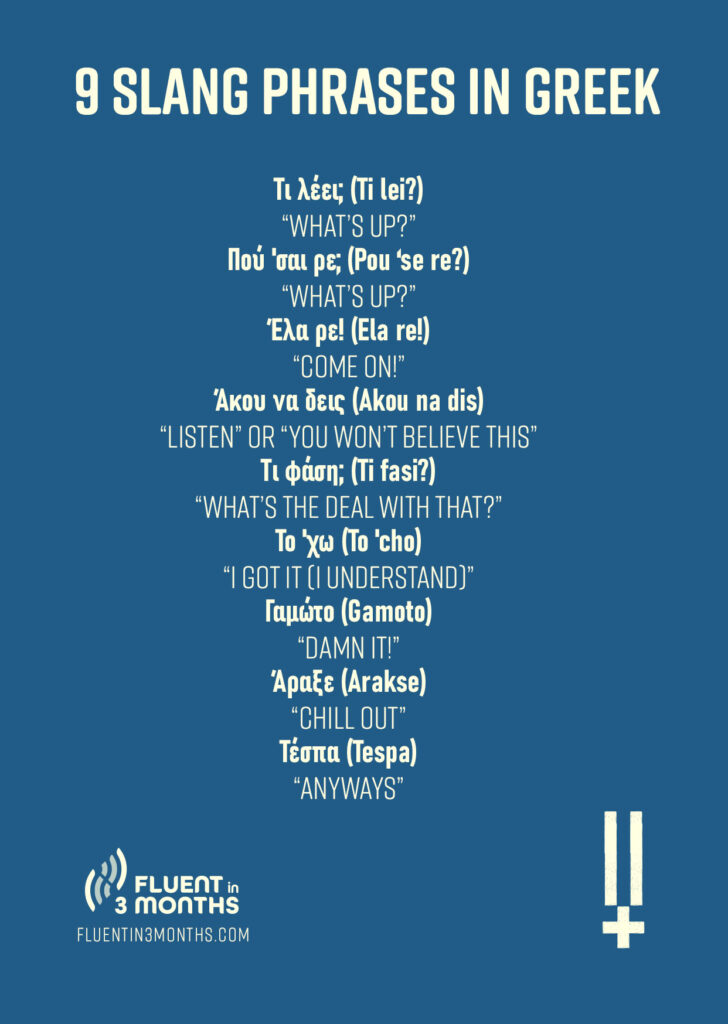
The Greek language is rich with colloquialisms that, while informal, are pervasive in daily life. One of the most famous—and controversial—terms is "Malaka" (μαλάκα). While technically a profanity, it is frequently used among close male friends as a term of endearment or a casual exclamation. However, travelers are cautioned to avoid using this term unless they have reached a high level of intimacy with the listener, as it remains offensive in formal or unfamiliar contexts.
Other useful slang includes "Ti lei?" (τι λÎει;), a casual "What’s up?", and "Ela re!" (Îλα ϱε!), an expression of surprise or disbelief similar to "Come on!" or "No way!". The term "Tespa" (Ï„Îσπα), a shortened version of "telos panton," is commonly used to mean "anyway" or "regardless," serving as a linguistic bridge to move a conversation forward.
Analysis of Cultural Wisdom: Famous Greek Proverbs
To truly understand the Greek mindset, one must look toward the proverbs that have survived millennia of linguistic evolution. These phrases offer a window into the values of patience, resilience, and community that define the Hellenic spirit.
- "Siga siga" (σιγά σιγά): Meaning "slowly, slowly." This is more than a phrase; it is a philosophy of life in Greece, encouraging individuals to enjoy the moment rather than rushing through tasks.
- "Kathe empodio gia kalo" (κάθε εμπÏÓδιο για καλÏÓ): Meaning "every obstacle is for the best." This reflects the resilient Greek outlook on hardship, suggesting that setbacks often lead to better outcomes.
- "I poli logia ine ftohia" (τα πολλά λÏÓγια είναι τψÏîεια): Meaning "many words are poverty." It is the Greek equivalent of "actions speak louder than words," emphasizing the importance of substance over rhetoric.
- "Otan lipi i gata, horevoun ta pontikia" (ÏÓταν λείπει η γάτα, Ïîοϱεϳουν τα ποντίκια): Meaning "when the cat is away, the mice will dance." A universal sentiment regarding the lack of supervision.
- "I kathariotita ine i misi arhontia" (η καθαϱιÏÓτητα είναι η μισή αϱÏîοντιά): Meaning "cleanliness is half of nobility." This underscores the high cultural value placed on personal and domestic presentation.
Broader Impact and Implications
The mastery of these phrases is not merely a task for the vacationer; it is a contribution to the preservation of the Greek language, which is one of the oldest recorded living languages in the world. As globalization continues to homogenize urban cultures, the effort to speak native languages acts as a counterbalance, protecting local identities.
For the Greek hospitality industry, the impact is tangible. Business owners in the "Kyklades" or the "Dodecanese" islands often prioritize service for those who attempt the local tongue, viewing it as a sign of respect for their heritage. This "linguistic social capital" can lead to better dining tables, insider travel tips, and a deeper understanding of the "Filoxenia"—the ancient Greek concept of hospitality to strangers.
In conclusion, while the Greek alphabet may appear daunting to those familiar only with Latin scripts, the phonetic consistency of Modern Greek makes it an accessible language for basic communication. By moving beyond "Hello" and "Thank you" into the realms of daily life, travel survival, and cultural wisdom, visitors can unlock a version of Greece that remains hidden from the average tourist. As the nation continues to evolve as a premier global destination, the bridge of language remains the most effective tool for meaningful cross-cultural exchange.
