

The pursuit of linguistic proficiency in Turkish has seen a significant surge over the last decade, driven by Turkey’s growing geopolitical influence, a burgeoning tourism sector, and the global "soft power" success of its television industry. For the modern language learner, the challenge of mastering a non-Indo-European language is often mitigated by a strategic focus on high-frequency vocabulary. Experts in linguistics suggest that a core set of approximately 1,000 words can account for nearly 80% of daily communication in Turkish. By prioritizing the most common nouns, verbs, and social markers, students can establish a functional foundation that facilitates immediate interaction and provides a scaffold for more complex grammatical structures.
Turkish, a member of the Turkic language family, is spoken by approximately 80 million native speakers and millions more as a second language. Unlike English or French, it is an agglutinative language, meaning it relies heavily on suffixes to convey meaning. However, the 1928 alphabet reform, which transitioned the language from the Arabic script to a modified Latin alphabet, has made it significantly more accessible to Western learners. This guide outlines the essential building blocks required to navigate Turkish society, from the initial greeting to the nuances of professional and social etiquette.
The Evolution of the Turkish Language and Modern Learning Trends
To understand the importance of basic Turkish vocabulary, one must consider the historical context of the language. The modern Turkish spoken today is the result of the "Language Revolution" (Dil Devrimi) initiated by Mustafa Kemal Atatürk. This movement aimed to "purify" the language by replacing many Persian and Arabic loanwords with Turkish roots or Western equivalents. Consequently, the vocabulary of contemporary Turkey is a blend of ancient Turkic origins and modern international terms, making it a unique linguistic landscape.
Recent data from language learning platforms indicates that Turkish is now among the top 15 most studied languages globally. This interest is largely attributed to the "Dizi" phenomenon—Turkish television dramas that are exported to over 150 countries. Educational psychologists note that learners who begin with high-frequency "survival" vocabulary—such as greetings and basic verbs—experience higher retention rates and greater motivation due to their ability to understand media content and participate in basic social exchanges early in their studies.
Social Foundations: Greetings and Polite Expressions
In Turkish culture, social etiquette and hospitality (misafirperverlik) are paramount. The way a person initiates a conversation often dictates the tone of the entire interaction. Turkish distinguishes between formal and informal addresses, a distinction that is vital for both social and professional settings.
Essential Greetings
The most fundamental greeting is "Merhaba" (Hello), which is appropriate in almost any situation. For a more informal setting among peers, "Selam" (Hi) is commonly used. Time-sensitive greetings are also crucial:
- Günaydın: Good morning
- İyi akşamlar: Good evening
- Görüşürüz: See you later
- Hoş geldin (Informal) / Hoş geldiniz (Formal): Welcome
A key cultural nuance involves the inquiry into one’s well-being. "Nasılsın?" (How are you?) is reserved for friends, while "Nasılsınız?" is the respectful version for elders or strangers. The standard response, "İyiyim" (I am fine), is often followed by a "Teşekkür ederim" (Thank you) to maintain social harmony.
The Language of Politeness
Turkish contains several unique "formulaic expressions" that have no direct equivalent in English but are essential for sounding natural.
- Lütfen: Please
- Özür dilerim: I am sorry
- Geçmiş olsun: Get well soon (Literally: "May it be past")
- Afiyet olsun: Enjoy your meal
- Elinize sağlık: Health to your hands (Used to thank a cook or someone who has done manual work)
- Kolay gelsin: May it be easy for you (A polite phrase used when seeing someone working, whether they are a shopkeeper or a colleague)
The Functional Core: Common Nouns and Categories
Nouns serve as the primary labels for the world around us. In Turkish, nouns do not have grammatical gender, which simplifies the learning process for English speakers. Categorizing these words into functional groups allows for more efficient memorization.
Food and Daily Sustenance
The culinary culture of Turkey is a central pillar of its identity. Knowing basic food items is essential for navigating markets and restaurants.
- Ekmek: Bread
- Su: Water
- Çay: Tea (The most consumed beverage in Turkey)
- Kahve: Coffee
- Et: Meat
- Balık: Fish
- Peynir: Cheese
- Süt: Milk
- Yumurta: Egg
- Makarna: Pasta
Learners should be wary of "false friends" in this category. For instance, the word "Pasta" in Turkish refers to "cake," not the Italian noodle dish, which is exclusively called "Makarna."
Kinship and Family Structures
Turkish vocabulary is exceptionally rich when describing family, reflecting the traditional importance of the extended family unit. Unlike English, Turkish specifies whether an uncle or aunt is from the maternal or paternal side.
- Anne: Mother
- Baba: Father
- Kardeş: Sibling
- Abla: Older sister
- Abi: Older brother
- Amca: Uncle (Paternal)
- Dayı: Uncle (Maternal)
- Hala: Aunt (Paternal)
- Teyze: Aunt (Maternal)
Navigation and Urban Infrastructure
For travelers and expatriates, identifying key locations is a priority for logistical success.
- Ev: House
- Okul: School
- Hastane: Hospital
- Restoran: Restaurant
- Otel: Hotel
- Banka: Bank
- Havaalanı: Airport
- Tren istasyonu: Train station
Action and Context: High-Frequency Verbs and Grammar
Verbs are the engines of the Turkish language. A significant grammatical difference between Turkish and English is word order; Turkish follows a Subject-Object-Verb (SOV) pattern. This means the action word typically concludes the sentence. Furthermore, the concepts of "to be" and "to have" are not separate verbs but are expressed through suffixes or the words "var" (there is/exists) and "yok" (there is not/does not exist).
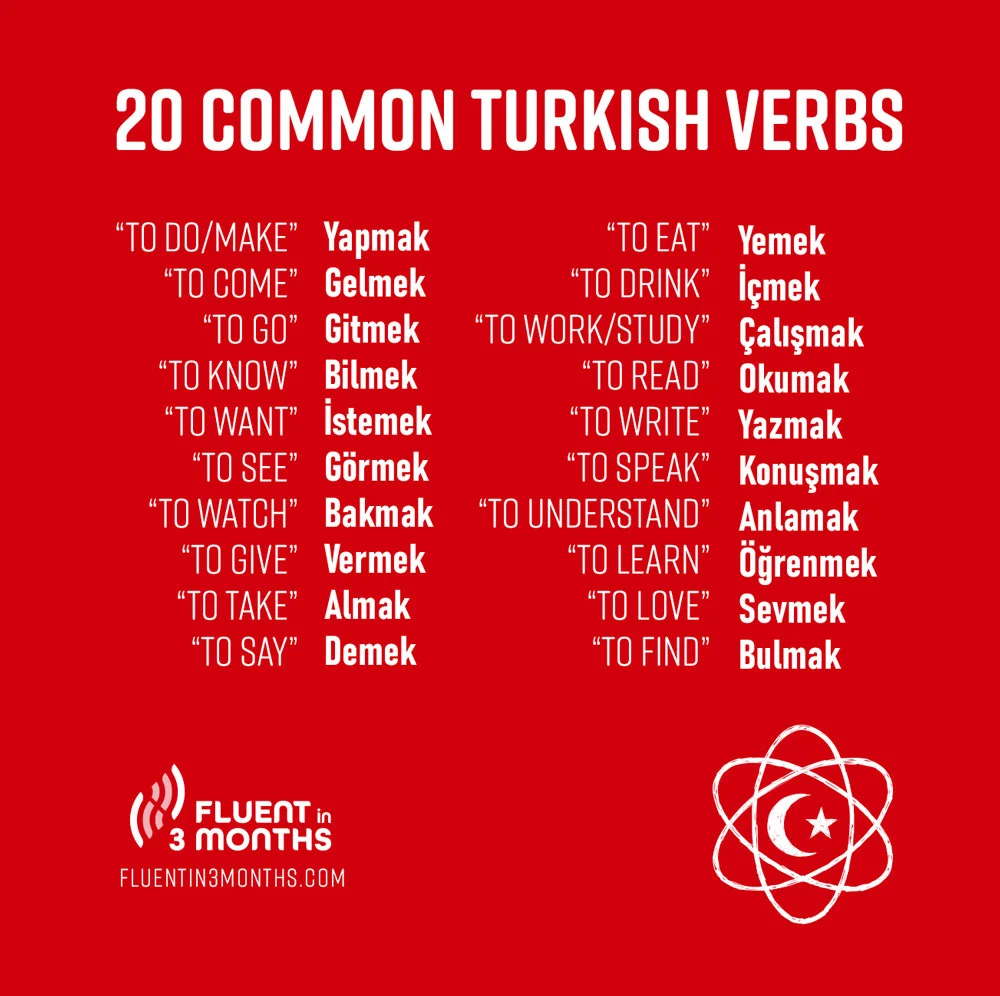
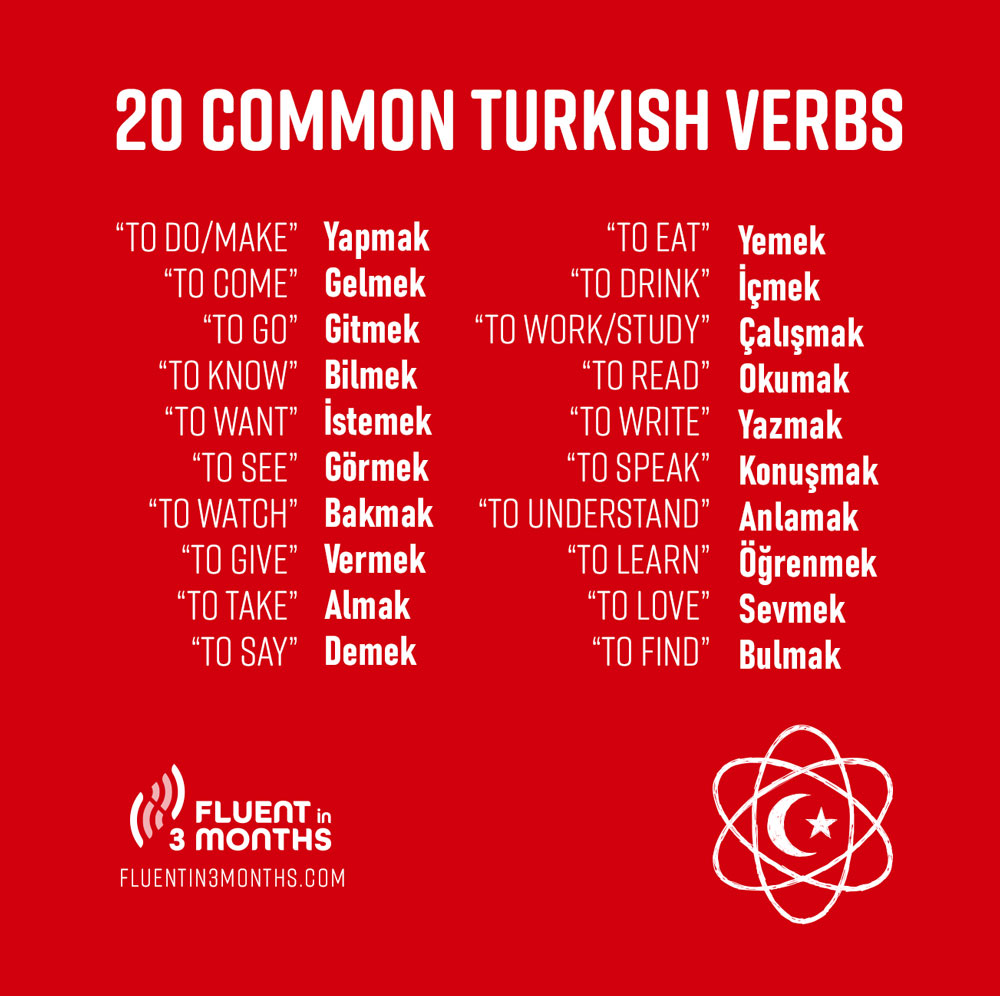
20 Essential Verbs for Daily Life
- Yapmak: To do/make
- Gelmek: To come
- Gitmek: To go
- Bilmek: To know
- İstemek: To want
- Görmek: To see
- Bakmak: To look/watch
- Vermek: To give
- Almak: To take/buy/get
- Demek: To say
- Yemek: To eat
- İçmek: To drink
- Çalışmak: To work/study
- Okumak: To read
- Yazmak: To write
- Konuşmak: To speak
- Anlamak: To understand
- Öğrenmek: To learn
- Sevmek: To love
- Bulmak: To find
Descriptive Language: Adjectives and Colors
Adjectives provide the necessary detail to express preferences and describe experiences. In Turkish grammar, adjectives always precede the noun they modify, similar to English.
Common Descriptors
- Büyük / Küçük: Big / Small
- Güzel / Çirkin: Beautiful / Ugly
- İyi / Kötü: Good / Bad
- Yeni / Eski: New / Old (for objects)
- Genç / Yaşlı: Young / Old (for people)
- Sıcak / Soğuk: Hot / Cold
- Kolay / Zor: Easy / Difficult
- Pahalı / Ucuz: Expensive / Cheap
The Spectrum of Color
- Kırmızı: Red
- Mavi: Blue
- Sarı: Yellow
- Yeşil: Green
- Beyaz: White
- Siyah: Black
Temporal and Logical Connectors
To move beyond isolated words and into cohesive speech, learners must utilize time-related words and conjunctions. These act as the "glue" for sentences.
Time Markers
- Bugün: Today
- Dün: Yesterday
- Yarın: Tomorrow
- Şimdi: Now
- Sonra: Later
- Gün / Hafta / Ay / Yıl: Day / Week / Month / Year
Logical Connectors
- Ve: And
- Ama: But
- Veya: Or
- Çünkü: Because
- Eğer: If
Question Words and Clarification
Effective communication is a two-way street. Being able to ask questions is vital for learning and survival in a foreign environment.
- Ne: What
- Kim: Who
- Neden: Why
- Nasıl: How
- Nerede: Where
- Hangi: Which
- Ne zaman: When
The "Dizi" Influence: Colloquialisms and Fillers
The global consumption of Turkish media has introduced learners to informal "fillers" and terms of endearment that are rarely found in textbooks but are ubiquitous in real-life conversations.
- Tabii ki: Of course
- Hadi: Come on / Let’s go
- Valla: I swear (Used to emphasize truthfulness)
- Maalesef: Unfortunately
- Canım: My dear (Literally: "My soul")
- Yok artık: No way / You’ve got to be kidding
Analysis of Implications: The Value of Turkish Proficiency
The strategic acquisition of Turkish vocabulary carries significant weight in the 21st century. Geopolitically, Turkey serves as a bridge between Europe, the Middle East, and Central Asia. For professionals in diplomacy, international trade, and energy sectors, even a basic command of the language can open doors that remain closed to those relying solely on English.
From a cognitive perspective, learning Turkish introduces students to "agglutination" and "vowel harmony," linguistic features that challenge and expand the brain’s processing capabilities. Furthermore, the economic impact of the Turkish diaspora in Europe—particularly in Germany—means that Turkish is a vital community language in the heart of the European Union.
In conclusion, while the Turkish language may initially seem daunting due to its unique structure, it is remarkably logical and consistent. By focusing on the high-frequency vocabulary outlined in this guide, learners can rapidly achieve a level of "functional fluency." This not only enables practical navigation of Turkish-speaking environments but also fosters a deeper appreciation for one of the world’s most historically rich and culturally vibrant civilizations. As Turkey continues to play a pivotal role on the world stage, the value of speaking its language will only continue to rise.
