

Numerical literacy serves as a fundamental pillar for any individual seeking to navigate the socio-economic landscape of the Republic of Turkey. Whether engaging in high-stakes commercial negotiations in Istanbul’s financial districts, settling a hospitality bill in the Mediterranean region, or exchanging contact information within a burgeoning social network, a precise command of Turkish numerals is indispensable. The Turkish numbering system is noted by linguists for its exceptional regularity and logical structure, diverging from the more complex irregular forms found in Romance or Germanic languages. By understanding the additive nature of these numerals, learners can rapidly scale their proficiency from basic counting to managing complex financial transactions.
The Structural Logic of Turkish Numerals
The Turkish language, being agglutinative and highly systematic, utilizes a decimal-based counting system that remains consistent across all magnitudes. Unlike English, which employs unique terms for numbers such as "eleven" or "twelve," or French, which uses a base-60 and base-80 hybrid for higher figures, Turkish follows a strict "Ten + Digit" or "Multiple + Base" formula. This linguistic consistency significantly reduces the cognitive load for language learners and international professionals.
The transition to the modern Turkish alphabet and the adoption of Western numerals occurred during the 1928 Alphabet Reform under Mustafa Kemal Atatürk. This shift standardized the way numbers are written and spoken, aligning Turkish commercial practices with international standards while maintaining the inherent logic of Turkic syntax.
The Foundation: Cardinal Numbers 1 through 10
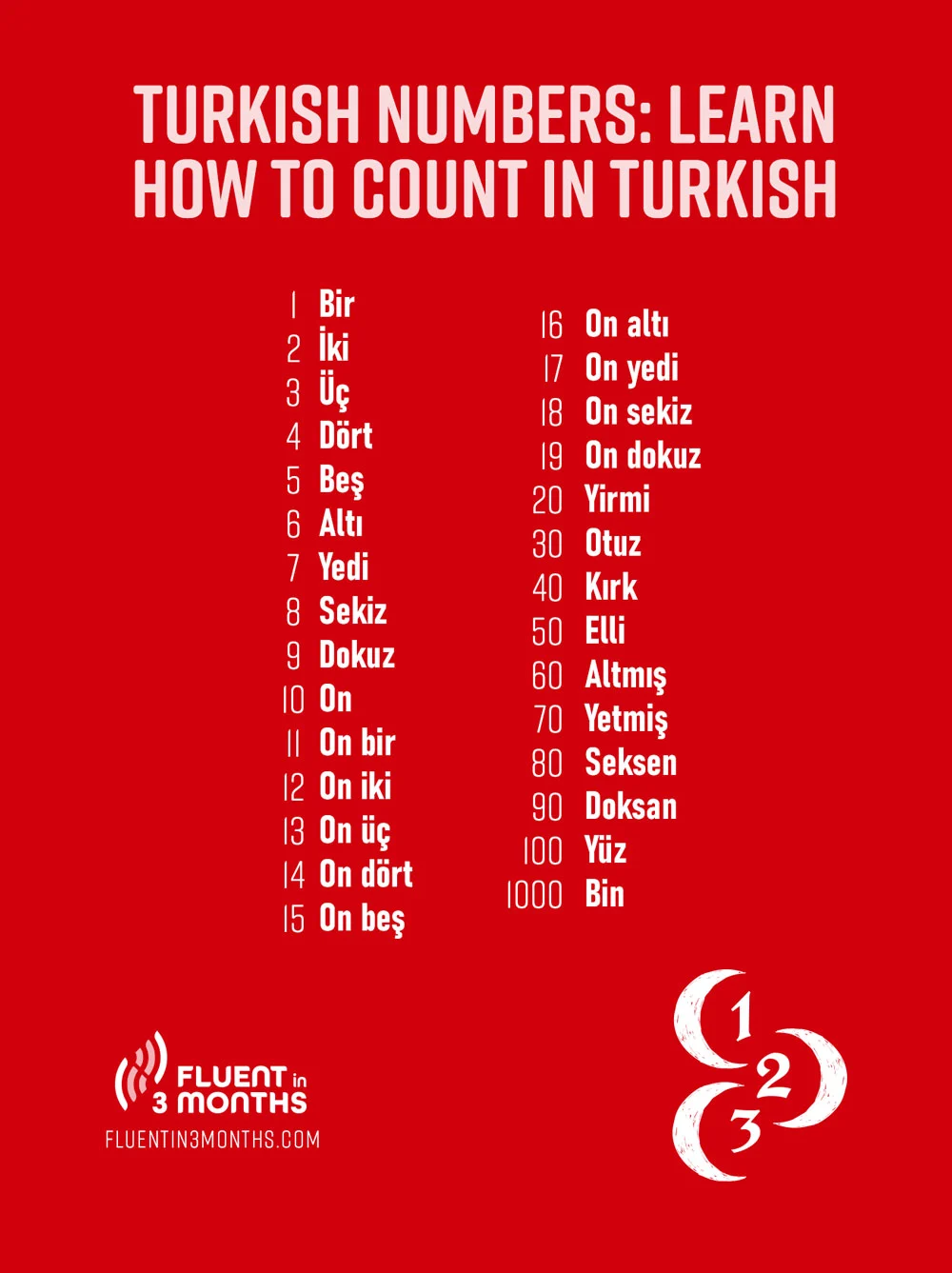
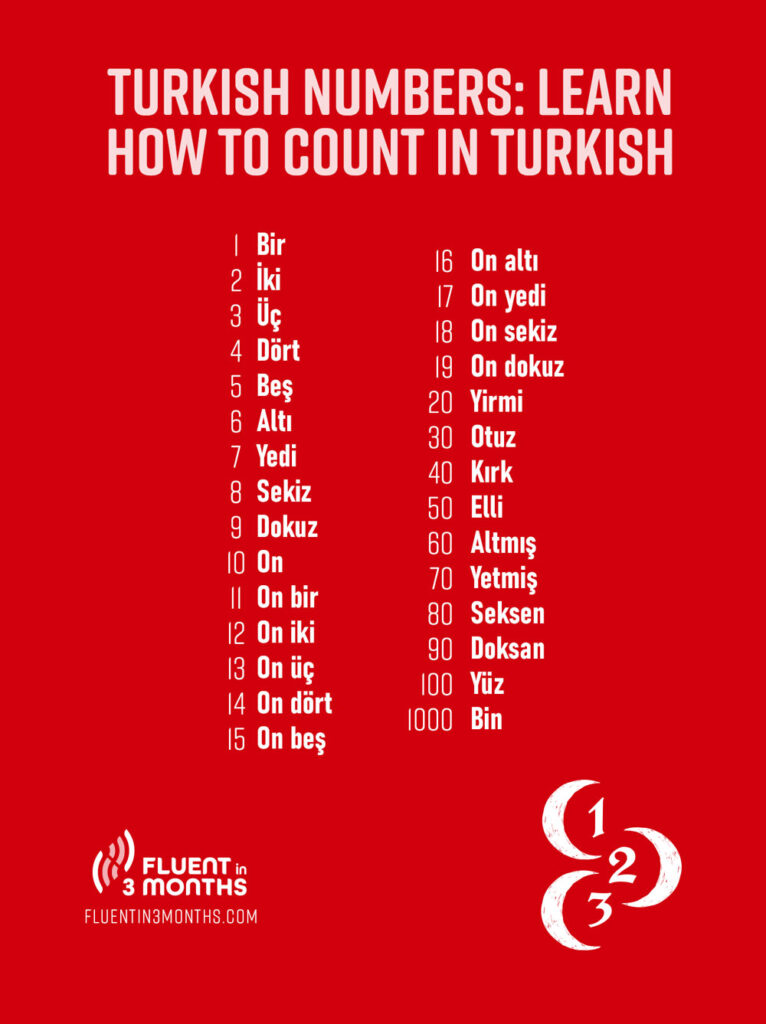
The mastery of Turkish numerals begins with the first ten digits. These monosyllabic and disyllabic words form the basis for every subsequent numerical value.
- Bir (One)
- İki (Two)
- Üç (Three)
- Dört (Four)
- Beş (Five)
- Altı (Six)
- Yedi (Seven)
- Sekiz (Eight)
- Dokuz (Nine)
- On (Ten)
In a commercial context, "bir" is also frequently used as an indefinite article, similar to "a" or "an" in English. For example, "bir kahve" translates to "a coffee" or "one coffee," depending on the emphasis of the speaker.
Linear Progression: Numbers 11 through 19
The Turkish system for the second decade of numbers is entirely predictable. By placing the word for ten (on) before the single digit, the compound number is formed. There are no exceptions to this rule, which facilitates rapid acquisition for beginners.
- 11: On bir (Ten one)
- 12: On iki (Ten two)
- 13: On üç (Ten three)
- 14: On dört (Ten four)
- 15: On beş (Ten five)
- 16: On altı (Ten six)
- 17: On yedi (Ten seven)
- 18: On sekiz (Ten eight)
- 19: On dokuz (Ten nine)
The Decades: Counting by Tens from 20 to 90
To progress toward 100, one must memorize the specific terms for each decade. While some terms bear a phonetic resemblance to their single-digit roots (such as altmış for 60 and altı for 6), others are distinct.
- 20: Yirmi
- 30: Otuz
- 40: Kırk
- 50: Elli
- 60: Altmış
- 70: Yetmiş
- 80: Seksen
- 90: Doksan
To form any number between these markers, the speaker simply follows the decade with the single digit. For instance, 45 is rendered as kırk beş, and 82 is seksen iki. This mathematical precision eliminates the need for the hyphenation often seen in English (e.g., "forty-five").
Scaling Magnitude: Hundreds, Thousands, and Millions
In the current Turkish economic climate, where the Turkish Lira (TRY) often involves larger denominations for daily purchases, understanding the terms for 100 (yüz) and 1,000 (bin) is essential for accurate budgeting and price comparison.
The Hundreds (Yüz)
The word for 100 is yüz. To express multiples of a hundred, the multiplier is placed before the word yüz.
- 100: Yüz (Note: "Bir yüz" is rarely used; "yüz" suffices)
- 200: İki yüz
- 500: Beş yüz
- 900: Dokuz yüz
To create complex numbers like 235, the components are stated in descending order of magnitude: İki yüz otuz beş (Two hundred thirty five).
The Thousands (Bin) and Beyond
Similarly, 1,000 is expressed as bin. This is a critical threshold for travelers, as many mid-range hotel stays or luxury items will be priced in the thousands.
- 1,000: Bin
- 5,000: Beş bin
- 10,000: On bin
- 1,000,000: Bir milyon
Ordinal Numerals and the Rule of Vowel Harmony
Ordinal numbers (first, second, third) are vital for identifying floor levels in buildings, dates, or sequences in a queue. In Turkish, these are formed by adding the suffix -ıncı, -inci, -uncu, or -üncü to the cardinal number. The choice of suffix is governed by "vowel harmony," a linguistic feature where the suffix’s vowel must match the phonetic characteristics of the preceding syllable.
- 1st: Birinci
- 2nd: İkinci
- 3rd: Üçüncü
- 4th: Dördüncü (Note the consonant shift from ‘t’ to ‘d’)
- 10th: Onuncu
Practical Applications in Contemporary Turkey
Financial Transactions and Currency
The official currency is the Turkish Lira (TL), subdivided into 100 kuruş. When reading prices, the lira amount is stated first, followed by the kuruş.
- Example: 15,50 TL is spoken as on beş lira elli kuruş.
- Common Inquiry: Fiyat ne kadar? (What is the price?)
Temporal Communication
Turkey officially operates on a 24-hour clock, particularly in formal sectors such as aviation, rail transport, and government broadcasting. However, in daily conversation, a 12-hour system is common, supplemented by terms for "half" and "quarter."
- Formal: 14:00 – Saat on dört
- Informal: 14:30 – Saat iki buçuk (Two and a half)
- Quarter Past: 14:15 – Saat ikiyi çeyrek geçiyor (Quarter past two)
Personal Identification and Telephony
Turkish phone numbers consist of a three-digit area or mobile code followed by a seven-digit number. Standard practice involves grouping these digits into a sequence of three, then two, then two.
- Format: 0 (5XX) XXX XX XX
- Example: 0532 123 45 67 would be articulated as: Sıfır, beş yüz otuz iki, yüz yirmi üç, kırk beş, altmış yedi.
Vital Statistics and Age
To inquire about age, the phrase Kaç yaşındasınız? (How old are you?) is used. The response follows the format: [Number] + yaşındayım.
- Example: Otuz iki yaşındayım (I am thirty-two years old).
Technical Conventions: Period vs. Comma
A critical point of distinction for international professionals is the Turkish convention for mathematical notation. In contrast to the Anglo-American system, Turkey uses the period (.) as a thousands separator and the comma (,) as a decimal separator.
- Turkish Standard: 1.250.000,75 (One million two hundred fifty thousand, and seventy-five cents/kuruş)
- English Standard: 1,250,000.75
Misinterpreting these symbols in a legal contract or financial statement can lead to significant discrepancies. It is advised that all diplomatic and commercial correspondence be double-checked for adherence to these local standards.
Analysis of Linguistic Impact on Integration
The accessibility of the Turkish numerical system serves as a gateway for broader linguistic acquisition. Because the system is devoid of the irregular "teens" or "base-20" complexities found in other languages, learners often report a higher sense of initial confidence. This confidence translates directly into greater autonomy when navigating the Turkish marketplace.
From a sociological perspective, the ability of a foreigner to use Turkish numbers accurately is often viewed by locals as a sign of respect and serious intent. In the "pazar" (market) culture of Turkey, where prices may occasionally be subject to negotiation, demonstrating numerical proficiency can lead to more equitable transactions and improved rapport with vendors.
Conclusion
Mastering Turkish numbers is more than a linguistic exercise; it is a vital tool for economic and social navigation within one of the world’s most dynamic emerging markets. By internalizing the 1-10 base, understanding the additive logic of the decades, and respecting the nuances of vowel harmony in ordinal forms, individuals can ensure precision in their daily interactions. As Turkey continues to solidify its role as a global hub for tourism and trade, the value of this numerical foundation will only continue to increase for the international community.
