

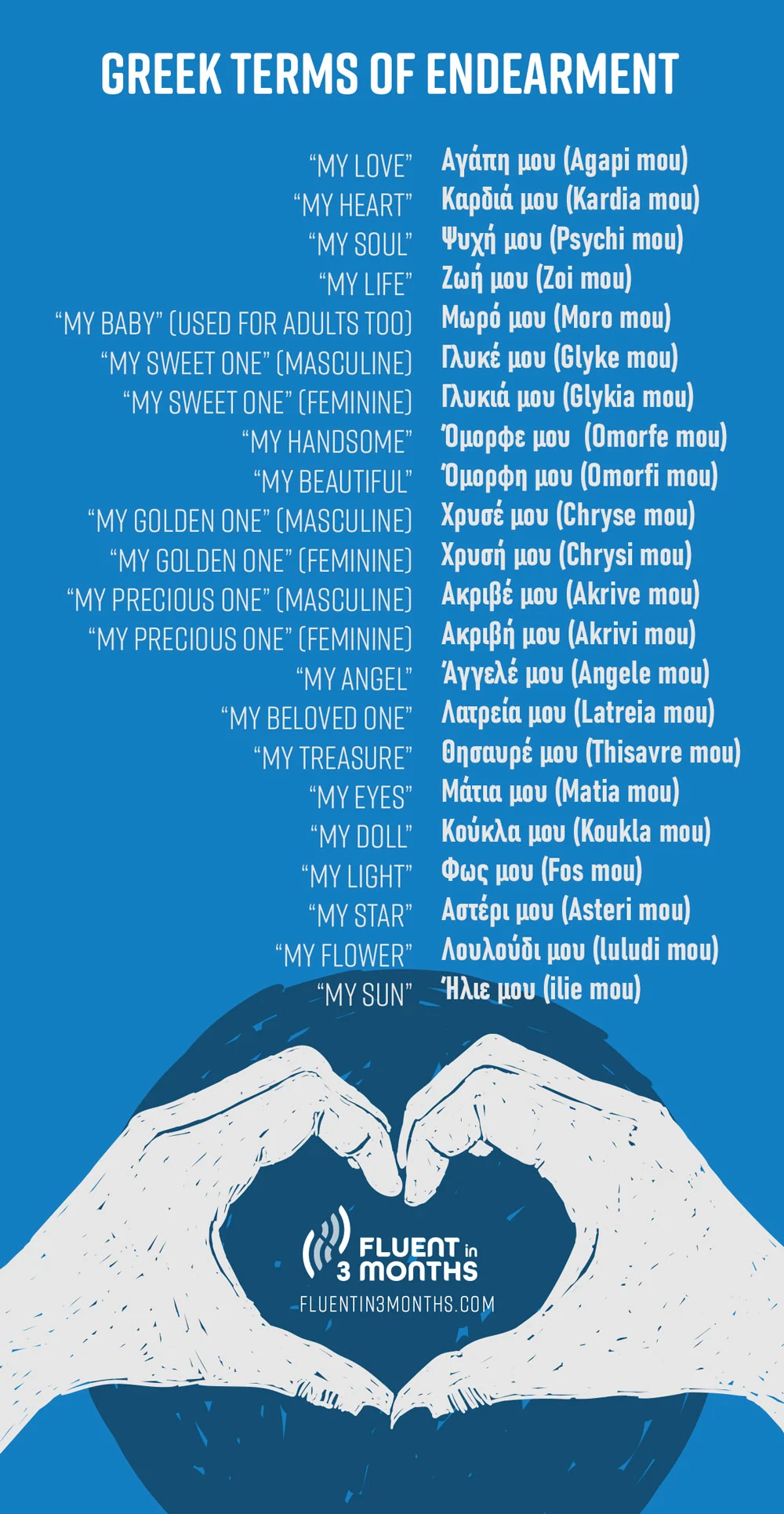
The Greek language, a cornerstone of Western civilization with a documented history spanning over 3,400 years, possesses one of the most sophisticated systems of endearment and emotional expression in the Indo-European family. Modern Greek communication relies heavily on a nuanced hierarchy of affectionate terms that transcend mere romantic utility, embedding themselves into the fabric of familial, platonic, and professional social structures. Central to this linguistic phenomenon is the syntactical application of the possessive pronoun "mou" (μου), meaning "my," which, when paired with specific nouns such as "agapi" (love) or "kardia" (heart), functions as a primary tool for establishing intimacy and social cohesion. This report examines the structural mechanics, historical evolution, and sociocultural implications of Greek terms of endearment as they are utilized in contemporary discourse.
The structural foundation of Greek affectionate language is rooted in the post-nominal placement of possessive markers. Unlike English, where the possessive precedes the noun (e.g., "my love"), Greek standard practice requires the pronoun to follow the noun, resulting in "agapi mou" (αγάπη μου). This grammatical consistency serves a dual purpose: it emphasizes the emotional subject while simultaneously claiming a personal connection to the listener. Linguists note that this pattern is nearly universal across various categories of endearment, ranging from "zoi mou" (my life) to "psychi mou" (my soul). The latter, derived from the Ancient Greek "psyche," reflects a deep-seated cultural tendency to equate affection with the very essence of human existence, a trait that has persisted from the Hellenistic period to the modern era.
The evolution of these terms is inextricably linked to the philosophical foundations of ancient Greece, which famously identified eight distinct forms of love. These categories—Eros (romantic passion), Philia (deep friendship), Storge (familial affection), Agape (unconditional love), Ludus (playful love), Pragma (long-standing commitment), Philautia (self-love), and Mania (obsessive love)—continue to inform the vocabulary of modern speakers. While ancient speakers might have used these terms to categorize the nature of a relationship, modern Greeks have synthesized these concepts into a versatile lexicon that allows for rapid shifts in social register. For instance, the term "agapi" (αγάπη), once reserved for the highest form of spiritual or unconditional love, is now the most common term of endearment for partners, children, and close friends alike, signifying a democratization of emotional language.

A critical component of Greek endearment is the use of the diminutive form, a morphological process where suffixes are added to names or nouns to convey smallness, youth, or affection. The most prevalent suffixes include "-aki" (-άκι), "-itsa" (-ίτσα), "-oulis" (-ούλης), and "-oula" (-ούλα). The application of these suffixes is governed by complex gender and phonetic rules. For example, a male named Georgios may be called "Yiorgaki" in a domestic setting, while a female named Maria might become "Marioula" or "Maritsa." This linguistic tool is not limited to proper names; it extends to common nouns such as "mama" (mother) becoming "manoula" (mommy) or "paidi" (child) becoming "paidaki" (little child). Data from sociolinguistic studies suggest that the use of diminutives in Greece and Cyprus is significantly higher than in Northern European linguistic groups, reflecting a Mediterranean cultural emphasis on warmth and interpersonal proximity.
In the context of romantic relationships, the Greek lexicon offers a tiered system of address. While "agapi mou" remains the standard, gender-specific terms provide additional layers of meaning. Men are frequently addressed as "agori mou" (my boy) or "omorfe mou" (my handsome one), while women may be called "koritsi mou" (my girl) or "koukla mou" (my doll). The term "moro mou" (my baby), though neuter in gender, is applied to adults of both sexes and is considered one of the most common colloquialisms in modern Greek dating culture. Furthermore, more intense terms such as "latreia mou" (my worship) and "thisavre mou" (my treasure) indicate a level of devotion that borders on the hagiographic, highlighting the performative and passionate nature of Greek romantic expression.
Beyond the romantic sphere, the family unit—the "oikogeneia"—remains the primary site for the transmission of these linguistic habits. Greek culture is characterized by strong intergenerational bonds, and the vocabulary used within the home reflects this priority. Terms like "paterouli mou" (my dear father) or "giayia mou" (my grandmother) are often used even by adults, signaling a lifelong adherence to familial hierarchy and affection. In many Greek-speaking households, it is common for parents to address their children using the same terms the children use for them (a phenomenon known as "inverse addressing"), where a mother might call her son "mama" as a term of endearment. This unique feature of the language underscores the reciprocal nature of Greek familial love.
The role of regional dialects, particularly the Cypriot dialect, also warrants analysis. While Standard Modern Greek is the prestige variety used in media and education, regional variations often preserve or emphasize certain terms of endearment. In Cyprus, the use of "mou" is equally pervasive, but the phonetic delivery and certain localized diminutives provide a distinct flavor to the emotional landscape. The intersection of these dialects ensures that the Greek language remains a living, breathing entity that adapts to the geographic and social realities of its speakers.
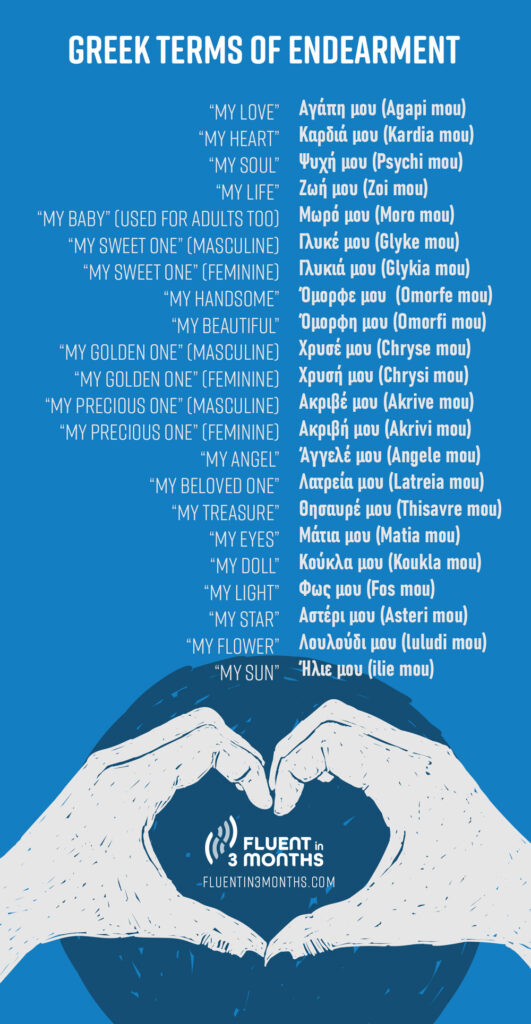
From a pedagogical perspective, for non-native speakers attempting to achieve fluency, mastering these terms is essential for social integration. However, the correct application of these words requires an understanding of the vocative case. When addressing someone directly with an adjective or noun of endearment, the endings of the words often change. For instance, "omorfo" (handsome) becomes "omorfe" in the vocative. This grammatical nuance is often the final hurdle for language learners seeking to sound natural in Greek conversation. Additionally, pronunciation plays a vital role; the Greek "gamma" (γ) and the "chi" (χ) are fricatives that require specific tongue placement, and the "delta" (δ) and "theta" (θ) are dental fricatives similar to the English "th" sounds. Mastery of these sounds is necessary to convey the intended warmth of the endearment.
The broader implications of this rich emotional vocabulary extend to the psychological well-being of the population. Psycholinguists argue that the frequent use of affectionate terms can reduce social anxiety and foster a sense of belonging. In Greek society, where "philoxenia" (hospitality toward strangers) is a core value, the transition from formal address to terms of endearment can happen remarkably quickly, often within a single conversation. A shopkeeper might call a regular customer "moro mou" or "agapi mou," not as an expression of romantic interest, but as a marker of communal familiarity. This "linguistic warmth" acts as a social lubricant, easing transactions and interactions in a way that more reserved languages may find difficult to replicate.
In conclusion, the Greek system of endearment is a multifaceted structure that combines ancient philosophical roots with modern grammatical precision and cultural warmth. Through the use of the possessive "mou," the versatile "agapi," and a complex array of diminutives, the language provides its speakers with a sophisticated toolkit for navigating the complexities of human relationships. Whether in the romantic, familial, or platonic realm, these terms serve as a constant reminder of the Greek priority on connection, emotion, and the enduring power of the spoken word. As the Greek diaspora continues to flourish globally, these terms of endearment remain a vital link to cultural identity, ensuring that "agapi mou" remains a recognized and cherished phrase across the international community. Future linguistic research may further explore how digital communication and social media are influencing these traditional forms, but for now, the classical foundations of Greek affection remain largely unshaken by the passage of time.
