

The ability to navigate the numerical landscape of the Republic of Turkey serves as a fundamental pillar for any foreign national seeking to engage with the nation’s vibrant economy, social fabric, or administrative systems. As Turkey continues to position itself as a global hub for tourism, international business, and secondary residency, the mastery of Turkish numerals has transitioned from a supplementary skill to a critical necessity for effective communication. From the bustling corridors of Istanbul’s Grand Bazaar to the digital interfaces of Turkish banking applications, the logic and application of Turkish numbers underpin nearly every daily interaction.
The Structural Logic of Turkish Numerals
The Turkish numerical system is characterized by its remarkable regularity and logical consistency, features that stem from the language’s agglutinative nature and the systematic language reforms initiated in the early 20th century. Unlike English, which employs unique terms for "eleven" and "twelve," or French, which utilizes a vigesimal (base-20) logic for higher numbers, Turkish operates on a strictly decimal and additive basis. This transparency allows learners to construct complex figures once a small set of root words is mastered.
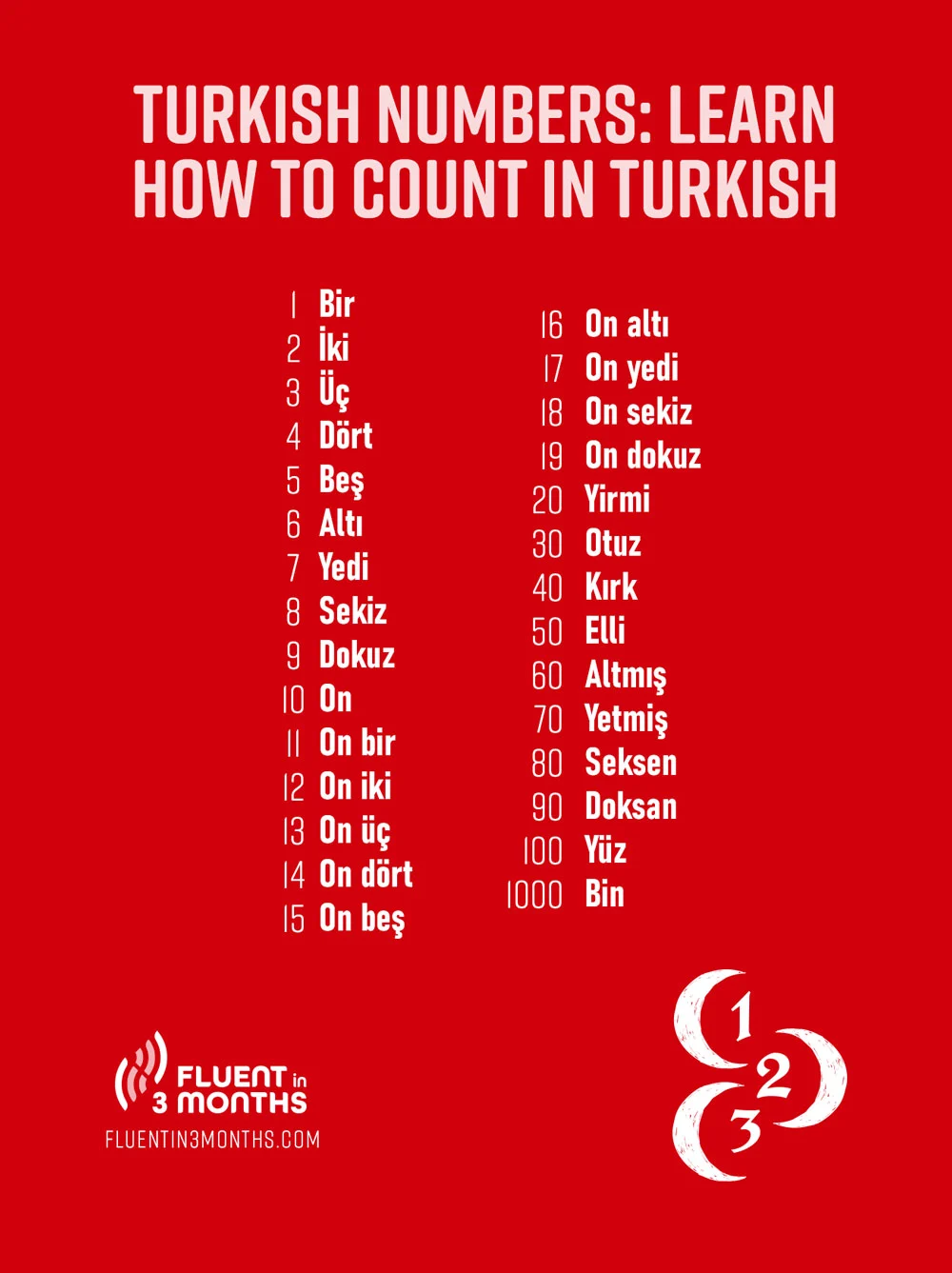
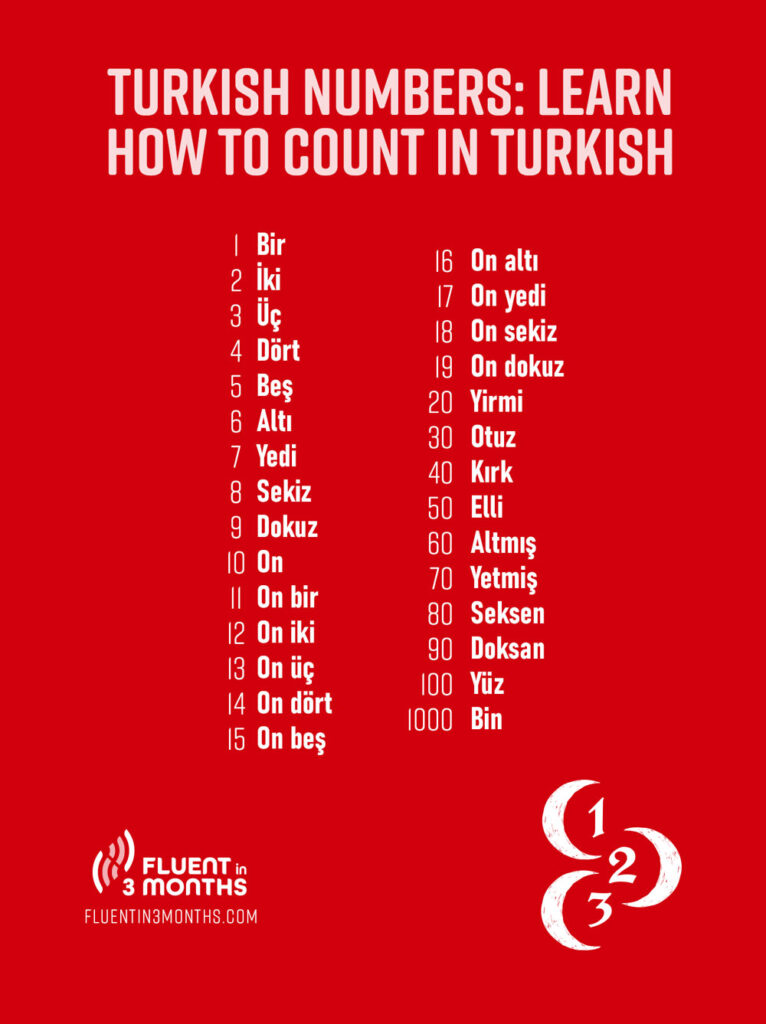
The foundational building blocks are the digits zero through nine: sıfır (0), bir (1), iki (2), üç (3), dört (4), beş (5), altı (6), yedi (7), sekiz (8), and dokuz (9). The number ten is represented by on. To form numbers between 11 and 19, the language simply places the word for ten before the single digit. For example, 11 is on bir (ten-one) and 19 is on dokuz (ten-nine). This pattern remains unwavering throughout the entire numerical spectrum.
Chronological Progression: From Tens to Thousands
To advance toward full numerical literacy, one must internalize the specific terms for the multiples of ten. These include yirmi (20), otuz (30), kırk (40), elli (50), altmış (60), yetmiş (70), seksen (80), and doksan (90). The construction of intermediate numbers follows the same additive logic used in the teens: the tens digit is followed immediately by the units digit. Consequently, 25 becomes yirmi beş and 99 becomes doksan dokuz.
The transition to larger denominations maintains this structural simplicity. One hundred is yüz. Multiples of one hundred are created by placing the multiplier before the word yüz, such as iki yüz (200) or beş yüz (500). The same rule applies to thousands (bin). Therefore, 2,000 is expressed as iki bin. When constructing a complex number like 1,923—the year of the Republic’s founding—the components are sequenced by magnitude: bin dokuz yüz yirmi üç (one thousand, nine hundred, twenty, three).
Supporting Data: The Impact of the 1928 Alphabet Reform
The current clarity of the Turkish numerical system is an indirect result of the "Harf Devrimi" or Alphabet Reform of 1928. Prior to this period, the Ottoman Empire utilized the Arabic script and a complex mix of Persian and Arabic numerical conventions. Under the leadership of Mustafa Kemal Atatürk, the transition to the Latin alphabet and the purification of the Turkish language led to a standardized, phonetic, and highly accessible numerical system.
According to historical linguistic data, this transition increased national literacy rates significantly, rising from roughly 10% in the late 1920s to over 90% in the modern era. For the contemporary expatriate or tourist, this historical legacy means that the numbers written on a price tag or a digital clock are identical to those used in the West, even if the verbal expressions differ.
Technical Nuances: Ordinal Numbers and Vowel Harmony
A distinctive feature of the Turkish language is vowel harmony, a phonetic rule where the vowels in a suffix must harmonize with the vowels in the root word. This is most visible when transforming cardinal numbers (one, two, three) into ordinal numbers (first, second, third).
The suffix for ordinal numbers is generally -ıncı, -inci, -uncu, or -üncü. The selection depends on the final vowel of the number:
- Bir (ends in a thin vowel) becomes Birinci (First)
- İki (ends in a vowel) becomes İkinci (Second)
- Dokuz (ends in a back vowel) becomes Dokuzuncu (Ninth)
In official contexts, such as describing the floor of a building or a rank in a competition, these ordinal markers are indispensable. In written form, Turkish often uses a period after the numeral to denote an ordinal (e.g., 1. instead of 1st), a convention common in many European countries but occasionally confusing for those from Anglophone backgrounds.
Socio-Economic Application: Currency and Commerce
The practical application of these numbers is most acute in the Turkish economic sector. The national currency, the Turkish Lira (TRY), is divided into 100 kuruş. Following the redenomination in 2005, which removed six zeros from the currency to combat historical hyperinflation, the system has stabilized.
In commercial transactions, price formatting differs from the US or UK standard. Turkey utilizes the period as a thousands separator and the comma as a decimal separator. For instance, a luxury item priced at five thousand lira and fifty cents would be written as 5.000,50 TL. Understanding this distinction is vital for international investors and tourists to avoid significant clerical errors during bank transfers or property acquisitions.
Professional Standards in Communication: Time and Telephony
The Turkish approach to time-telling and telephone communication requires specific numerical etiquette. In formal environments, such as airport announcements or television schedules, the 24-hour clock is the standard. Saat on sekiz otuz refers to 18:30 (6:30 PM). However, in colloquial settings, the 12-hour clock is supplemented by terms like buçuk (half past) and çeyrek (quarter). For example, 10:30 is commonly expressed as on buçuk.
Telephony provides another unique cultural quirk. Turkish citizens typically recite phone numbers in a specific grouping: the three-digit area code, followed by a three-digit block, and two two-digit blocks. For a number like 05XX 123 45 67, a local would say: "sıfır beş yüz [XX], yüz yirmi üç, kırk beş, altmış yedi." Mastering this grouping is essential for foreign nationals when registering for government services via the e-Devlet portal or opening a local utility account.
Official Responses and Expert Analysis
Linguistic experts at the Turkish Language Association (Türk Dil Kurumu) emphasize that the transparency of the numerical system is one of the most significant "entry points" for students of the Turkish language. Dr. Ahmet Yılmaz, a specialist in Turkic linguistics, notes, "The mathematical precision of our numbers reflects the broader structural logic of Turkish grammar. Once a learner understands that the language is built like a set of interlocking blocks, the intimidation factor of learning a non-Indo-European language diminishes."
From a social perspective, sociologists observing the integration of the Syrian and Russian diaspora communities in Turkey have noted that numerical proficiency is often the first bridge toward economic independence. The ability to verify a bill at a restaurant or negotiate a lease agreement without a translator empowers foreign nationals and reduces the likelihood of exploitation.
Broader Implications for Global Integration
As Turkey expands its influence through the "Middle Corridor" trade route and its growing defense and tech industries, the standardization of its linguistic tools becomes a matter of soft power. The Turkish numerical system is not merely a tool for counting; it is a gateway to the Turkish mindset—one that values order, logic, and historical continuity.
For the traveler, these numbers unlock the secrets of the spice markets and the history of the Sultans. For the professional, they are the language of the Istanbul Stock Exchange (Borsa İstanbul). For the resident, they are the cadence of daily life. While the Turkish language may present challenges through its unique syntax and suffix-heavy grammar, its numbers remain a steadfast and reliable guide. By mastering the sequence from bir to bin, a visitor ceases to be a mere observer and begins to participate actively in the narrative of a nation that sits at the literal and figurative crossroads of the world.
