

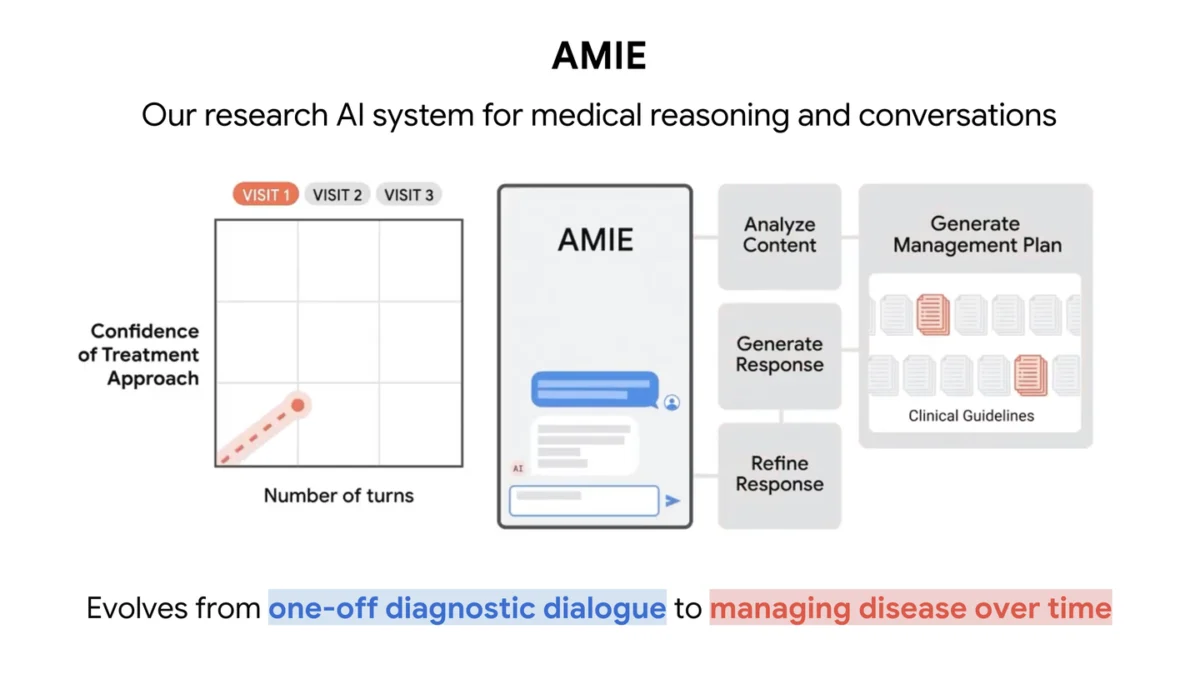
The landscape of modern medicine is increasingly defined not by the singular moment of diagnosis, but by the complex, ongoing management of chronic conditions. While identifying a disease is the critical first step in the patient journey, the subsequent challenge involves navigating a labyrinth of longitudinal care, which includes tracking fluctuating symptoms across multiple consultations, interpreting frequently updated clinical guidelines, and meticulously fine-tuning medication dosages. To address these systemic complexities, Google Research has unveiled new findings in the journal Nature regarding the Articulate Medical Intelligence Explorer (AMIE), a specialized artificial intelligence system designed to evolve beyond one-off diagnostic interactions into a sophisticated tool for long-term disease management.
The research marks a significant milestone in the field of medical AI, shifting the focus from static information retrieval to dynamic clinical reasoning. By leveraging the advanced long-context capabilities of Google’s Gemini models, the AMIE system has demonstrated an ability to process and synthesize vast amounts of patient history alongside authoritative medical literature. In a rigorous, blinded study involving patient actors, AMIE was compared against 21 primary care physicians, performing at a level that matched the clinicians in overall management reasoning while exceeding them in specific areas such as plan preciseness and strict alignment with clinical guidelines. This development suggests a future where AI does not replace the physician but serves as a highly capable "co-pilot," potentially alleviating the administrative and cognitive burdens that currently contribute to global healthcare provider burnout.
The Evolution of AMIE: From Diagnosis to Management
The Articulate Medical Intelligence Explorer was initially introduced as a research project focused on conversational diagnostic AI. Its primary function was to engage in natural language dialogue with patients to elicit symptoms and provide a differential diagnosis. However, medical care is rarely a linear path. According to data from the Centers for Disease Control and Prevention (CDC), chronic diseases—such as diabetes, heart disease, and hypertension—are the leading causes of death and disability in the United States and are the primary drivers of the nation’s $4.5 trillion in annual healthcare costs. These conditions require "longitudinal care," a term describing the continuous relationship between a patient and the medical system over months or years.
The transition of AMIE from a diagnostic tool to a "management" (Mx) tool represents a technical and clinical leap. While diagnosis requires a "snapshot" of a patient’s current state, management requires a "video"—a continuous understanding of how a patient responds to treatment over time. To achieve this, Google researchers integrated "long-context" window capabilities. In the realm of large language models (LLMs), a context window refers to the amount of information the system can "keep in mind" at one time. By utilizing Gemini’s ability to process hundreds of thousands of tokens, AMIE can ingest an entire patient history, including years of lab results, previous visit notes, and the full text of multiple clinical guidelines, ensuring that its recommendations are grounded in the specific trajectory of the individual patient.
The Dual-Agent Architecture: Empathy and Reasoning
One of the most innovative aspects of the AMIE system detailed in the Nature study is its dual-agent architecture. The researchers recognized that effective medical management requires two distinct, yet overlapping, skill sets: interpersonal communication and rigorous clinical logic.
The first component is an "Empathetic Dialogue Agent." This agent is trained specifically for real-time patient conversations. In clinical settings, the way information is delivered is often as important as the information itself. Studies have shown that empathetic communication increases patient adherence to medication and improves overall health outcomes. AMIE’s dialogue agent is designed to listen, validate patient concerns, and explain complex medical concepts in accessible language.
The second component is a "Deep-Thinking Management Reasoning Agent." This agent operates in the background, serving as the "intellectual engine" of the system. It is tasked with cross-referencing the patient’s specific data against hundreds of pages of authoritative clinical knowledge, such as drug formularies and updated specialty guidelines. For example, if a patient with hypertension is also diagnosed with chronic kidney disease, the reasoning agent identifies that certain first-line blood pressure medications may need to be avoided or adjusted according to the latest nephrology standards. By separating the dialogue from the reasoning, the system ensures that its empathetic exterior is backed by a precise and evidence-based interior.
Methodology and Comparative Performance Data
To validate the efficacy of AMIE in disease management, Google conducted a blinded study that utilized a "standardized patient" model—a gold standard in medical education. In this setup, professional actors are trained to portray patients with specific medical histories and symptoms. A total of 21 primary care physicians (PCPs) were recruited to participate in the study, providing a human benchmark for the AI’s performance.
The study was "blinded," meaning the specialist physicians who evaluated the transcripts did not know whether the responses were generated by a human doctor or the AMIE system. The evaluation focused on several key metrics:
- Management Reasoning: The logical flow and soundness of the clinical plan.
- Plan Preciseness: The specificity of medication dosages, follow-up intervals, and lifestyle recommendations.
- Guideline Alignment: The degree to which the plan adhered to established medical protocols (e.g., American Heart Association or American Diabetes Association guidelines).
- Empathy and Communication: The quality of the interaction from the patient’s perspective.
The results, as published in Nature, were striking. AMIE matched the 21 primary care clinicians in the core category of overall management reasoning. More notably, the AI scored significantly higher than the human clinicians in plan preciseness and guideline alignment. This is often attributed to the "knowledge bottleneck" faced by human physicians; with the volume of medical literature doubling every few months, it is increasingly difficult for even the most dedicated doctors to remain perfectly aligned with every updated nuance of every guideline. AMIE’s ability to instantly "read" and apply these updates gives it a distinct advantage in technical accuracy.
Chronology of Development and Future Research
The journey of AMIE is part of a broader timeline of medical AI development at Google.
- Early 2023: Introduction of Med-PaLM and Med-PaLM 2, which demonstrated the ability of LLMs to pass medical licensing-style exams with high scores.
- Late 2023: The initial unveiling of AMIE as a research prototype focused on diagnostic dialogue.
- Early 2024: The expansion of AMIE’s capabilities to include long-term management and the integration of Gemini’s long-context architecture.
- Mid-2024: The publication of the peer-reviewed study in Nature, validating the system’s reasoning capabilities in a simulated environment.
- Current Phase: Transitioning from "in-silico" (simulated) testing to "real-world" feasibility studies.
Google has already announced the next steps in this trajectory. This includes a nationwide randomized study designed to assess how AI can support real-world virtual care. While the Nature study used patient actors, the upcoming research will focus on actual clinical settings to determine how AI interacts with the messiness of real-world data, including incomplete medical records and the nuances of diverse patient populations.
Industry Reactions and Clinical Implications
The publication has sparked significant discussion within the medical and technological communities. Dr. Alan Karthikesalingam, a research lead at Google Health, has emphasized that the goal of AMIE is not to operate in isolation. "We see this as a way to give physicians more time to spend with patients," Karthikesalingam noted in previous discussions regarding AI’s role in the clinic. By automating the "homework" of medicine—checking guidelines, drafting management plans, and tracking symptom trends—AI can theoretically free doctors from the "screen time" that currently dominates much of the patient encounter.
However, the medical community remains cautiously optimistic. Critics and bioethicists point out that while AMIE performs well in simulated environments, the "human element" of medicine—intuition, physical examination, and the building of long-term trust—cannot be fully replicated by a machine. There are also concerns regarding "hallucinations," a phenomenon where AI generates plausible-sounding but incorrect information. Google’s approach of using a "deep-thinking" reasoning agent that must cite authoritative sources is specifically designed to mitigate this risk, but real-world testing remains the ultimate crucible.
Broader Impact on Global Healthcare
The implications of a system like AMIE extend far beyond the borders of high-resource medical centers. In many parts of the world, there is a profound shortage of specialist physicians. A tool that can provide specialist-level management reasoning for chronic conditions could serve as a force multiplier for community health workers and general practitioners in underserved areas.
Furthermore, the integration of AI into virtual care could revolutionize remote patient monitoring. Currently, patients with chronic conditions often only see their doctor every three to six months. In the intervening time, symptoms can worsen without intervention. An AI agent capable of longitudinal management could provide "continuous care," checking in with patients weekly, identifying trends in their data, and alerting a human physician only when a clinical threshold is crossed.
As Google continues its nationwide study and explores clinical integration, the focus will remain on safety, equity, and the "human-in-the-loop" model. The research published in Nature provides a robust proof-of-concept that AI can handle the complexities of disease management, but the journey from a research paper to a bedside tool involves rigorous regulatory oversight and a fundamental shift in how healthcare is delivered.
In conclusion, the advancement of AMIE represents a pivotal shift in the capabilities of artificial intelligence. By moving from simple diagnosis to the nuanced management of health over time, AI is beginning to address the true heart of modern medicine. While the technology is still in the research phase, the data suggests that the synergy between human expertise and machine precision could eventually lead to more accurate, guideline-aligned, and empathetic care for patients worldwide.
