

The Evolution of Circular Commerce: A Chronology of Discovery
The integration of AI into the thrifting experience is the culmination of a decade-long transformation in consumer behavior. In the early 2010s, the "thrifting" phenomenon was largely localized, relying on physical proximity and manual brand research. By 2015, the rise of peer-to-peer marketplaces like Depop and Poshmark began digitizing the experience, yet the "hunt" remained fragmented between physical stores and siloed apps.
The year 2019 marked a turning point with the refinement of Google Lens, which allowed users to identify objects through their cameras, though the technology was primarily used for general information rather than commerce. By 2023, Google’s introduction of "multisearch" enabled users to search with both images and text simultaneously, a feature that laid the groundwork for modern vintage shopping. In 2025 and 2026, the launch of Circle to Search and the widespread deployment of Generative AI (AI Mode) transformed the search engine from a passive directory into an active shopping concierge. This timeline reflects a broader industry move toward "circular commerce," where the lifespan of a product is extended through multiple owners, supported by a digital infrastructure that makes finding, valuing, and buying used goods as seamless as purchasing new items.

Strategic Planning with AI-Driven Search Logistics
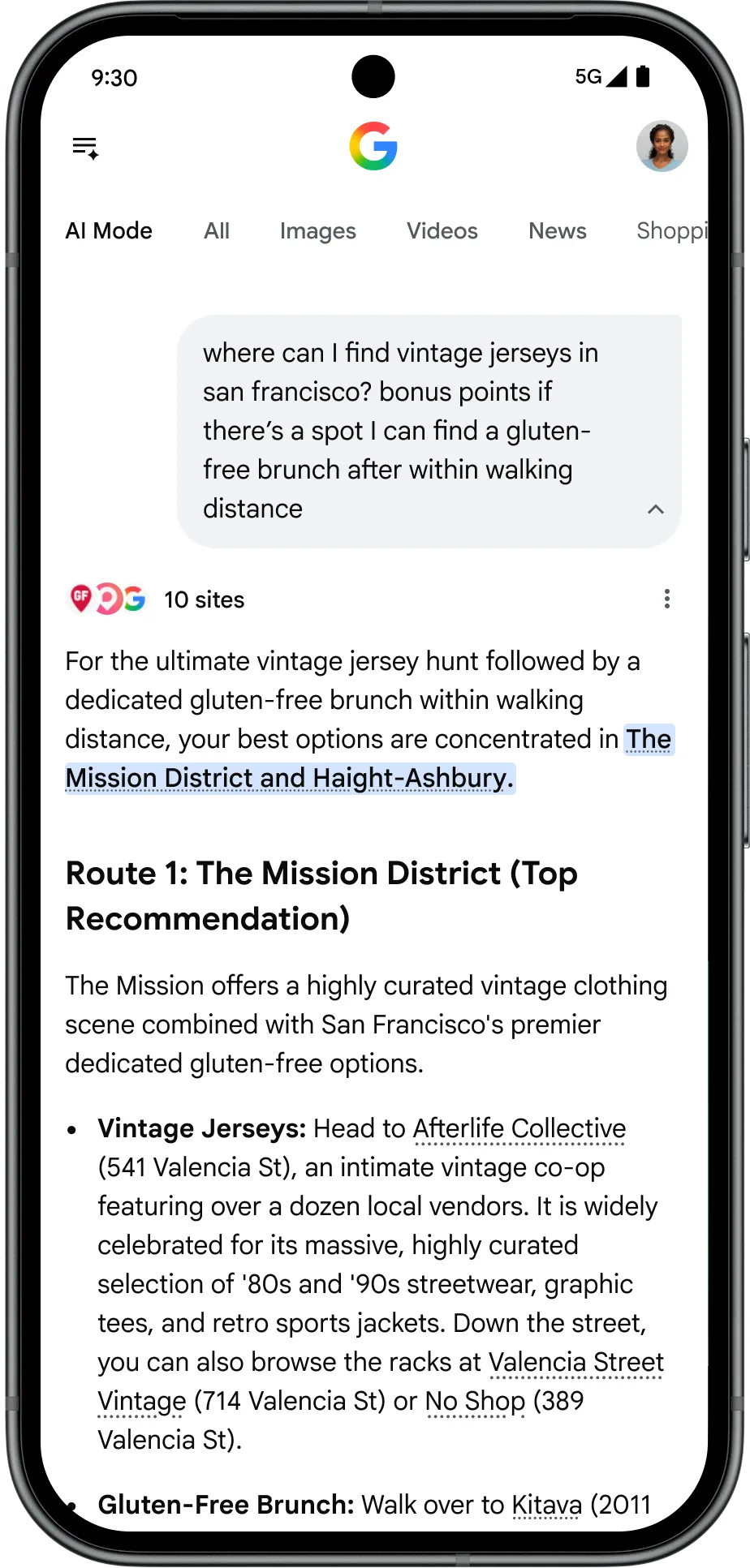
The first major advancement in the 2026 suite of tools is the application of AI Mode in Search to the logistical challenges of thrifting. Unlike traditional retail, where inventory is predictable and stores are often clustered in malls, high-quality vintage and thrift stores are frequently scattered across diverse urban neighborhoods. Google’s AI Mode now processes complex, multi-layered queries that combine commercial intent with lifestyle requirements.
For instance, a user planning a day of shopping in a city like San Francisco can input highly specific parameters: "Where can I find 1990s sports jerseys in the Mission District, and is there a gluten-free brunch spot within a five-minute walk?" The AI does not merely provide a list of links; it synthesizes data from Google Maps, business profiles, and recent user reviews to create a bespoke itinerary. This capability addresses a primary pain point for "professional" thrifters—the time-intensive nature of scouting locations. By integrating local inventory data and proximity-based services, Google has effectively turned a chaotic hobby into a data-driven excursion.
Real-Time Authentication and Valuation via Computer Vision
Perhaps the most disruptive tool for the physical shopping experience is Google Lens, which now serves as a real-time authentication and valuation assistant. In the high-stakes environment of vintage markets, where "hidden gems" are often mixed with modern reproductions, the ability to instantly verify an item’s provenance is invaluable.

When a shopper encounters a crocodile-embossed leather bag or a mid-century modern desk, they can use Lens to snap a photo and receive an immediate AI-generated overview. This summary includes the likely era of production, the designer or manufacturer, and, crucially, an estimated resale value based on current listings across the web. This transparency levels the playing field between seasoned antique dealers and casual shoppers. Data indicates that search interest for "vintage desk" spiked by 190% over the past year, and tools like Lens allow consumers to confirm if a piece is a genuine 1960s artifact or a contemporary replica before committing to a purchase.
Seamless Discovery through Circle to Search
As social media platforms like TikTok and Instagram continue to drive fashion trends, the "Circle to Search" feature has become a critical link between inspiration and acquisition. This tool allows Android users to identify items within any app—including videos and social feeds—by simply circling the object on their screen.
This is particularly relevant for the "vintage jersey" trend, which hit an all-time high in search volume in early 2026. When a user sees a celebrity or influencer wearing a specific piece of rare athletic apparel, they no longer need to navigate away from the app or attempt to describe the item in a text-based search bar. By circling the jersey, they can access a list of similar items available on various resale platforms, compare prices, and even ask follow-up questions like, "Which of these are authentic vintage versus modern retros?" This frictionless transition from "seeing" to "buying" is a hallmark of the new search era, prioritizing visual context over keywords.

The Digital Dressing Room: Overcoming the Fit Barrier
One of the most persistent obstacles in second-hand apparel shopping is the inconsistency of sizing and the inability to return items. Vintage sizes often differ drastically from modern standards, and many thrift stores do not offer fitting rooms. Google’s Virtual Try-On (VTO) technology aims to solve this "fit friction."
By utilizing generative AI, the VTO feature allows users to see how a garment would drape and fit on a body similar to their own. In the context of thrifting, a user can find a similar item to a thrifted find via Lens and then select the "try it on" button. By uploading a full-body photo, the AI simulates the garment’s appearance on the user’s specific frame. This technology significantly reduces the "buyer’s remorse" associated with vintage shopping and encourages more consumers to participate in the circular economy by removing the risk of purchasing ill-fitting items.
Facilitating the Circular Economy: The "Sell" Functionality
Thrifting is a bi-directional economy, and Google’s fifth pillar of 2026 search updates focuses on the supply side: helping consumers clear out their own closets. The same Lens technology used for buying is now optimized for selling. By photographing an item they own, users can ask, "Could I resell this?" or "Which local stores buy this brand?"

This feature provides immediate market intelligence, showing the user what similar items are currently selling for on platforms like eBay, Depop, or specialized luxury resellers. This lowers the barrier to entry for casual sellers, ensuring that high-quality goods remain in circulation rather than ending up in landfills. According to industry data, the "resale revolution" is heavily dependent on maintaining a steady flow of "pre-loved" inventory, and by simplifying the valuation process, Google is directly supporting the sustainability of the fashion ecosystem.
Market Context and Broader Implications
The surge in tech-enabled thrifting is supported by compelling economic data. A 2026 retail report suggests that the second-hand market is growing three times faster than the global apparel market as a whole. Inflationary pressures have made price-conscious shopping a necessity for many, while "eco-anxiety" has turned thrifting into a moral preference for younger demographics.
Google’s move to dominate this space is a strategic response to the changing nature of the "Shopping Graph," a comprehensive dataset of billions of product listings. By indexing the inventory of thousands of small vintage shops and individual resellers alongside major retailers, Google is positioning itself as the ultimate arbiter of the circular economy.

Industry analysts suggest that this shift will force traditional retailers to adapt. "We are seeing a world where a 20-year-old jacket is just as discoverable as a brand-new one," says Dr. Elena Rossi, a retail technology analyst. "Google’s tools are effectively removing the ‘information asymmetry’ that used to define the vintage market. This democratization of data is good for consumers and the environment, but it puts pressure on fast-fashion brands to justify their value proposition against high-quality, tech-discoverable vintage goods."
The implications extend beyond fashion. The 190% spike in searches for "vintage desks" and the record highs for "vintage beach fits" indicate that the "old is new" mentality is infiltrating home decor, travel, and lifestyle sectors. As AI continues to refine its ability to understand texture, era, and aesthetic "vibe," the distinction between "searching" for an item and "discovering" a treasure will continue to blur, making 2026 a landmark year for the integration of artificial intelligence and sustainable commerce.
