

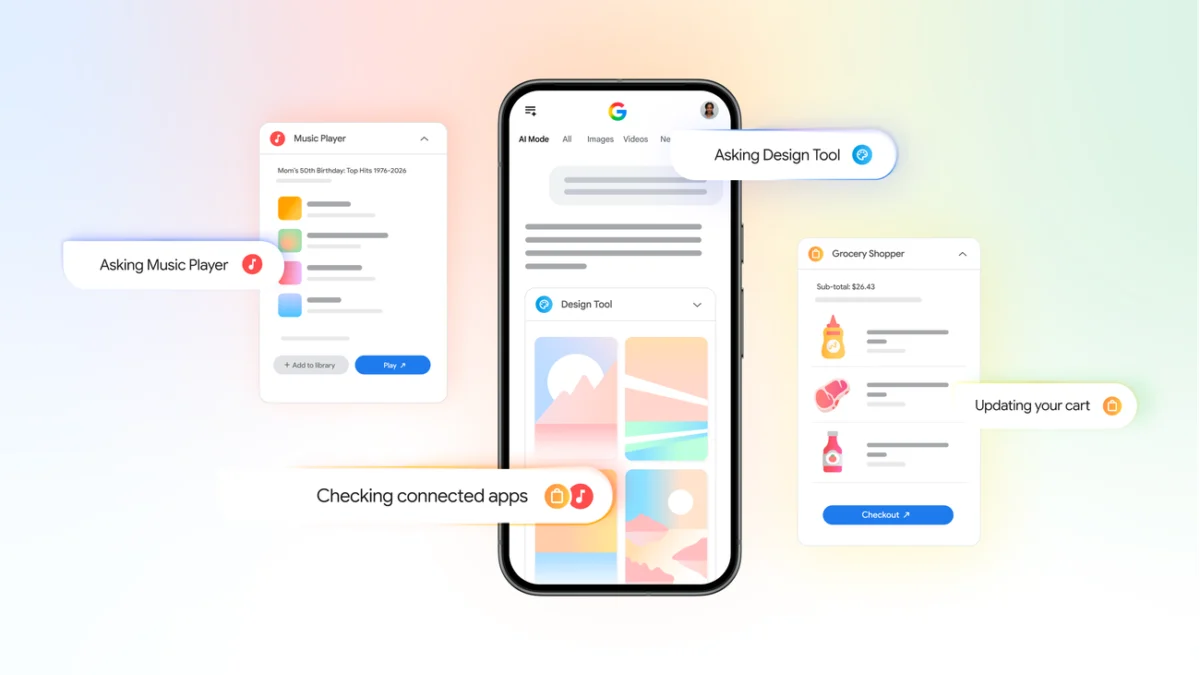
Google has officially announced a significant expansion of its Search capabilities, enabling users to securely link and interact with third-party services directly within the platform’s "AI Mode." This strategic shift, led by Senior Product Manager Chips Mistry and Engineering Lead Biharck Araújo, marks a transition from a purely informational search engine to a more "agentic" ecosystem where the AI can perform tasks on behalf of the user. Starting this week for users in the United States, the integration allows for seamless handoffs between Google Search and popular services such as Instacart, Canva, and YouTube Music. This development is part of a broader industry trend toward "Action-Oriented AI," where Large Language Models (LLMs) move beyond text generation to execute real-world transactions and creative workflows.
The primary objective of these integrations is to reduce the friction between a user’s initial intent—such as planning a meal or designing a project—and the final execution. By connecting apps directly to the AI Mode in Search, Google is positioning its Gemini-powered architecture as a central hub for personal productivity. According to the product leads, this functionality allows the search engine to provide more tailored, "Personal Intelligence" responses based on the specific tools and data a user chooses to connect.
The Shift Toward Agentic Search: Use Cases and Functionality
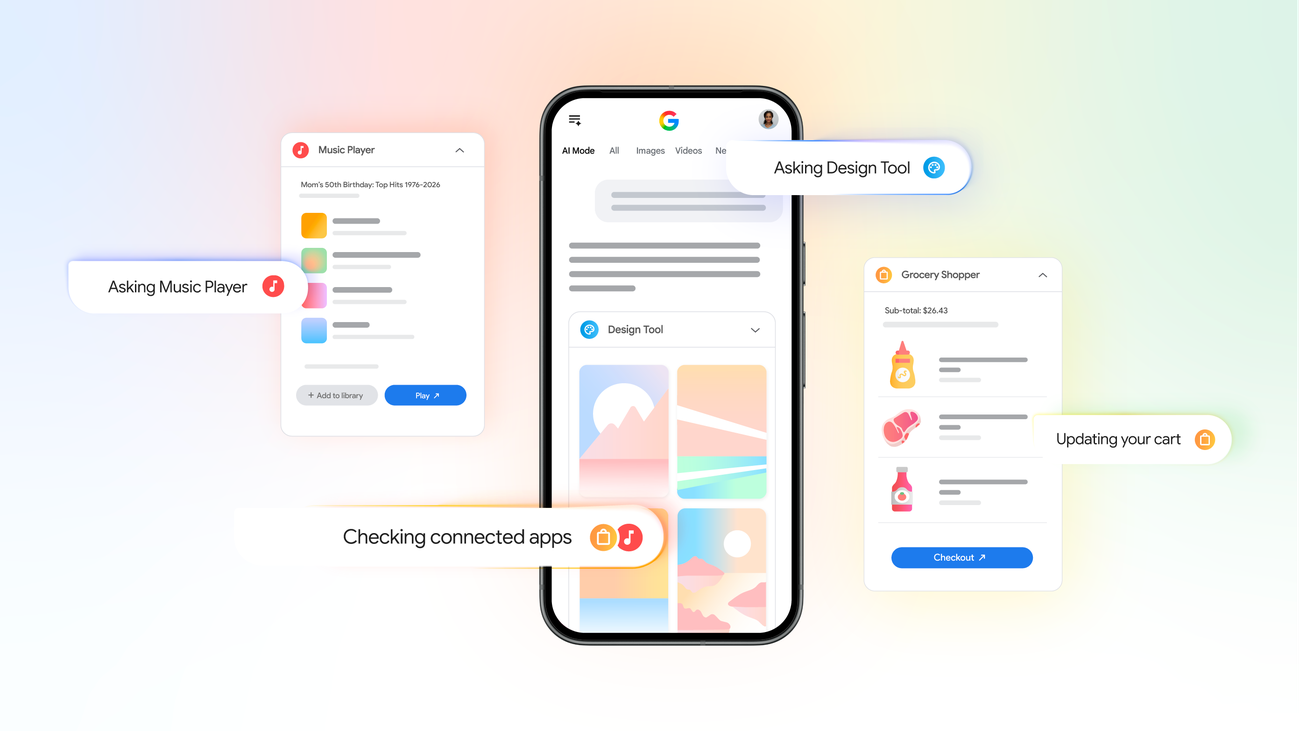
The rollout focuses on three distinct pillars of consumer activity: e-commerce, creative design, and media consumption. In the realm of grocery shopping and logistics, the integration with Instacart allows users to plan menus or grocery lists within AI Mode and immediately export those items to a digital shopping cart. Instead of manually copying a recipe’s ingredients into a separate app, the AI bridge handles the data transfer, requiring only a final confirmation from the user on the Instacart platform to complete the purchase.
For creative professionals and students, the Canva integration addresses the need for rapid prototyping. When a user queries Search for design inspiration or template concepts—such as a flyer for a community event—the AI can now surface specific Canva templates. This eliminates the traditional step of navigating to a homepage and using internal site search, effectively turning Google Search into a direct portal for specialized software tools. Similarly, the YouTube Music integration allows for the instant creation and curation of playlists. Users can describe a specific mood or event to the AI, which then generates a tracklist and saves it directly to the user’s library, ready for immediate playback.
A Chronology of Google’s AI Search Evolution
The introduction of Connected Apps is the latest milestone in a multi-year effort to modernize Google Search in the face of rising competition from generative AI startups.
- May 2023: Google introduces the Search Generative Experience (SGE) at its I/O developer conference, signaling a move away from the "ten blue links" format toward AI-generated summaries.
- December 2023: The Gemini model is integrated into various Google products, providing a more sophisticated reasoning engine for complex queries.
- May 2024: Google rebrands SGE as "AI Overviews" and begins a wide-scale rollout to millions of users in the U.S., focusing on synthesizing information from across the web.
- July 2024: The company begins testing "AI Mode," a dedicated interface for interactive, multi-turn conversations with the search engine.
- Present: The launch of Connected Apps represents the "Action" phase of this evolution, where the AI gains the ability to interact with external APIs (Application Programming Interfaces) to perform tasks.
Supporting Data and Market Context
The move to integrate third-party apps comes at a time when the search market is undergoing its most significant disruption in two decades. According to data from Gartner, traditional search engine volume is projected to drop by 25% by 2026 as consumers migrate toward AI chatbots and specialized discovery platforms. By embedding third-party services, Google aims to retain user engagement within its ecosystem, preventing "platform leakage" where users leave Search to complete tasks elsewhere.
Furthermore, internal Google data suggests that users are increasingly looking for "zero-click" solutions. A study by SparkToro recently indicated that nearly 60% of searches end without a click to a traditional website. By offering "Connected Apps," Google provides a structured way for businesses to participate in this zero-click environment. For partners like Instacart, this represents a high-intent conversion funnel; for Google, it provides a "Personal Intelligence" layer that makes the search engine more indispensable to the user’s daily routine.
Technical Infrastructure and User Privacy
A critical component of this rollout is the security framework governing how data is shared between Google and third-party partners. The "Connected Apps" feature utilizes secure OAuth protocols, ensuring that Google does not have access to a user’s third-party login credentials. Users must explicitly grant permission for each app they wish to link, and they maintain the ability to revoke access at any time through their Google Account settings.
This focus on security is a response to growing concerns regarding AI privacy. As search engines become more "personal," they require access to more sensitive data—such as shopping habits, design preferences, and listening history. Google has emphasized that these integrations are designed to be "securely linked," with the AI acting as a facilitator rather than a permanent repository for third-party data. This distinction is vital for maintaining user trust as the company competes with Apple’s "Apple Intelligence" and OpenAI’s "SearchGPT," both of which have made privacy a central pillar of their marketing.
Official Responses and Industry Implications
While Google has not disclosed the full list of future partners, the company confirmed it is "working with a range of partners" to expand the library of connected apps. Industry analysts view this as a necessary defensive and offensive move. By opening Search to third-party integrations, Google is essentially creating a "Plugin" ecosystem similar to what OpenAI attempted with ChatGPT, but with the advantage of Google’s massive existing user base and web indexing capabilities.
The implications for digital marketing and SEO are profound. Traditional SEO has long focused on optimizing for keywords to drive traffic to a website. However, in a "Connected App" world, the goal may shift toward "API Optimization"—ensuring that a company’s services are easily accessible and interpretable by Google’s AI. For instance, a retailer’s success may soon depend on how effectively their product catalog can be "read" and "acted upon" by a search agent, rather than how high they rank in a list of links.
Broader Impact on the Digital Ecosystem
The rollout of Connected Apps in Search AI Mode signals the beginning of the "Agentic Web." In this new paradigm, the internet is no longer just a collection of pages to be read, but a collection of services to be orchestrated. For the average consumer, this means a more unified digital experience where the boundaries between different apps begin to blur.
However, this transition also raises questions about the "Walled Garden" effect. As Google integrates more services directly into its interface, there is a risk that smaller developers who are not part of the initial partnership programs could see a decline in traffic. Regulators in both the U.S. and the E.U. have been closely monitoring how dominant tech platforms prioritize their own services or those of preferred partners. Google’s approach of allowing users to "link and interact with your go-to services" suggests an attempt to create an open-ended platform, but the criteria for partnership and the prominence of certain apps will likely remain a point of scrutiny.
Future Outlook
As the rollout continues in the U.S., the tech community is looking toward the global expansion of these features. The success of the Instacart, Canva, and YouTube Music integrations will likely serve as a blueprint for future categories, including travel booking (Expedia or Booking.com), professional networking (LinkedIn), and financial management.
The ultimate vision presented by Mistry and Araújo is one of "Personal Intelligence"—an AI that understands not just what the world knows, but what the user needs to do. By bridging the gap between information and action, Google is attempting to redefine the very nature of search, transforming it from a tool for finding answers into a tool for getting things done. As AI Mode becomes more sophisticated, the "Connected Apps" feature is expected to become the primary way users interact with the web, marking a new chapter in the evolution of human-computer interaction.
