


A recent discourse within the professional sphere, reignited by a provocative LinkedIn post declaring, "I don’t use AI to write my content," has brought the evolving relationship between artificial intelligence and content creation into sharp focus. The author of the post clarified that this assertion was not a boast of inherent superiority but a commentary on the ultimate arbiter of value: the content itself. This perspective, while holding merit, overlooks a critical nuance in the burgeoning integration of AI into creative and professional workflows. The distinction lies not merely in the origin of the words, but in the underlying process of thought and the authenticity of the voice.
The debate centers on a fundamental question: is AI being employed as a sophisticated tool to augment human intellect and creativity, or is it becoming a substitute for genuine human thought and experience? While the output of AI can undoubtedly be polished and valuable, the question of authenticity and the erosion of personal expertise is gaining traction among thought leaders and professionals who build their careers on their unique insights and established authority.
The Rise of AI in Content Creation: A Timeline of Integration
The widespread availability of advanced AI language models, such as OpenAI’s GPT series, has accelerated the adoption of AI in content creation across various industries. Initially, AI was largely confined to tasks like data analysis, translation, and basic content generation for marketing. However, as these models have become more sophisticated, their capabilities have expanded to encompass drafting articles, scripts, social media posts, and even creative writing.
- Early 2020s: The public release and rapid improvement of large language models (LLMs) mark a turning point. These models demonstrate an unprecedented ability to generate human-like text, sparking widespread interest and experimentation.
- 2022-2023: AI-powered writing assistants and content generation platforms gain significant traction. Businesses and individuals begin integrating these tools into their daily workflows, seeking to enhance efficiency and scale content production.
- Present Day: Discussions around the ethical implications, authenticity concerns, and the definition of "original" content become prominent. The initial excitement around AI’s capabilities is now tempered by a deeper consideration of its long-term impact on human expertise and influence.
The Nuance of AI Integration: Augmentation vs. Replacement
The core of the ongoing discussion lies in distinguishing between using AI to improve thinking and using AI to replace thinking. This distinction is crucial, particularly for individuals and organizations that rely on their personal brand, expertise, and authentic voice for influence and credibility.
Consider the hypothetical scenario of a professional who has cultivated a significant following through books, courses, and public appearances. If it were discovered that the foundational ideas, narratives, and conclusions presented were not the product of the individual’s own lived experience and intellectual development, but rather generated by AI, the impact on audience trust could be profound. This echoes the historical precedent set by the music group Milli Vanilli in the late 1980s. Despite their immense success, the revelation that they did not perform their own vocals led to a swift and dramatic collapse of their careers. The issue was not the quality of the music itself, but the fundamental deception regarding the source of the artistry.
This parallel suggests that in the realm of influence, authenticity is not a secondary concern; it is foundational. When individuals or brands leverage AI to generate content that purports to represent their unique perspective, accumulated knowledge, and lived experiences, they risk undermining the very authority and trust they have worked to build.
Expertise and Authority in the Age of AI
Dr. Robert Cialdini’s established principles of influence, particularly the principle of Authority, highlight the inherent human tendency to trust individuals who possess genuine expertise. However, the integrity of this expertise is paramount. If AI is consistently generating an individual’s ideas, examples, stories, and conclusions, the demonstrated expertise shifts from personal insight to proficiency in prompt engineering. While prompt engineering is a valuable skill, it is distinct from the deep, experiential knowledge that forms the bedrock of authentic authority.
The implications for various professions are significant:
- Content Creators and Influencers: Building a personal brand relies heavily on the perception of genuine insight and unique perspective. Over-reliance on AI risks diluting this brand and eroding audience trust.
- Thought Leaders and Academics: The value of their contributions lies in their original research, critical analysis, and intellectual contributions. AI can assist in refining and disseminating these ideas, but it cannot replace the core process of intellectual discovery.
- Educators and Trainers: Their credibility is tied to their ability to impart knowledge and wisdom derived from experience and study. The authenticity of their teaching is a critical component of their effectiveness.
Data and the Evolving Landscape of Content Creation
The rapid adoption of AI tools is reflected in market trends and industry reports. While specific data on the percentage of content generated by AI is still nascent and difficult to quantify precisely, the growth of AI writing tools and platforms indicates a significant shift.
- Market Growth: The global AI writing assistant market is projected to grow substantially in the coming years. Reports from market research firms indicate a compound annual growth rate (CAGR) that points to widespread adoption across various sectors.
- User Adoption: Anecdotal evidence and platform analytics suggest that millions of users are engaging with AI writing tools daily, utilizing them for tasks ranging from drafting emails to generating blog posts and creative narratives.
- Efficiency Gains: Studies and internal company reports often highlight significant time savings and increased content output when AI tools are integrated into workflows. This efficiency is a primary driver of AI adoption.
However, these metrics of efficiency and adoption do not inherently address the qualitative aspects of authenticity and the long-term impact on individual expertise. The challenge lies in harnessing AI’s power without sacrificing the unique human elements that foster genuine connection and influence.
Broader Impact and Implications
The integration of AI into content creation has far-reaching implications that extend beyond individual creators and businesses.
- The Future of Expertise: There is a growing concern that a generation of professionals might emerge who are adept at leveraging AI but lack the deep, foundational expertise that comes from years of hands-on experience, critical reflection, and personal struggle. This could lead to a superficial understanding of complex subjects and a decline in truly innovative thought.
- Information Overload and Disinformation: The ease with which AI can generate content raises concerns about the potential for an unprecedented surge in information, making it increasingly difficult for audiences to discern credible sources from AI-generated content that may be subtly biased, inaccurate, or even intentionally misleading. The challenge of identifying and combating AI-generated disinformation will likely intensify.
- The Value of Human Experience: In a world increasingly saturated with AI-generated content, the value of authentic human stories, personal anecdotes, and lived experiences may paradoxically increase. These elements are inherently unique to individuals and cannot be replicated by AI, which lacks consciousness, emotions, and subjective experience.
Navigating the Future: AI as a Collaborator, Not a Creator
The key to successfully navigating this evolving landscape lies in viewing AI not as a replacement for human intellect and creativity, but as a powerful collaborator. AI can excel at tasks such as:
- Organizing thoughts and ideas.
- Challenging assumptions and providing alternative perspectives.
- Improving clarity, grammar, and syntax.
- Identifying blind spots in reasoning.
- Streamlining the editing and refinement process.
However, the fundamental experiences, convictions, and unique voice that define an individual’s expertise are irreplaceable. These are the elements that AI, by its very nature, cannot possess. The stories of trials and triumphs, the lessons learned from mistakes, and the deeply held beliefs that shape one’s worldview are the raw materials of authentic influence.
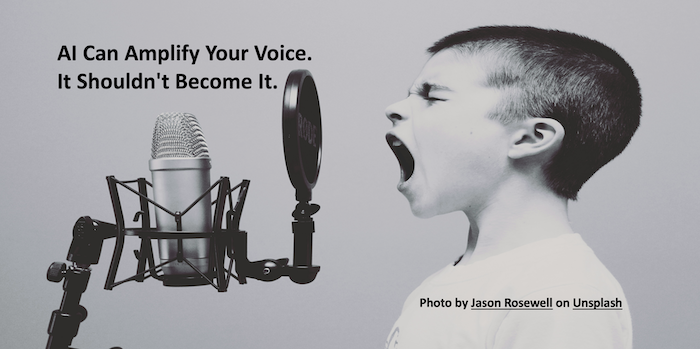
The professionals who will likely thrive in the coming decade are those who have diligently cultivated genuine expertise over years and then strategically employ AI to amplify their message and communicate their insights more effectively. AI can serve as a powerful amplifier for a well-developed voice, but it should never become the voice itself.
A Question for Reflection
As professionals and creators increasingly integrate AI into their work, the critical question remains: where do you draw the line between utilizing AI as a tool to enhance your capabilities and allowing it to become the de facto author of your expertise? The answer to this question will shape not only individual careers but also the very nature of influence and authenticity in the digital age. The pursuit of efficiency must be balanced with an unwavering commitment to genuine human insight and the cultivation of an authentic, irreplaceable voice.
