

The verb ir represents one of the most significant morphological challenges and functional necessities within the Spanish linguistic landscape. Classified as a highly irregular and suppletive verb, its forms are derived from three distinct Latin roots, resulting in a conjugation pattern that appears disparate to the uninitiated learner. Despite its complexity, ir serves as a fundamental pillar of communication, functioning not only as a primary verb of motion—meaning "to go"—but also as the essential component of the periphrastic future tense. This analysis explores the historical evolution, grammatical structures, and practical applications of ir, providing a comprehensive resource for understanding its role in modern Spanish.
The Etymological Evolution: A Tripartite Origin
To understand why the conjugations of ir—such as voy, fui, and iba—differ so drastically, one must examine the historical development of the Romance languages from Latin. Linguists categorize ir as a suppletive verb, meaning its paradigm is filled by forms from entirely different roots. This phenomenon typically occurs in high-frequency verbs where various stems merge over centuries of usage.
The first root, the Latin ire, provides the infinitive (ir), the future tense (iré), and the conditional tense (iría). This is the most direct descendant and follows the pattern of many other Romance languages. The second root, vadere, which means "to advance" or "to walk," provides the present indicative forms (voy, vas, va, van) and the present subjunctive (vaya). This root is also visible in English words like "pervade" or "evade." The third root, fui, which was the perfect tense of the Latin esse (to be), was adopted by both the Spanish verbs ir and ser. This explains why the preterite forms of ir (fui, fuiste, fue) are identical to those of ser.
Chronological data suggests that these forms began merging during the transition from Vulgar Latin to Old Spanish. By the 13th century, the Alfonsine scripts already showed a stabilization of these disparate roots into the single functional unit known today as the verb ir.
The Periphrastic Future: A Functional Linguistic Shortcut
In modern Spanish, the verb ir is the engine behind the "ir + a + infinitive" construction. This grammatical structure is functionally equivalent to the English "going to [verb]" and is the most common way to express future intentions in spoken Spanish.
Statistical analysis of spoken corpora in Madrid and Mexico City indicates that the periphrastic future is used significantly more often than the simple future (futuro simple) in daily conversation. While the simple future (iré) often carries a tone of solemnity, uncertainty, or a distant promise, the "ir + a" construction denotes immediacy and high intentionality. For example, "Voy a comer" (I am going to eat) is the standard expression for an imminent action, whereas "Comeré" might be reserved for more formal or hypothetical contexts.
Comprehensive Analysis of Indicative Mood Conjugations
The indicative mood is the primary vehicle for stating facts and describing reality. Because ir is central to daily life, its indicative forms are the first mastered by students of the language.
Simple Tenses: The Core Paradigm
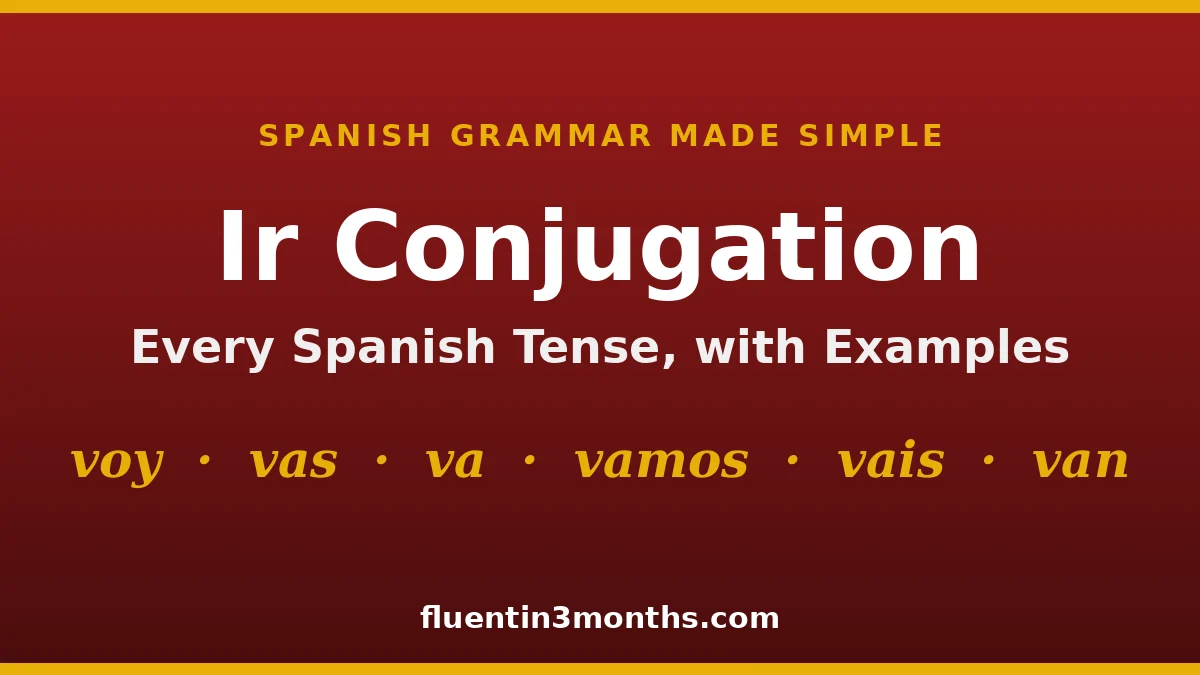
The present tense of ir is the most frequently utilized. The forms—voy, vas, va, vamos, vais, van—are essential for travel, routines, and the aforementioned future construction. Following the present tense, the preterite and imperfect provide the necessary tools for narration.
The preterite (fui, fuiste, fue, fuimos, fuisteis, fueron) is used for completed actions in the past. Because it is shared with the verb ser, context is the sole determinant of meaning. In the sentence "Fui a la tienda" (I went to the store), the preposition "a" signals motion. In "Fui un niño feliz" (I was a happy child), the noun phrase identifies a state of being.
The imperfect tense (iba, ibas, iba, íbamos, ibais, iban) is notably irregular. While most -ir verbs take an -ía ending (e.g., vivir becomes vivía), ir reverts to a form derived from the Latin ibam. This tense is used for ongoing past actions or habitual behaviors, such as "Iba al parque todos los sábados" (I used to go to the park every Saturday).
Compound Tenses: The Role of the Past Participle
The compound tenses are formed using the auxiliary verb haber and the past participle of ir, which is "ido." These tenses include the present perfect (he ido), the pluperfect (había ido), and the future perfect (habré ido). Data from the Real Academia Española (RAE) suggests that the present perfect is used with higher frequency in Peninsular Spanish (Spain) than in many Latin American dialects, where the simple preterite is often preferred for recent actions.
The Subjunctive Mood: Navigating Doubt and Desire
The subjunctive mood is employed to express subjectivity, doubt, wishes, or reactions. For ir, the present subjunctive (vaya, vayas, vaya, vayamos, vayáis, vayan) is commonly triggered by expressions of emotion or necessity, such as "Espero que vayas" (I hope you go).
The imperfect subjunctive presents two forms: the -ra form (fuera) and the -se form (fuese). While both are grammatically correct and interchangeable, linguistic surveys show a strong preference for the -ra form in the Americas, while the -se form retains a presence in formal and literary contexts in Spain. These forms are essential for hypothetical "if" clauses, such as "Si fuera rico, iría a Japón" (If I were rich, I would go to Japan).
The Imperative Mood: Commands and Collective Action
The imperative mood of ir is unique due to its brevity and its overlap with other verbs. The informal singular command (tú) is "ve." This is orthographically identical to the third-person singular of ver (to see), though they are rarely confused in context.
The "nosotros" command, "vamos," is particularly noteworthy. While the technically correct subjunctive form "vayamos" is used for negative commands (no vayamos), "vamos" has become the universal affirmative command for "let’s go." This form has even crossed linguistic boundaries, becoming a recognized loanword in English and other languages to signal encouragement or movement.
Regional Variations and the Impact of Voseo
In regions such as Argentina, Uruguay, and parts of Central America, the use of "vos" instead of "tú" alters the conjugation of ir. In the present tense, the voseo form is "vas," which happens to be identical to the tú form, though it lacks the characteristic accentuation found in other voseo verbs (like "pensás" or "querés"). In the imperative, however, the voseo command for ir is "andá," derived from the verb andar (to walk). This substitution is a fascinating example of how regional dialects resolve potential ambiguities in high-frequency irregular verbs.
Common Linguistic Pitfalls and Clarifications
Linguistic research into second-language acquisition identifies several recurring errors regarding the verb ir. One of the most common is the confusion between "ido" (the past participle) and "yendo" (the gerund). Unlike many verbs where the gerund follows a predictable pattern, ir requires the "y" to maintain its phonetic structure.
Another point of confusion is the distinction between "ir" and "irse." The pronominal form "irse" changes the meaning from "to go" to "to leave" or "to go away." For example, "Voy al cine" means "I am going to the cinema," whereas "Me voy" means "I am leaving." Mastering this distinction is often cited by educators as a key milestone in achieving conversational fluency.
Broader Implications for Language Learners and Educators
The study of ir is more than a rote memorization exercise; it is an entry point into the history of Western Romance languages. The verb’s irregularity is a testament to its antiquity and its necessity. From a pedagogical standpoint, the "ir + a + infinitive" hack provides learners with immediate communicative power, allowing them to bypass the complexities of future tense conjugations in the early stages of acquisition.
Expert philologists argue that the persistence of such irregular forms in Spanish—and their counterparts in French (aller) and Italian (andare)—is due to their "entrenchment." Because these words are used so frequently, they are resistant to the natural linguistic pressure to regularize over time. For the student, this means that while the initial hurdle is high, the reward is a foundational tool that appears in nearly every facet of Spanish discourse.
In conclusion, the verb ir is a multifaceted tool of the Spanish language. Its roots in Latin, its pivotal role in future-tense constructions, and its varied regional applications make it a subject of endless fascination for linguists and a vital asset for speakers. By understanding the structural logic behind its apparent chaos, one gains a deeper appreciation for the evolution of Spanish and the intricate ways in which human beings communicate motion, intent, and time.
