

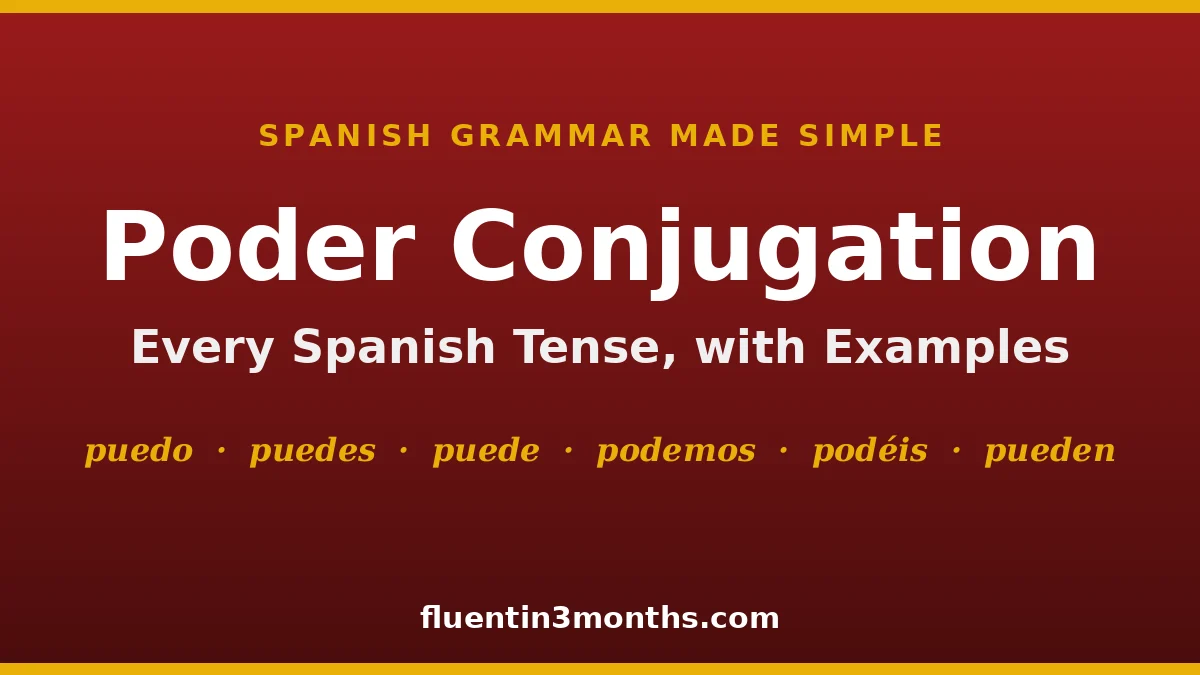
The Spanish verb poder, which translates to "can" or "to be able to" in English, represents one of the most critical linguistic foundations for students of the Romance languages. Functioning as a modal verb, it serves to express ability, possibility, and permission, acting as a primary driver of sentence structure in both casual and formal discourse. Despite its ubiquity, poder presents a significant challenge for learners due to its dual-layered irregularity: a stem-changing pattern in the present tense and a "strong" irregular stem in the preterite. Understanding these complexities is essential for achieving fluency, as the verb ranks among the top 20 most frequently used words in the Spanish language, according to frequency dictionaries and linguistic corpora.
The Linguistic Evolution and Chronology of Poder
The development of poder is rooted in the transition from Latin to the Ibero-Romance languages. Historically, the verb derives from the Vulgar Latin potere, which itself evolved from the Classical Latin posse. The chronological evolution of the verb explains many of its modern irregularities. In Classical Latin, the verb was a compound of potis (able) and esse (to be). As the language transitioned into Old Spanish, the intervocalic "t" voiced into a "d," and the infinitive ending shifted to conform to the second conjugation (-er) pattern.
The stem-changing phenomenon, where the "o" becomes "ue" under stress, is a common feature of Spanish phonology known as diphthongization. During the development of the Spanish language, short stressed vowels in Latin often evolved into diphthongs. This historical shift created the "boot verb" pattern seen today, where the change occurs in all forms except those where the stress falls on the ending, such as the first-person plural (nosotros) and the second-person plural (vosotros).
Structural Analysis: The Indicative Mood
In the indicative mood, which is used to state facts and certainties, poder functions as the primary vehicle for describing situational capacity. Linguists categorize its present tense as a "stem-changing" or "radical-changing" verb. The "o" to "ue" shift is mandatory in the singular forms and the third-person plural.
Present Tense Overview:
- Yo puedo (I can)
- Tú puedes (You can)
- Él/Ella/Usted puede (He/She/You can)
- Nosotros/as podemos (We can)
- Vosotros/as podéis (You all can)
- Ellos/Ellas/Ustedes pueden (They can)
Data from the Corpus de Referencia del Español Actual (CREA) indicates that the first-person singular "puedo" and the third-person singular "puede" are among the most frequent verbal forms in spoken Spanish, appearing in nearly every conversational context from requesting permission to stating a possibility.
The preterite tense of poder represents a departure from standard -er verb endings. It belongs to a group of "strong preterites" characterized by a stem change to "pud-" and the absence of traditional accent marks. The chronological shift from the Latin potui led to the modern Spanish pude. This tense is semantically distinct; while the English "could" can be ambiguous, the Spanish preterite pude often implies that the speaker not only had the ability but also successfully completed the action (e.g., "Pude terminar la tarea" translates more accurately to "I managed to finish the homework").
Preterite and Imperfect Distinctions:
- Preterite (Pude, pudiste, pudo): Used for completed actions or successful attempts.
- Imperfect (Podía, podías, podía): Used for ongoing ability in the past or descriptions of circumstances without a specific conclusion.
The Subjunctive Mood and Conditional Usage
The subjunctive mood, used for expressing doubt, emotion, or hypothetical situations, maintains the "o" to "ue" stem change found in the present indicative. In complex sentence structures, the present subjunctive "pueda" is often triggered by phrases of uncertainty or impersonal expressions such as "es posible que" (it is possible that).
The conditional tense, podría, serves a dual purpose. Beyond expressing what "would" be possible, it is the standard for polite requests in Spanish. According to sociolinguistic studies, using the conditional form ¿Podría usted…? (Could you…?) instead of the present ¿Puede usted…? (Can you…?) significantly increases the perceived level of formality and courtesy in social interactions.
Semantic Precision: Poder vs. Saber
A recurring point of contention for English-speaking learners is the distinction between poder and saber. In English, the word "can" is used to denote both learned skills and physical or situational ability. Spanish, however, demands categorical precision.
Saber (Cognitive Ability/Skill): Used when the "can" refers to a learned skill or knowledge. For example, "Sé hablar español" (I can/know how to speak Spanish).
Poder (Situational/Physical Ability): Used when the "can" refers to the opportunity or physical capacity at a specific moment. For example, "No puedo hablar ahora" (I cannot speak right now [because I am busy]).
Educational data suggests that the misuse of poder in place of saber is one of the most common fossilized errors among intermediate Spanish learners. Academic experts from the Instituto Cervantes emphasize that mastering this distinction is a hallmark of the transition from B1 to B2 proficiency levels under the Common European Framework of Reference for Languages (CEFR).
Compound Tenses and the Role of the Participle
The compound tenses of poder utilize the auxiliary verb haber combined with the past participle podido. These forms are essential for expressing actions that have occurred over a period or possibilities that existed in the past.
Common Compound Forms:
- Present Perfect: He podido (I have been able to)
- Pluperfect: Había podido (I had been able to)
- Conditional Perfect: Habría podido (I would have been able to)
The use of the gerund, pudiendo, is less frequent but remains vital for progressive constructions, such as "Aun pudiendo hacerlo, no lo hizo" (Even being able to do it, he didn’t).
Pedagogical Perspectives and Expert Analysis
Language acquisition experts note that the irregularity of poder is actually a benefit for long-term retention. "High-frequency irregular verbs like poder are often the first that students internalize because they are reinforced through constant repetition," states Dr. Elena Ramirez, a specialist in Hispanic linguistics. "The ‘strong’ preterite forms like pude and pudo share a pattern with other essential verbs like tener (tuve) and estar (estuve), allowing students to learn a ‘cluster’ of irregularities simultaneously."
However, data from digital learning platforms indicates that the imperative mood of poder is rarely utilized. Grammatically, forms like puede (singular) or puedan (plural) exist, but they are logically incongruous in most contexts. One cannot command another to "be able to" do something. Instead, speakers typically use the present indicative or the subjunctive to grant permission or express hope.
Broader Impact and Implications for Communication
The mastery of poder has implications beyond simple grammar. It is a tool for negotiation, social navigation, and nuance. In legal and professional Spanish, the future tense podrá is frequently used to outline rights and authorizations (e.g., "El usuario podrá cancelar su suscripción," meaning "The user shall be able to cancel their subscription").
Furthermore, the noun form of poder translates to "power." This shared etymology highlights the verb’s core meaning: the possession of the means or authority to act. In political and social discourse, phrases like "el poder del pueblo" (the power of the people) underscore the weight the word carries in the Spanish-speaking world.
Conclusion
For the dedicated learner, poder is not merely a hurdle of irregular conjugations but a versatile instrument of expression. By understanding the historical reasons for its stem changes, the semantic differences between situational and learned ability, and the specific nuances of its various tenses, speakers can move toward a more sophisticated and accurate use of the language. As one of the primary pillars of Spanish communication, the ability to conjugate and deploy poder correctly is a non-negotiable requirement for anyone seeking to bridge the gap between basic competency and true linguistic fluency.
