

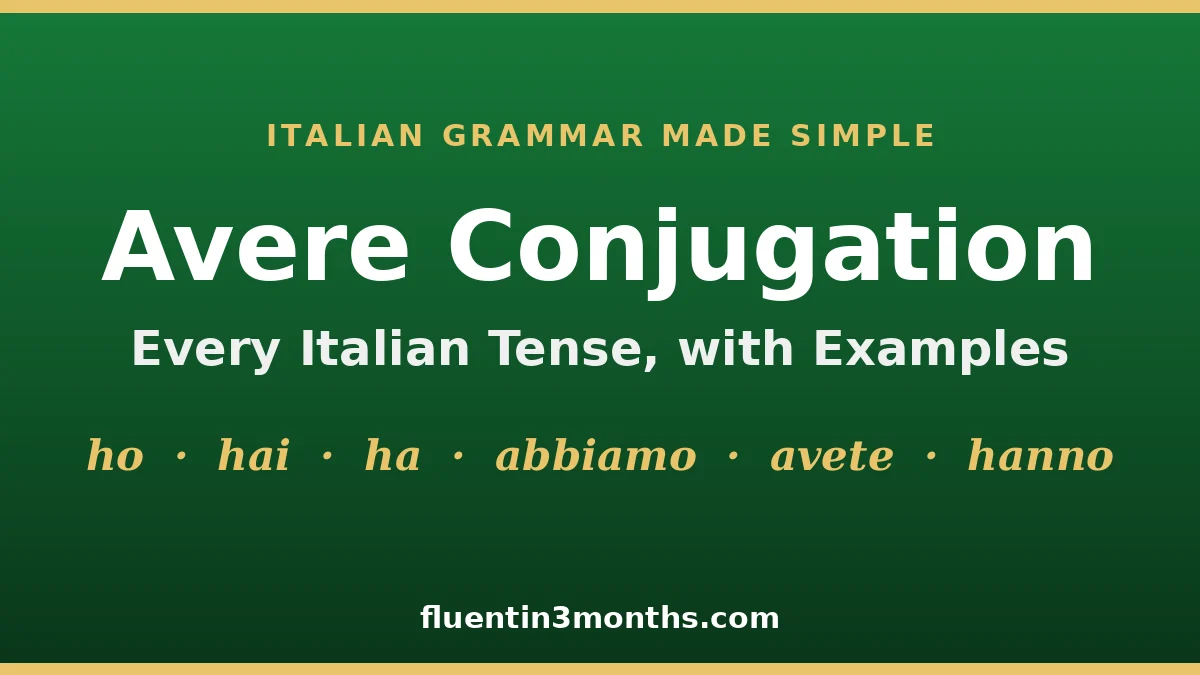
The verb avere stands as one of the fundamental pillars of the Italian language, serving both as a primary lexical indicator of possession and as a vital grammatical auxiliary for the construction of compound tenses. For linguists and students of Romance languages, understanding avere is not merely a matter of vocabulary acquisition but a necessary step in navigating the structural complexities of Italian syntax. Often described as a "workhorse" verb, its utility extends from everyday survival phrases to the sophisticated literary constructions found in classical Italian prose. Beyond its literal meaning of "to have," avere is central to expressing physical states, age, and various subjective experiences that, in English, are typically conveyed using the verb "to be."
The Orthographic Significance of the Silent H
One of the most distinctive features of the verb avere is the presence of a silent "h" in several of its present tense forms: ho (I have), hai (you have), ha (he/she/it has), and hanno (they have). While this "h" is never pronounced in modern standard Italian, its inclusion in written communication is mandatory. This orthographic requirement serves a critical functional purpose: it distinguishes the verb forms from their homophones.
In the Italian writing system, the "h" acts as a visual marker to prevent ambiguity. For instance, "ho" (I have) is distinguished from "o" (the conjunction "or"). Similarly, "hai" (you have) is separated from the prepositional contraction "ai" (to the); "ha" (he/she has) is distinguished from the preposition "a" (to/at); and "hanno" (they have) is distinguished from "anno" (year). Failure to include the "h" is considered a significant grammatical error and can fundamentally alter the meaning of a sentence, leading to potential confusion in professional and academic correspondence.
Historical Context and Linguistic Evolution
The Italian verb avere finds its roots in the Latin infinitive habēre. The transition from Latin to the various dialects of the Italian peninsula involved a series of phonetic shifts and morphological simplifications. During the development of the Italian language, particularly as it was codified by figures such as Dante Alighieri and later by the Accademia della Crusca, the verb retained its irregular status due to its high frequency of use.
In historical linguistics, high-frequency verbs are more resistant to the "leveling" process—the tendency for irregular verbs to become regular over time. This explains why avere, along with its counterpart essere (to be), maintains a complex and idiosyncratic conjugation pattern. The use of the "h" in the present tense is a vestige of this evolution, originally intended to represent the Latin "h" and later maintained specifically to resolve the aforementioned homophonic conflicts.
Morphological Analysis: The Indicative Mood
The indicative mood is the primary framework for expressing facts and objective reality. Within this mood, avere displays several irregular stems, particularly in the future and conditional tenses.
Simple Tenses of the Indicative
The present tense (presente) is the most immediate tool for communication. Its forms—ho, hai, ha, abbiamo, avete, hanno—allow speakers to discuss immediate needs, possessions, and current states of being. Moving into the past, the imperfect (imperfetto)—avevo, avevi, aveva, avevamo, avevate, avevano—is utilized for descriptive purposes, habitual actions in the past, or ongoing states without a defined conclusion.
The remote past (passato remoto) presents a more complex sociolinguistic picture. While forms like ebbi, avesti, ebbe, avemmo, aveste, and ebbero are essential for reading Italian literature and historical texts, their use in spoken language varies significantly by geography. In Northern Italy, the passato remoto is rarely heard in conversation, often replaced by the passato prossimo. However, in Central and Southern Italy, the passato remoto remains a vibrant part of the daily vernacular, used to describe completed actions in the distant past.
The Future and Conditional
The future tense (futuro semplice) and the present conditional (condizionale presente) share a contracted stem: "avr-". Instead of following the regular "aver-" pattern, the verb drops the internal vowel, resulting in forms like avrò (I will have) and avrei (I would have). The conditional mood is particularly important for Italian etiquette, as it is used to frame polite requests and hypothetical scenarios.
Compound Tenses and the Auxiliary Function
Avere is indispensable in its role as an auxiliary verb. In Italian, compound tenses are formed by combining a conjugated form of an auxiliary verb with the past participle of the main verb. For avere, the past participle is "avuto."
The choice between using avere or essere as an auxiliary is one of the most challenging aspects of Italian grammar for non-native speakers. Generally, all transitive verbs (verbs that take a direct object) use avere. For example, "Ho mangiato la mela" (I have eaten the apple). Many intransitive verbs also use avere, particularly those that denote a physical or mental activity that does not involve a change of state or location.
Data from linguistic studies suggests that approximately 70% of Italian verbs utilize avere as their auxiliary. However, certain nuances exist. For instance, when using avere as an auxiliary, the past participle "avuto" typically remains invariable in gender and number. This changes only when the verb is preceded by a third-person direct object pronoun (lo, la, li, le), in which case the participle must agree with the pronoun.
The Subjunctive and Imperative Moods
The subjunctive mood (congiuntivo) is a hallmark of sophisticated Italian speech and writing, used to express doubt, emotion, desire, or necessity. The present subjunctive forms of avere—abbia, abbia, abbia, abbiamo, abbiate, abbiano—are frequently triggered by introductory phrases such as "Credo che…" (I believe that…) or "Spero che…" (I hope that…).
In the imperative mood, which is used for commands and exhortations, avere takes on forms that encourage the listener to adopt a certain state. Common expressions include "Abbi pazienza" (Have patience) or "Abbiate cura" (Take care). These forms are essential for effective interpersonal communication and providing direction.
Idiomatic Usage: Where Italian and English Diverge
Perhaps the most critical area for learners to master is the set of idiomatic expressions where Italian uses avere but English uses "to be." This represents a fundamental difference in how the two languages conceptualize physical and psychological states.
In the Italian worldview, states such as hunger, thirst, and heat are "possessed" rather than "inhabited." Consequently, one does not "be" hungry; one "has" hunger. Key expressions include:
- Avere fame: To be hungry (literally: to have hunger)
- Avere sete: To be thirsty (literally: to have thirst)
- Avere caldo/freddo: To be hot/cold (referring to the person’s sensation)
- Avere ragione/torto: To be right/wrong
- Avere paura: To be afraid
- Avere sonno: To be sleepy
- Avere … anni: To be … years old
The expression of age is a frequent point of error for English speakers. To say "I am 30 years old" in Italian, one must say "Ho trent’anni" (I have thirty years). Using the verb essere in this context is a tell-tale sign of a non-native speaker and is grammatically incorrect.
Academic Perspectives and Global Importance
According to data from the Italian Ministry of Foreign Affairs, Italian is the fourth most studied language in the world. Educational institutions emphasize the mastery of avere early in the curriculum because it serves as the gateway to the "passato prossimo," the most commonly used past tense in modern conversation.
The Accademia della Crusca, the world’s oldest linguistic academy, continues to provide guidance on the evolution of the verb. In recent years, discussions have surfaced regarding the "transitivation" of certain intransitive verbs (such as "scendere" or "salire") and how this affects auxiliary choice. While regional variations exist, the Academy maintains that standard Italian requires a strict adherence to the auxiliary rules established in the 20th-century grammatical canons.
Implications for Fluency and Communication
The broader impact of mastering avere extends beyond mere grammatical correctness; it is about cultural integration. Because avere is used to express so many fundamental human experiences—from age to physical needs—it is impossible to engage in even the most basic Italian conversation without it.
For the professional or diplomat, the correct use of avere in its subjunctive and conditional forms signals a high level of education and respect for the nuances of the Italian language. In a journalistic or literary context, the ability to manipulate the past tenses of avere allows for precise storytelling and the clear delineation of chronological events.
Ultimately, avere is more than just a verb; it is a linguistic engine that powers the Italian language. By understanding its irregular morphology, its historical roots, and its unique idiomatic applications, one gains the tools necessary to communicate with clarity, accuracy, and cultural resonance in one of the world’s most influential languages. As the Italian saying goes, "Sapere è potere" (Knowledge is power), but in the realm of linguistics, "Avere è potere"—to have the verb is to have the power of expression.
