

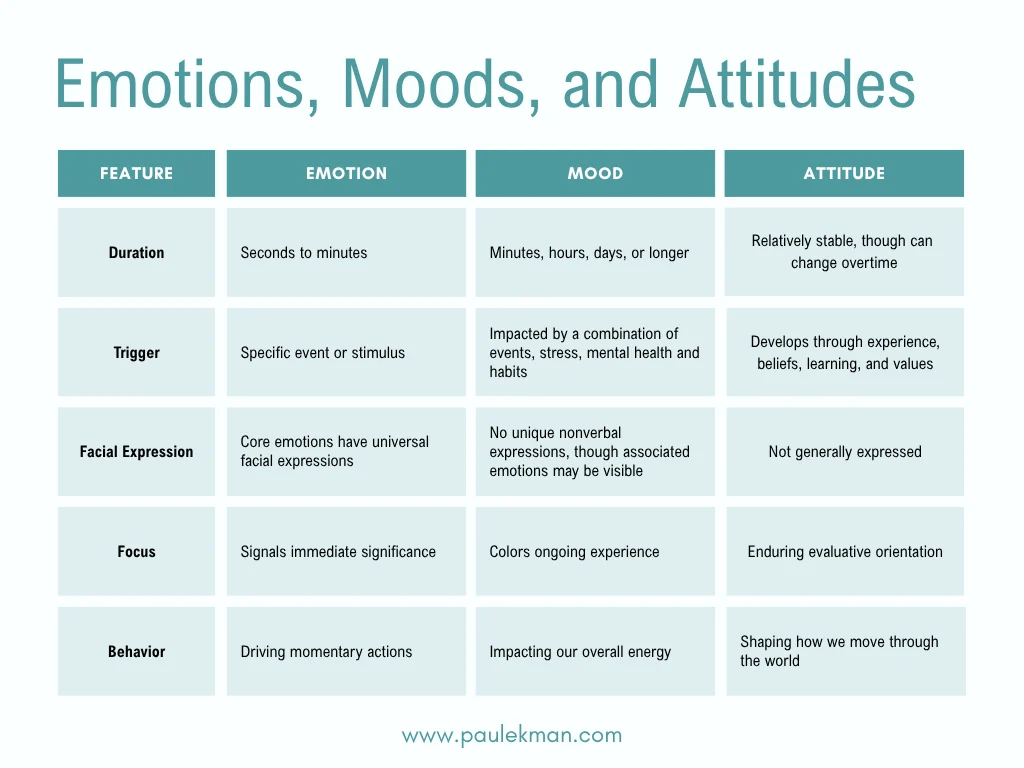
Building on a foundational understanding of the distinctions between fleeting emotions and more pervasive moods, this in-depth analysis expands to encompass a third critical psychological construct: attitudes. These three interconnected elements – emotions, moods, and attitudes – profoundly shape our subjective experiences of ourselves and the world around us. However, they operate on distinct temporal scales and fulfill unique psychological functions. A comprehensive grasp of their interplay is paramount for cultivating deeper emotional intelligence, enhancing emotional regulation, and fostering a more profound comprehension of our ingrained patterns of thought and behavior.
The Fleeting Nature of Emotions: Rapid Appraisal and Physiological Response
Emotions are fundamentally automatic appraisal processes, deeply influenced by both our evolutionary heritage and the accumulated tapestry of our personal experiences. They are triggered when events of significance arise in relation to our fundamental goals, deeply held needs, or our overall well-being. This cognitive and situational assessment initiates a cascade of coordinated psychological and physiological changes designed to prepare us for action.
By their very definition, emotions are characterized by their relative brevity. They typically manifest and resolve within a spectrum ranging from fractions of a second to a few minutes. This rapid temporal characteristic is mirrored by their encompassing physiological impact. Emotions orchestrate changes throughout the body, including alterations in autonomic nervous system activity, which governs involuntary functions such as heart rate, breathing, and digestion. Furthermore, emotions are often accompanied by distinct facial expressions, a universally recognized aspect of human communication. These coordinated physical and expressive changes serve to equip us to effectively navigate and respond to whatever is most pertinent in a given moment. For instance, the emotion of fear, triggered by a perceived threat, might lead to increased heart rate, dilated pupils, and a facial expression that signals danger, facilitating either a fight or flight response. Research published in journals like Psychological Science has consistently demonstrated the rapid onset and distinct physiological signatures associated with various basic emotions, underscoring their role as immediate response mechanisms.
The Lingering Influence of Moods: Diffuse Affective States
In stark contrast to the transient nature of emotions, moods are characterized by their enduring quality. Moods represent more diffuse affective states that can persist for hours, days, or even extended periods. A key differentiator is that moods often lack a clearly identifiable trigger; they are not typically directed toward a specific event, person, or object in the immediate environment. This can lead to subjective experiences such as waking up already "in a mood" or finding oneself gradually slipping into one without any discernible external cause.
While moods may not elicit the pronounced facial expressions associated with many discrete emotions, subtle observable signs can still be present. These might include variations in muscle tension, changes in posture, or shifts in overall energy levels. For example, a person in a generally irritable mood might exhibit a slight furrowing of the brow or a more hunched posture, even without experiencing a specific emotionally charged event.
Instead of serving as a direct response to a particular situation, moods function more like an overarching emotional backdrop. They exert a significant influence on how readily certain emotions are likely to be triggered and can profoundly shape our interpretations of events, our social interactions, and even our internal thought processes throughout the duration of the mood state. A positive mood, for instance, can make us more optimistic in our interpretations and less prone to experiencing negative emotions, while a negative mood can amplify our susceptibility to frustration or disappointment. Studies on affect and cognition have consistently shown that prevailing moods can bias our perception and memory retrieval, leading us to focus on and recall information that aligns with our current affective state.
The Enduring Framework of Attitudes: Evaluations and Tendencies
Unlike emotions and moods, which are experiential states, attitudes are not inherently emotional in themselves. Instead, attitudes represent relatively enduring evaluations of people, ideas, objects, behaviors, or experiences. Psychologists commonly conceptualize attitudes as comprising a tripartite structure, often referred to as the ABC model of attitudes:
- Affective Component: This refers to the emotional associations linked to the attitude object. For example, a positive attitude toward a particular brand of coffee might be associated with feelings of warmth and comfort.
- Behavioral Component: This component reflects our tendencies to act in a certain way toward the attitude object. Someone with a positive attitude toward exercise might be inclined to participate in physical activities regularly.
- Cognitive Component: This aspect involves the beliefs and thoughts we hold about the attitude object. A person might believe that a particular political policy is beneficial, which contributes to their attitude toward it.
Furthermore, attitudes are often classified as either explicit or implicit. Explicit attitudes are those that we are consciously aware of and can readily report. Implicit attitudes, conversely, operate at an unconscious level but can still exert a significant influence on our thoughts, feelings, and behaviors. For instance, someone might consciously believe in gender equality (an explicit attitude) but still harbor unconscious biases (implicit attitudes) that affect their interactions with colleagues.
Consider the example of public speaking. An attitude toward public speaking might encompass several facets: the belief that it is an important skill to possess, the emotional memory of feeling embarrassed during a previous presentation, and a behavioral tendency to either actively seek out or consistently avoid opportunities to speak in public.
While attitudes are generally more stable and resistant to change than emotions or moods, they are not immutable. They are dynamic constructs that develop and evolve over time. This development is shaped by a multitude of factors, including repeated emotional experiences, various forms of learning (such as classical and operant conditioning), the influence of social and cultural norms, interpersonal relationships, and introspective reflection. New experiences can serve to reinforce existing attitudes, diminish their strength, or gradually reshape them. Crucially, and unlike moods, attitudes are always directed toward a specific target. We can hold attitudes towards individuals, inanimate objects, abstract policies, particular events, or even toward our own emotional experiences. Because attitudes act as a filter through which we interpret new information and shape our subsequent responses, they function as an evaluative lens that colors our perception of the world. Research in social psychology, particularly studies on attitude formation and change, has provided robust evidence for the enduring nature of attitudes and their predictive power over behavior.
The Interconnected Dynamics: How They Influence One Another
While emotions, moods, and attitudes are distinct psychological constructs, their influence on each other is constant and multifaceted, creating a dynamic interplay that shapes our inner world and outward behavior.
Mood’s Amplification of Emotion
Our prevailing moods significantly influence the likelihood and intensity with which specific emotions are experienced. An individual in an upbeat, positive mood may find themselves recovering more swiftly from minor frustrations or setbacks, viewing them through a more optimistic lens. Conversely, someone experiencing an irritable or negative mood is more prone to reacting with heightened intensity to even trivial inconveniences. This suggests that moods can act as a pre-existing condition that either buffers or exacerbates our emotional responses. Moreover, a series of concentrated, intense emotions, such as periods of worry or frustration, can coalesce over time to contribute to the formation or perpetuation of a more prolonged affective state, such as an anxious or irritable mood. This cyclical relationship highlights how transient emotional experiences can contribute to more stable affective dispositions.
Attitudes as the Evaluative Filter
Attitudes play a pivotal role in both shaping and being shaped by our emotional lives. Imagine two individuals receiving the same piece of constructive feedback. One individual might hold an attitude that views feedback as a valuable opportunity for personal growth and learning, thereby experiencing feelings of motivation and enthusiasm. In contrast, another individual might possess an attitude that perceives feedback as a personal threat or criticism, leading to emotions of anxiety and annoyance. In this scenario, the objective situation remains identical, but the pre-existing attitudes of each person dictate their interpretation of the event and, consequently, the emotional responses they experience. This underscores the power of attitudes in mediating our emotional reactions to external stimuli.
Attitudes Towards Emotions: The Meta-Emotional Layer
A particularly significant dimension of attitudes involves our evaluations of emotions themselves. We may develop deeply ingrained beliefs about the nature and appropriateness of various emotional experiences. For instance, we might hold the attitude that anger is inherently destructive, sadness signifies weakness, fear should always be suppressed, or that joy is a sentiment that should be universally shared. These meta-attitudes often emerge over years of development, influenced by family dynamics, cultural upbringing, educational experiences, and the unique trajectory of our personal history.
Our attitudes toward emotions directly impact our willingness and ability to acknowledge, accept, express, and learn from them. For example, an attitude that views sadness as a sign of weakness might lead an individual to actively avoid or suppress feelings of sadness, thereby hindering their capacity to process grief or disappointment effectively. These attitudes are also closely linked to the concept of "display rules," which are culturally learned norms that govern when, where, and to whom emotional expressions are considered appropriate. While research by pioneers like Paul Ekman has established the universality of certain basic facial expressions of emotion across cultures, the application and interpretation of these expressions are often modulated by culturally specific display rules. These variations contribute to the diverse ways in which emotions are expressed and perceived globally, illustrating the intricate interplay between universal emotional biology and culturally shaped attitudes.
Cultivating Emotional Awareness: A Path to Greater Well-being
At the core of navigating our emotional landscape effectively lies the cultivation of emotional awareness. This process begins with learning to observe our internal experiences with a heightened degree of clarity and a spirit of genuine curiosity. By diligently recognizing our emotions as they arise, understanding the pervasive influence of the moods that may be coloring our experience, and becoming consciously aware of the attitudes that shape our interpretations of events, we equip ourselves to respond to ourselves and to others with greater wisdom, compassion, and effectiveness.
The development of these critical skills is not an instantaneous achievement but rather an ongoing practice that can be progressively strengthened over time. For individuals seeking to deepen their understanding of the science of emotion and enhance their emotional intelligence, resources such as those offered by the Paul Ekman Group provide a scientifically grounded approach. These resources often delve into the nuances of emotional expression, the identification of universal emotions, and practical strategies for emotional regulation, all rooted in decades of empirical research. By embracing the complexity and interconnectedness of emotions, moods, and attitudes, we embark on a journey toward a more nuanced understanding of human psychology and a more fulfilling experience of life. The ability to differentiate these internal states and understand their dynamic interactions forms a cornerstone of psychological well-being and interpersonal effectiveness.
